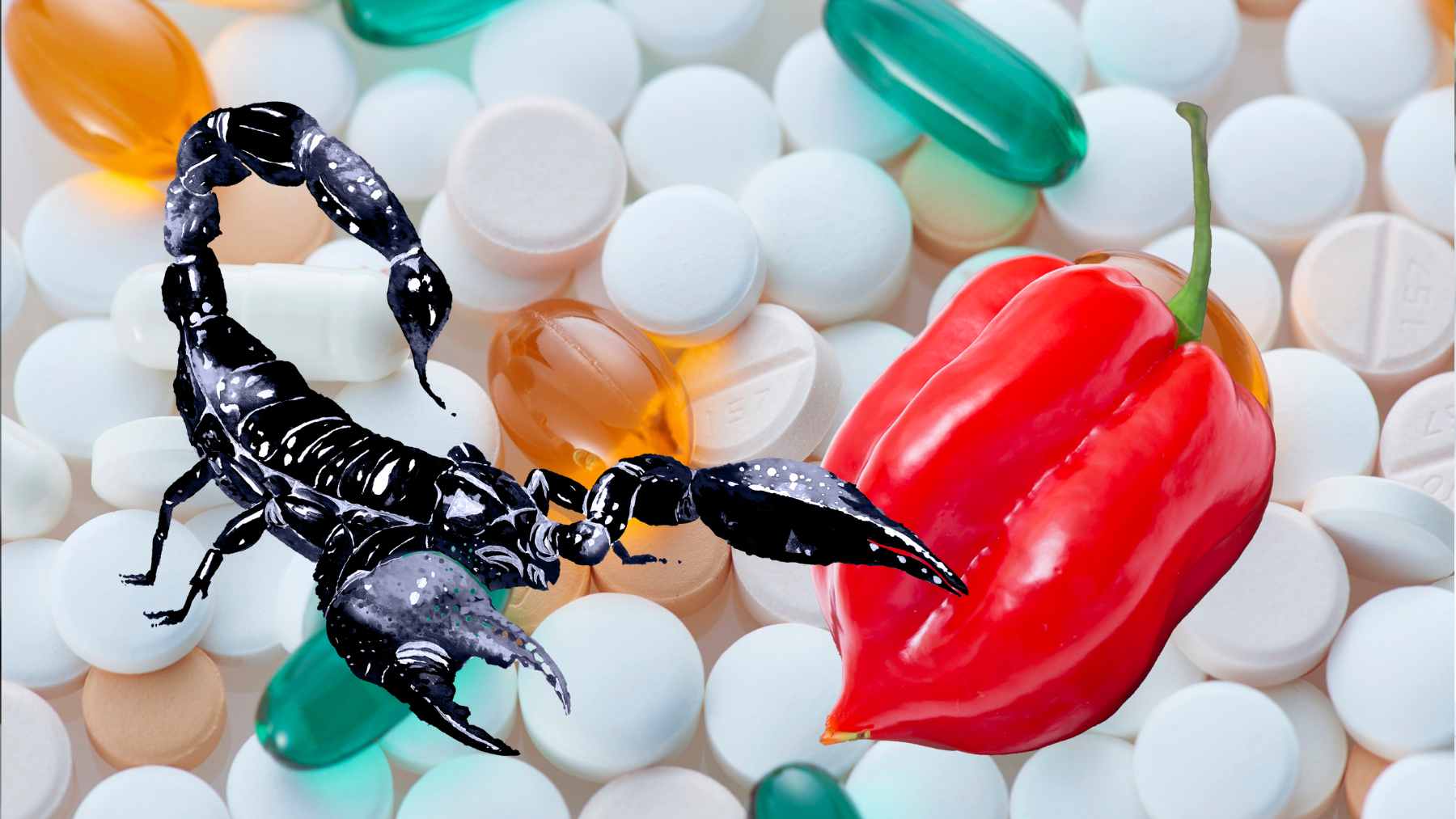
Mexican researchers have turned two unlikely sources, scorpion venom and habanero pepper, into three experimental antibiotic candidates aimed at some of medicine’s most stubborn bacteria.
The work focuses on tuberculosis, Staphylococcus aureus, and Pseudomonas aeruginosa, pathogens that can become difficult to treat when standard drugs fail. It is a strange pairing at first glance, but nature often keeps useful chemistry in places people would rather not touch.
The findings do not mean a new drug is ready for the pharmacy shelf. For the most part, the results come from laboratory studies and animal testing, with clinical trials still ahead.
Even so, the work lands at a tense moment, as antimicrobial resistance already contributes to millions of deaths worldwide and pushes doctors toward older, harsher, or less reliable treatments.
A sting with a medical twist
The scorpion side of the work began with Diplocentrus melici, a species found in Veracruz. Lourival Domingos Possani Postay, working at the Institute of Biotechnology at the National Autonomous University of Mexico (UNAM), helped isolate two colorless molecules from its venom.
These molecules are called benzoquinones, a type of small chemical compound that is not made from amino acid chains like many venom toxins.
Here is the curious part. When the molecules meet air, one turns blue and the other red, a color change that helped researchers work out their structures and then make them in the lab.
The blue compound showed activity against Mycobacterium tuberculosis, the bacterium that causes tuberculosis, while the red one acted against Staphylococcus aureus, a common hospital-linked threat that can cause skin infections, pneumonia, blood infection, and heart infection.
Why tuberculosis matters
Tuberculosis is not an old problem that quietly went away. It spreads through the air, usually attacks the lungs, and can be deadly without proper treatment. In 2024, the World Health Organization estimated that 10.7 million people fell ill with TB worldwide, and 1.23 million died from it.
Drug-resistant TB is especially troubling because the usual medicines may not work.
Rogelio Hernández Pando, from the Salvador Zubirán National Institute of Medical Sciences and Nutrition, tested the blue benzoquinone in mice with induced tuberculosis and found strong antibiotic activity.
Richard Zare at Stanford University also helped determine and synthesize the scorpion-derived molecules, strengthening the chemistry behind the work.
More than one hospital threat
After the TB work, the same blue compound was tested against Acinetobacter baumannii, a bacterium that often worries hospitals because it can resist some of the last medicines doctors rely on.
A 2025 study in The Journal of Antibiotics reported that the molecule killed drug-resistant strains of this pathogen and did not trigger resistance after repeated exposure in the experiment. That is not a guarantee in patients, but it is the kind of early signal antibiotic researchers look for.
Why does that matter to ordinary people? Because resistant infections are not just a hospital chart problem. They can mean longer stays, more expensive care, and, for families, a much scarier wait for a medicine that still works.
From hot pepper to hospital infections
The habanero side sounds almost like kitchen folklore, but it is not about eating more hot sauce.
A team led by Gerardo Corzo Burguete, in collaboration with Georgina Estrada Tapia of the Yucatán Scientific Research Center, identified a peptide in habanero pepper called defensin J1-1. A peptide is a small chain of building blocks, and in plants, defensins help defend against microbes.
The researchers developed a biotech process to produce a candidate called XisHar J1-1. First, they modified a bacterium so it would make the peptide, then grew it through submerged fermentation, a common industrial method for producing useful compounds.
The purified peptide showed activity against Pseudomonas aeruginosa, which the same global health agency includes among important drug-resistant pathogens, along with Staphylococcus aureus and drug-resistant tuberculosis.
Promise with limits
There is a catch, and it matters. Estrada Tapia noted that the Pseudomonas tests did not use a resistant strain taken from patients, but a laboratory strain used to study antimicrobial peptides.
In practical terms, that means the next tests must move closer to the real infections doctors see every day.
The teams are also working through drug-development problems that rarely make splashy headlines. Molecules can break down inside the body, lose strength, or affect healthy cells, so researchers are exploring nanoparticles that could stabilize and protect the scorpion-derived compounds.
The patents in Mexico and South Africa are useful steps, but patents are not the same as approved medicines.
The road to patients
Clinical trials are the next big gate. Possani Postay has said those trials will require significant funding and has called for support from a Mexican pharmaceutical company to help scale up production.
That step is where many promising antibiotic ideas stall, not because the biology is dull, but because the path from lab bench to bedside is expensive and slow.
Iván Arenas Sosa put the larger challenge plainly. “The problem of antibiotic-resistant bacteria has increased in recent years and will continue in the future.”
The official report on this work has been published in Gaceta UNAM.