Stephen Hawking’s line about finding something you can do and succeed at has traveled far beyond science. It appears on posters, social feeds, school slides, and quick messages sent to someone going through a hard week.
But the full context makes the quote sharper. Hawking was not selling easy optimism, he was pointing to a method for staying active when life feels narrowed by illness, fear, work, grief, or plain exhaustion.
In his 2016 Oxford Union Speech, the British theoretical physicist placed the idea after a call to raise your gaze, think about the universe, and keep curiosity alive.
Then came the famous line, “however difficult life may seem,” followed by the reminder that there is “something you can do,” and then the part often left behind, “don’t just give up.”
The missing context
On quote pages, the sentence can look like a motivational poster. In the speech, it comes after Hawking talks about the universe, human understanding, and the long effort to make sense of what we see.
That changes the tone. The message is not just “feel better.” It is closer to this: look beyond the immediate problem, stay curious, and choose one possible action.
What does it mean to look beyond your feet? Not that your problems are small or fake, but that when the ground in front of you fills your whole view, perspective itself can become a tool.
Not easy optimism
The key word is “something.” Hawking did not say you can do everything. He did not promise that life becomes fair, smooth, or instantly fixable.
That means finding a reachable task and working there. A student might read one chapter. A patient might make one appointment. A researcher might return to one calculation that still has a chance.
That sounds modest. It is. But sometimes the first victory is not dramatic, rather, it is simply proving that action still exists.
A life shaped by limits
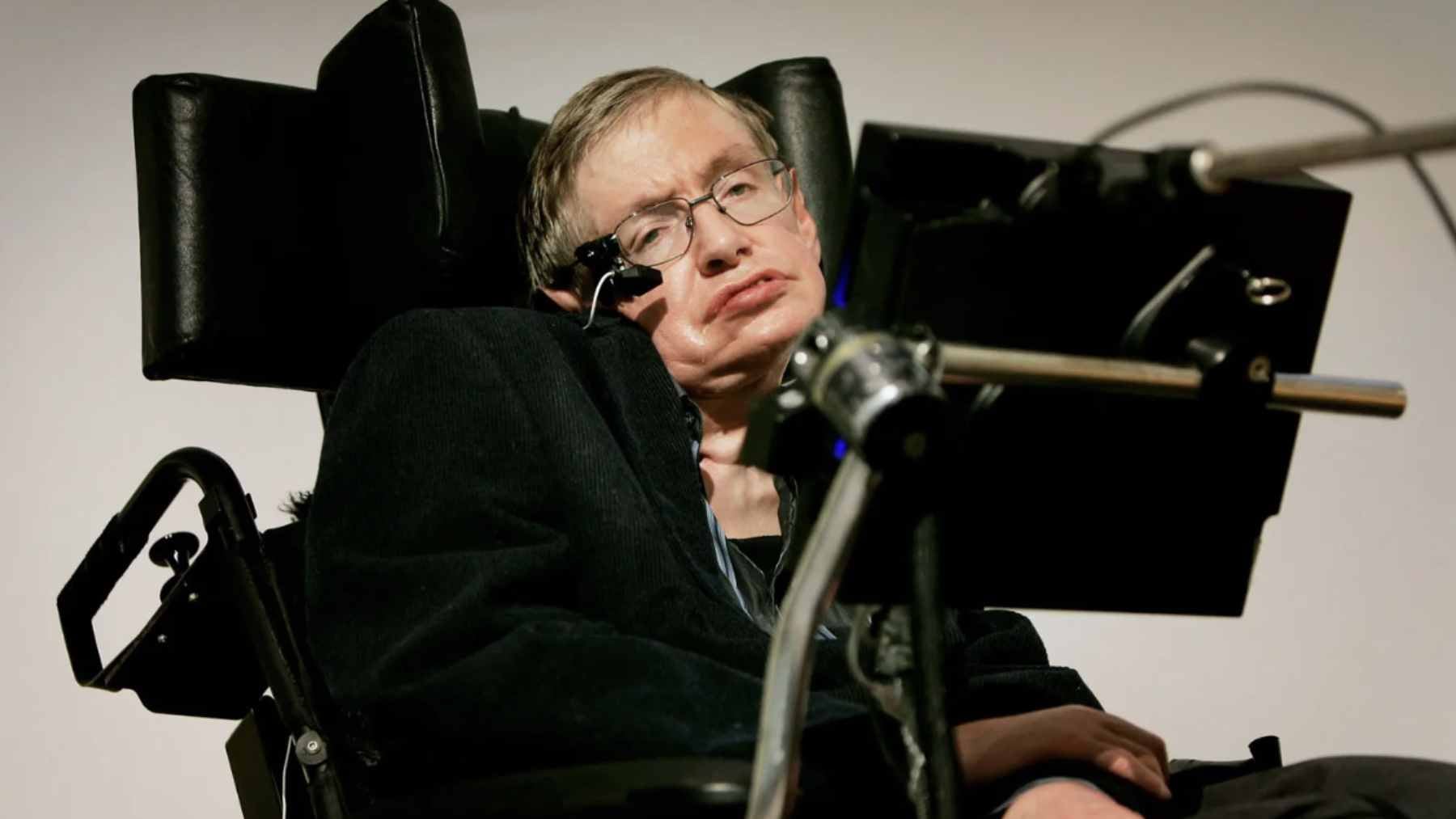
The sentence carries weight because it fits Hawking’s public life. Soon after his 21st birthday, he was diagnosed with amyotrophic lateral sclerosis, or ALS, a disease that damages the nerve cells needed for voluntary movement. His official biography says he was given only two years to live.
Yet he continued to work, write, teach, and speak through technology. The contrast became impossible to ignore. His body became more limited over time, while his mind kept pushing into some of the biggest questions humans can ask.
That is why the quote does not sound like empty self-help. Coming from Hawking, “something” feels specific. It means the field of action may shrink, but it does not always vanish.

The science behind the voice
Hawking’s own “something” was cosmology, the study of the universe as a whole. He became closely linked to black holes, which are regions of space where gravity is so strong that even light cannot escape once it crosses a certain boundary.
One of his best-known ideas was that black holes are not completely black. They can have a temperature and give off radiation, a concept now known as Hawking radiation. The University of Cambridge described that work as one of the discoveries that changed theoretical physics.
He also helped bring difficult science to ordinary readers. A Brief History of Time asked huge questions about the origin, nature, and fate of the universe in language meant for the public, not just specialists. That public voice is part of why his advice still travels.
How to use the quote
Maybe that is why the line keeps coming back. It can fit a school exam, a medical wait, a stalled job search, or a private worry at 2 a.m. We have all had moments when the next step feels too heavy.
But the strongest version of the quote asks for more than sharing it. At the end of the day, it points to a small plan: raise your gaze, stay curious, pick one possible action. Repeat.
No grand speech required. No fake certainty, either. Just the next workable step, taken seriously.
Why it still matters
The internet trims sayings because shorter is easier to post. But here, trimming loses the spine of the idea. Hawking was not saying that success is always waiting around the corner, he was saying that effort still matters when the corner is hard to see. That is a tougher message, but also a more useful one.
His quote is not a promise that life will become easy. It is a reminder that action can survive inside difficulty. While there is life, there is margin, and that margin has to be worked.
The official speech has been published in the Stephen Hawking Estate’s online archive under the title Oxford Union Speech.