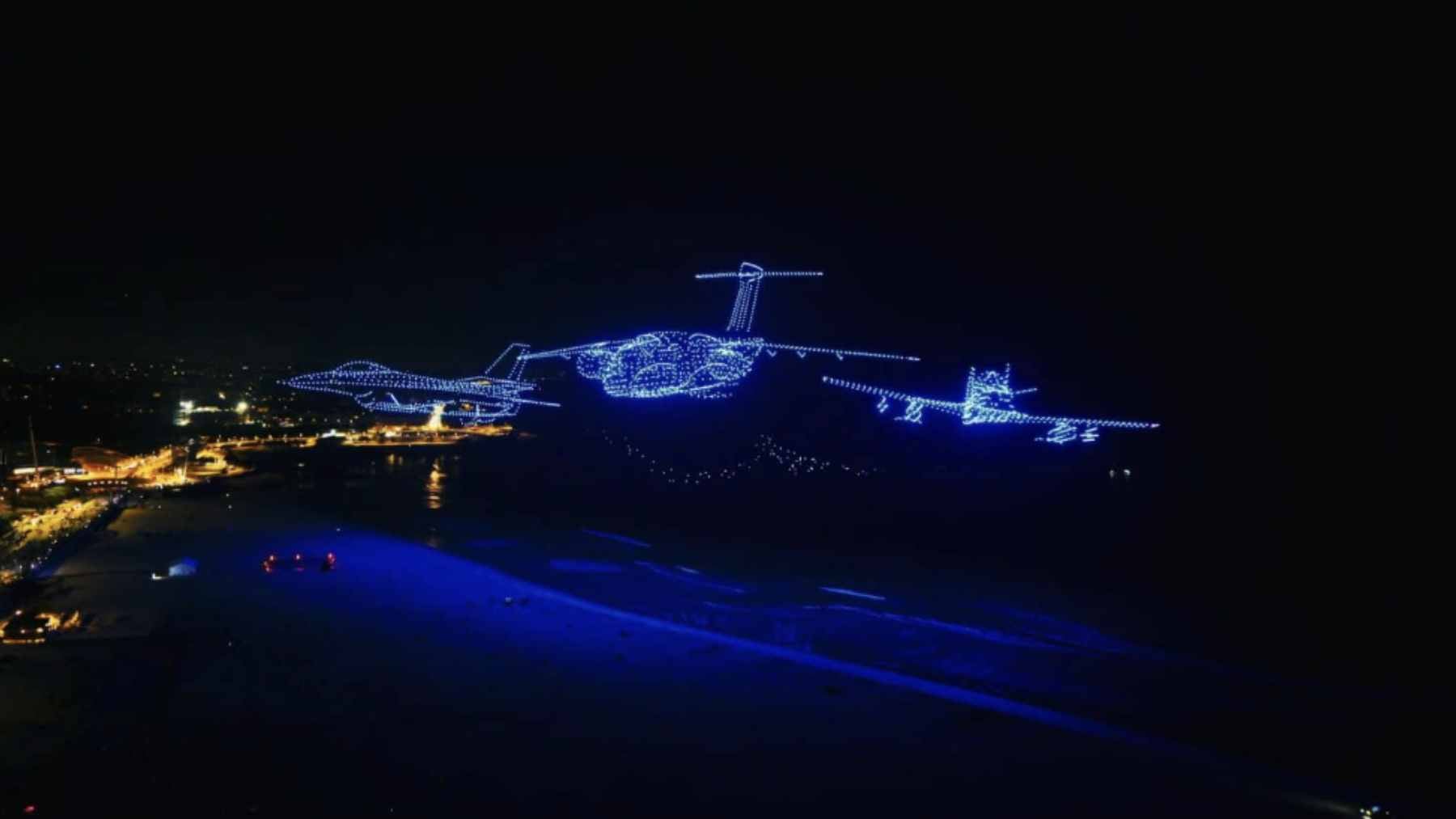
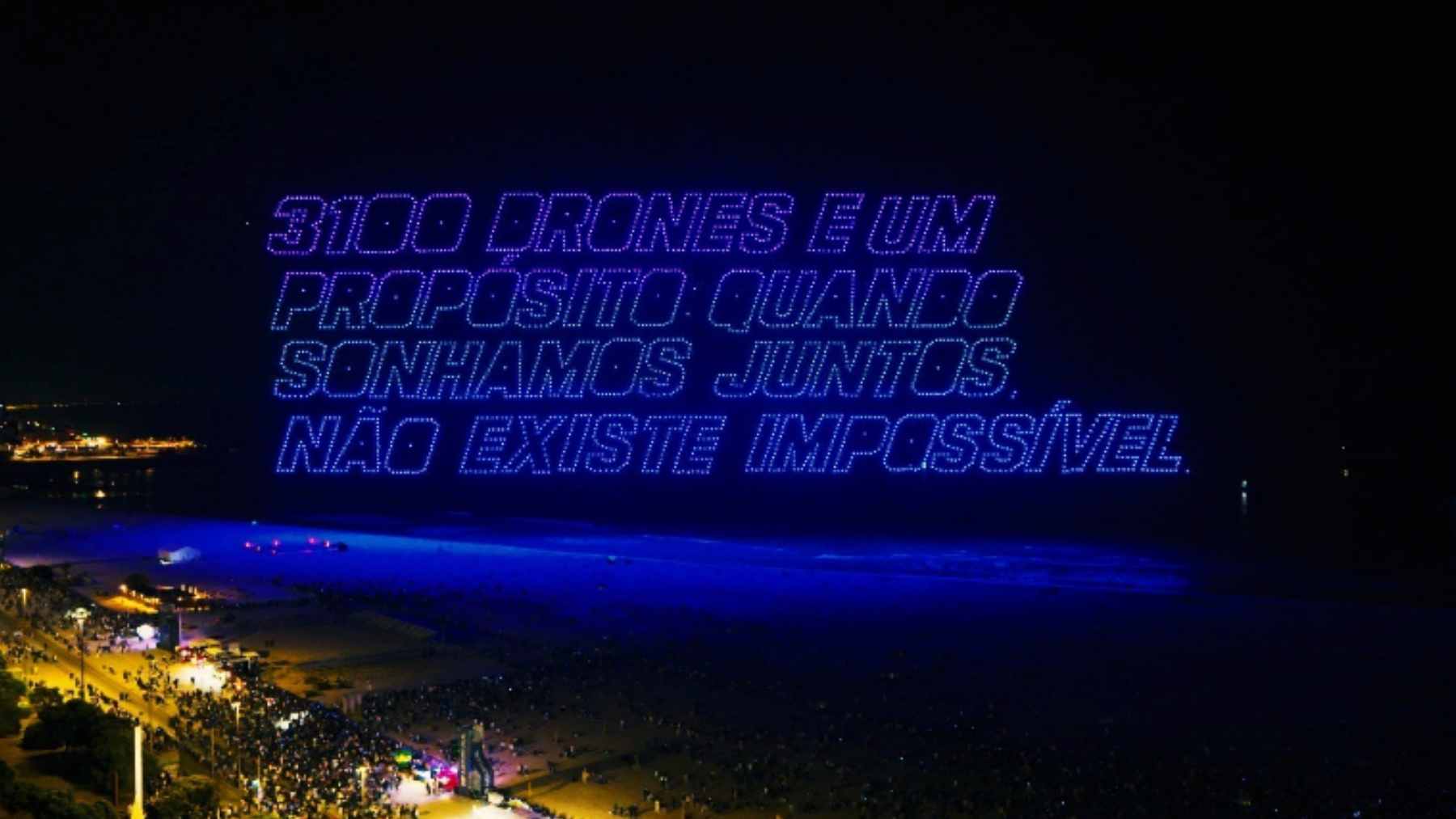
A Spanish drone company has just turned the night sky over Portugal into a giant digital canvas. Flock Drone Art Studio, based in Girona, synchronized 3,097 drones during the Air Invictus festival near Porto and earned a Guinness World Records title for the largest aerial sentence formed by multirotors or drones.
The achievement matters for more than the spectacle. As cities, brands, and public institutions look for ways to stage big celebrations with less smoke, less debris, and more control, drone shows are moving from novelty to serious event technology. Still, the environmental story is not as simple as “drones good, fireworks bad.”
A sky full of code
The record-setting show took place during the opening night of Air Invictus, a public aviation and entertainment festival held from June 19 to 21 across the Porto region. Guinness says the 10-minute performance included formations inspired by Porto, Portuguese culture, and aviation before the drones spelled out a sentence which broke the record, lasting more than 20 seconds.
Flock’s own statement says the company also broke the European record for the largest number of drones flying simultaneously in an aerial light and art show. That detail is important, because Guinness officially lists the world record here as the largest aerial sentence, not the largest drone show in every category.
Just picture it for a second. Nearly 3,100 small aircraft had to take off, hold position, communicate, move as one, and then write a readable message in the sky. No room for sloppy timing.
Why the record matters
From the ground, a drone show can look effortless, almost like fireflies obeying a hidden conductor. Behind the scenes, though, it is a mix of aviation planning, software, battery management, choreography, and public safety work.
Flock’s CEO Fran Arnau told SER Catalunya that the team was satisfied after completing a challenge that exceeded expectations. He described it as “a huge technological challenge,” a phrase that fits the scale of the operation.
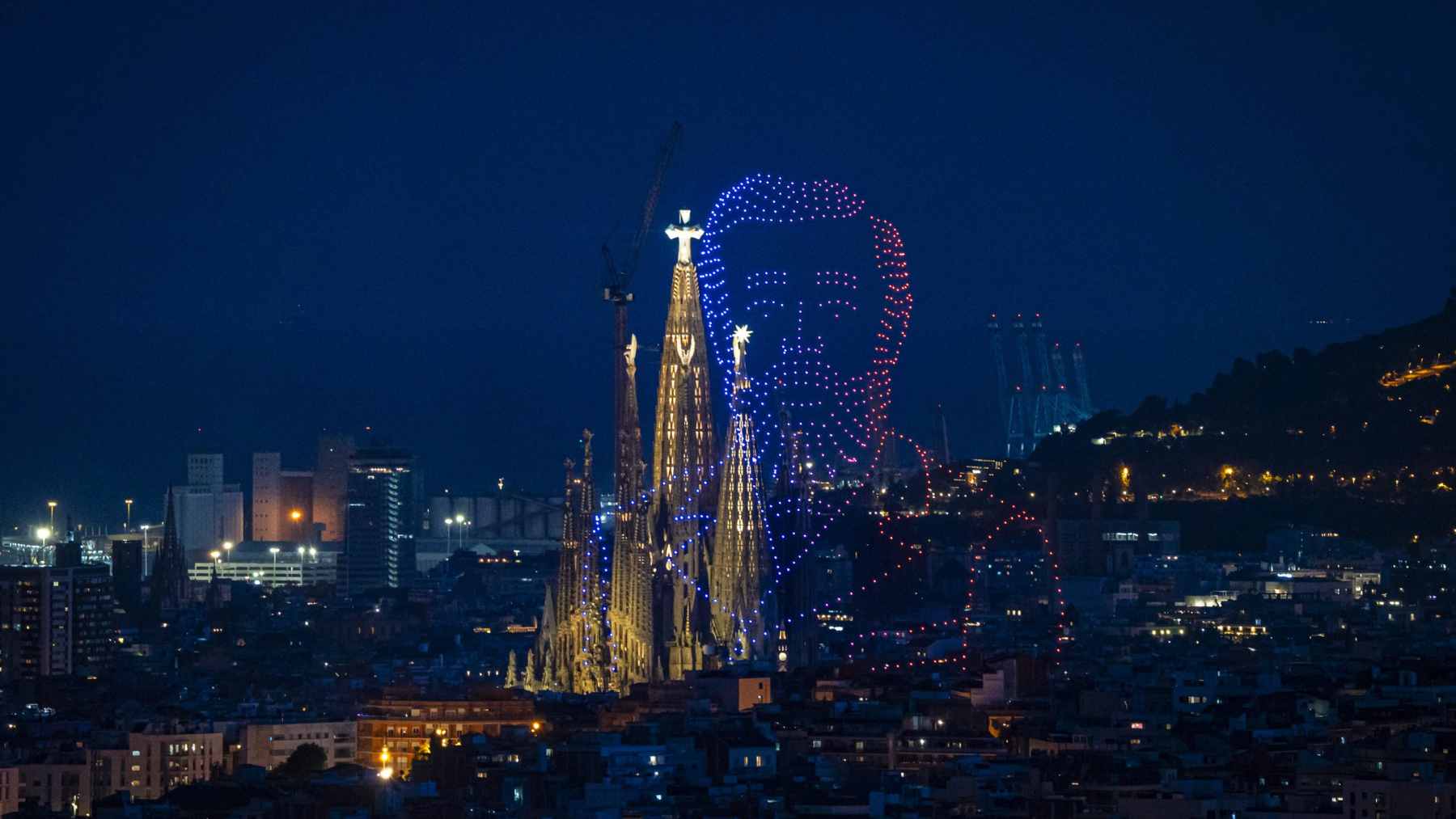
The company had already drawn attention days earlier after participating in the drone show linked to the Sagrada Familia celebrations in Barcelona. Flock said that project required weeks of meetings, tests, timing adjustments, route corrections, and safety checks before the public saw a few glowing minutes in the sky.
Fireworks face scrutiny
So why are drones getting so much attention now? One big reason is the growing discomfort around traditional fireworks, especially in crowded cities and dry areas where smoke, noise, and debris are harder to ignore.
A large U.S. study using 315 air quality monitoring sites found that fine particulate matter rose by an average of 42 percent over the 24-hour period beginning at 8 p.m. on July 4. The same study found the biggest average increase between 9 and 10 p.m., with levels returning to normal by noon the next day.
More recent research in Southern California found that fireworks are a short-lived but extreme source of particulate air pollution, with particles that can contain metals such as barium, copper, strontium, chromium, and lead. That is not exactly the image most families have in mind when they look up from a picnic blanket.
Cleaner does not mean impact-free
Drone shows can avoid some of the most obvious problems linked to fireworks. They do not explode in clouds of smoke, they do not scatter spent shells across parks or beaches, and they are usually far quieter than pyrotechnics.
But it would be too tidy to call them impact-free. Drones need batteries, charging, transport, maintenance, replacement parts, trained crews, and permissions from aviation authorities. In practical terms, the environmental benefit depends on how the fleet is powered, how often it is reused, and whether it truly replaces fireworks instead of being added on top of them.
Flock has presented drone shows as a quieter and more environmentally friendly alternative to traditional formats. That claim makes sense to a large extent when the comparison is smoke-heavy pyrotechnics, but the real test will be transparency around energy use, equipment lifecycles, and local rules.
A business and defense signal
Air Invictus was not just a light show. The official event page described a program with civil and military aerial displays, drone shows, model aircraft, paramotors, exhibitions, and the presence of Portugal’s Air Force, Army, Navy, and road safety authority.
That mix says a lot about where drone culture is heading. The same public fascination that fills a beach for a night show is also tied to a broader low-altitude economy, where swarm coordination, precise positioning, and command systems matter for logistics, emergency response, infrastructure inspection, and defense-adjacent planning.
For context, the global drone-count race is already far beyond 3,097 in some categories. EHang said in February that its subsidiary flew 22,580 UAVs in China and set the Guinness title for the most multirotors or drones airborne simultaneously from a single computer.
The sky as a screen
What Flock achieved in Portugal is not only a record. It is also a preview of how cities may celebrate in the next decade, especially when environmental pressure makes loud, smoky spectacles harder to justify.
At the end of the day, the appeal is easy to understand. A drone fleet can draw a face, write a sentence, honor a city, promote a brand, or tell a story without the same blast-and-smoke formula that has defined public celebration for generations.
The official record was published on Guinness World Records.