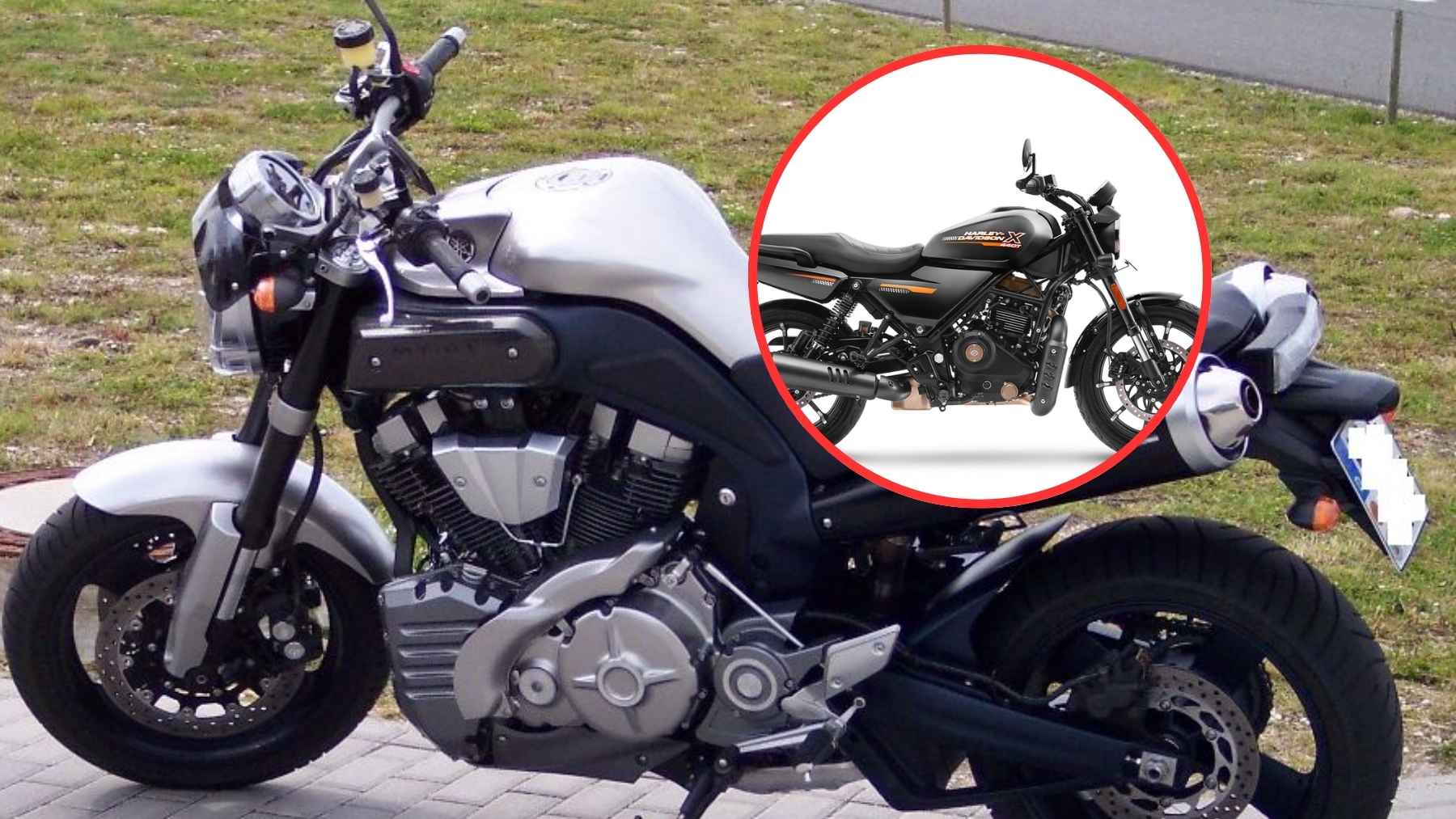
More than two decades ago, when performance naked bikes were chasing superbike revs, Yamaha chose the opposite route. It took the low-revving logic associated with American cruisers, wrapped it in Japanese sportbike hardware, and launched the MT-01 in Europe in 2005.
The result was a 102-cubic-inch air-cooled V-twin with about 89 horsepower and 111 pound-feet of torque, mounted in an aluminum frame with serious brakes and high-set exhausts. It never became a mass-market success, but it became the strange, oversized starting point for an MT family that would later become a signature part of Yamaha’s street lineup.
A cruiser heart in a naked bike
The idea first appeared as a concept at the 1999 Tokyo Motor Show. Yamaha’s engineers even questioned whether a naked bike built around such a large cruiser engine was practical, then tested an early prototype with a Warrior powerplant installed in an XJR1300 frame.
The production machine used a CF aluminum die-cast frame and a five-speed transmission. Yamaha rated it at roughly 89 horsepower at 4,750 rpm and 111 pound-feet of torque at 3,750 rpm, while its official dry weight was about 529 pounds.
It was not a literal Harley-Davidson copy. Yamaha borrowed the broad American-cruiser recipe of a large, air-cooled V-twin with strong low-speed thrust, then rebuilt the rest of the motorcycle around Japanese naked-bike engineering. That was the gamble.
Torque was the whole point
Yamaha called the development idea “Soul Beat V-Twin Sports,” while the letters MT initially stood for “Mega Torque.” On paper, the horsepower figure looked modest for such a huge engine, but the experience changed as soon as the throttle opened.
There was little need to chase the redline or tap constantly through the gearbox. Rolling away from a stoplight or accelerating out of a slow corner, the engine delivered a deep, immediate shove accompanied by the pulse of two very large pistons.
Yamaha also treated sound and vibration as performance, placing the underseat mufflers close to the rider and tuning the frame and swingarm around the sensation of torque.
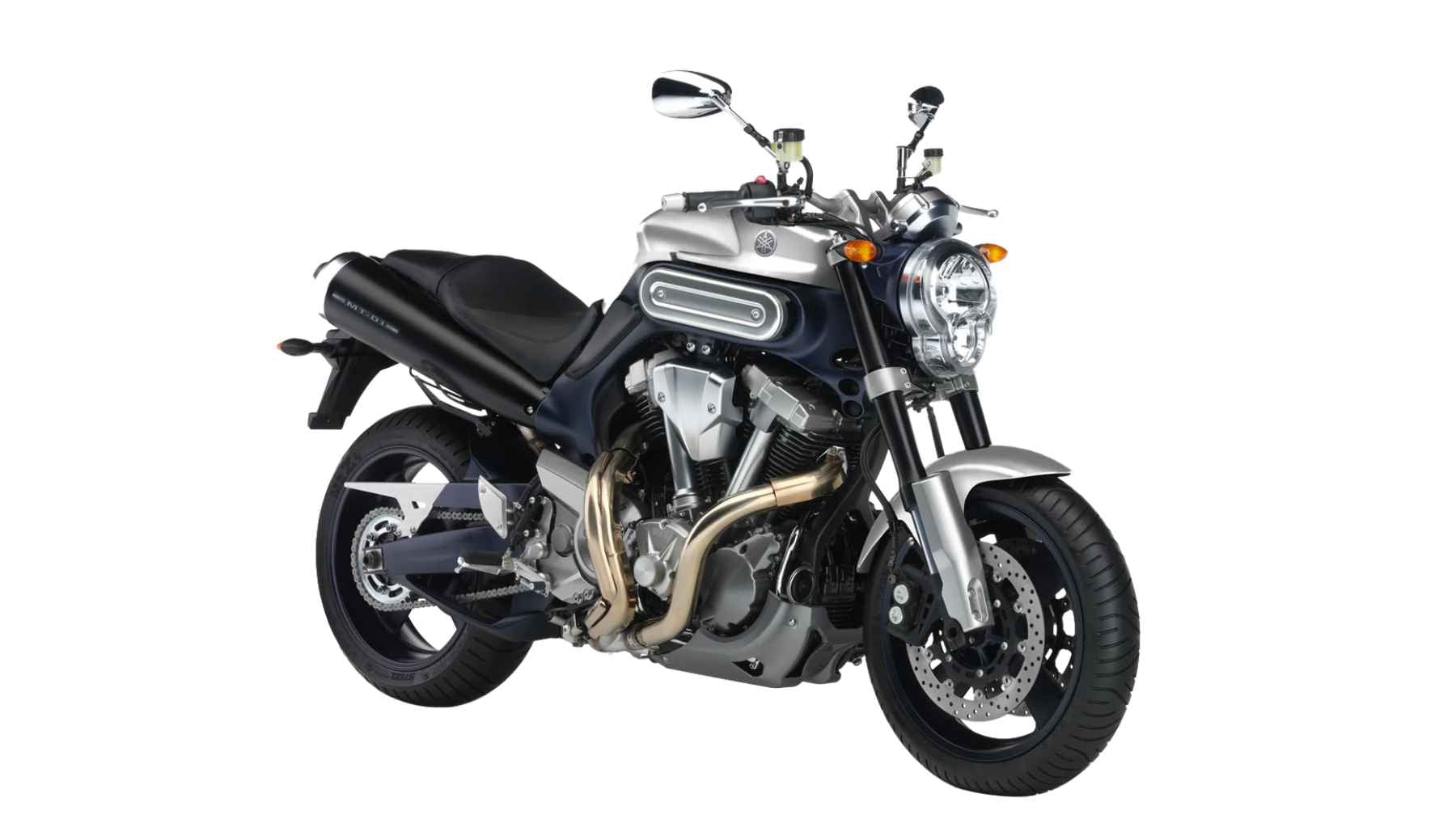
The playful description “the MotoGP bike of Harley-style machines” works only as a metaphor. The MT-01 had the heartbeat of a cruiser and hardware associated with a serious road bike, not the speed or purpose of a race machine. A later SP version sharpened the formula with Öhlins suspension.
The weight exposed the compromise
At 529 pounds dry, before gasoline and other fluids, the MT-01 could never hide its mass for long. In a parking lot, on a tight city street, or through a quick series of bends, changing direction required commitment at the handlebars.
Once settled into a corner, it could feel planted rather than clumsy. But the hard seat and firm response over broken pavement made longer trips less relaxing than its upright riding position suggested.
What exactly was it? It was not a custom cruiser, a conventional sport naked, or quite an American-style muscle bike. That blurry identity gave it personality, but it also made the sales pitch harder to understand.
A failure that created a brand
Yamaha now acknowledges that the MT-01’s unusual character was also why it “was not embraced by riders everywhere.” Still, the company saw enough value in the idea to continue with the MT-03 and later reshape the philosophy around lighter motorcycles with a “Torquey & Agile” character.
In business terms, the MT-01 showed that a product can miss its original market and still create valuable product knowledge and brand identity. Its sculpted mechanical look, low-to-midrange focus, and emphasis on rider sensation became more useful once Yamaha put those ideas into slimmer and easier-to-handle packages.
That is why the bike feels more important today than its sales record suggests. Commercial weakness made surviving examples unusual, while the MT name became one of Yamaha’s signature motorcycle families. The machine failed, but the concept escaped.
Old-bike checks matter
Anyone considering a used MT-01 should look beyond paint and exhaust condition. Some motorcycles were covered by a throttle-position-sensor campaign because an internal fault could cause unstable idling and stalling, while another recall addressed a rear suspension arm that could crack after corrosion exposure.
Recall completion should be checked through the motorcycle’s identification number and a Yamaha dealer. A careful inspection should also cover the suspension linkage, rear shock, fuel pump operation, wheel bearings, mirrors, and fasteners loosened by years of V-twin vibration.
This is now a two-decade-old motorcycle, even when it has low mileage. Rubber, seals, electrical connectors, and corrosion matter as much as the engine’s reputation for toughness. Rare does not automatically mean ready.
The environmental lesson is harder
The MT-01’s longevity has one positive side because keeping a well-maintained machine in service extends its useful life. But nostalgia does not erase gasoline use or tailpipe emissions.
Yamaha says use of sold products accounts for 94.1% of its total carbon dioxide emissions, with motorcycles producing about 90% of that category and roughly 85% of the company’s overall total.
Yamaha’s current pathway includes improved combustion engines, battery-electric models, and carbon-neutral fuels. What can a 2005 torque monster contribute? A design lesson, since riders responded to its pulse, immediate thrust, sound, and unmistakable identity even when the overall package was too heavy and difficult to classify.
Yamaha now describes its YE-01 electric motocross concept as a “fun-based approach” to carbon neutrality. That phrase matters because lower-carbon motorcycles cannot succeed as compliance appliances alone, and they still have to make someone glance back after parking.
The MT-01’s lasting lesson is that emotion can become durable engineering value, while the next challenge is preserving that pulse with far less carbon.
The official history of the MT-01 was published on Yamaha Motor.