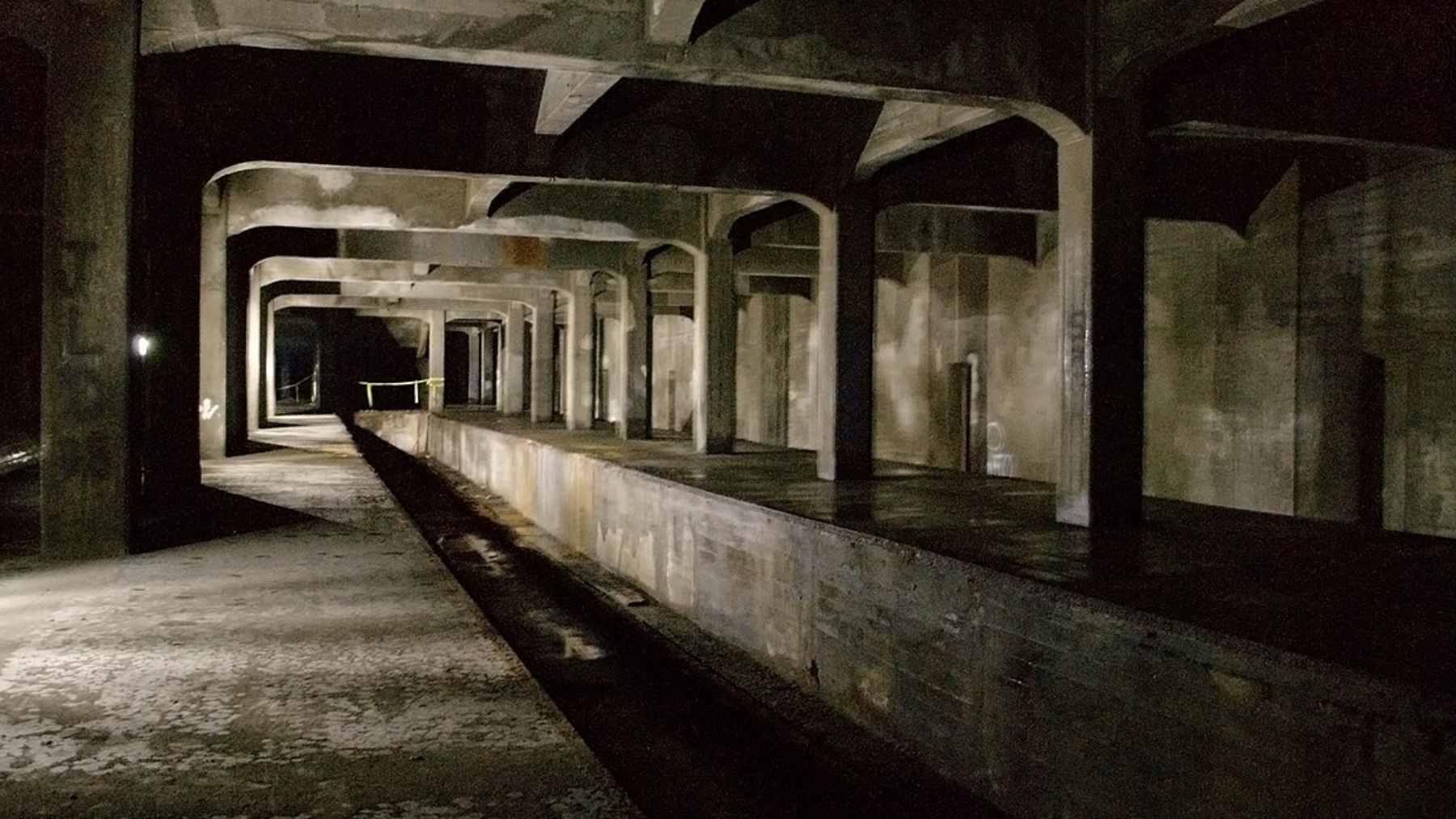
Under the cars rushing along Cincinnati’s Central Parkway, a subway system sits in the dark like a public works project frozen mid-sentence. The city dug tunnels, built stations, and planned for trains, but no tracks were laid, no subway cars were ordered, and no passenger ever rode between the stations that were built.
Now the old tunnel is back in the conversation for a very modern reason. Cincinnati has asked for a feasibility study on adaptive reuse of the underground infrastructure, turning a 1920s transit failure into a fresh question about climate, business, technology, and urban planning. Can a buried mistake become useful again?
A subway nobody used
The surviving tunnel runs for about two miles under Central Parkway, between Walnut Street and a point north of the Western Hills Viaduct. Cincinnati-Transit.net describes it as the country’s largest abandoned subway tunnel, and the remaining underground stations still sit below a street that most drivers cross without thinking about what is underneath.
That alone would make it strange, but the environmental angle is what makes it timely. Transportation accounted for 29% of total U.S. greenhouse gas emissions in 2022, according to the Environmental Protection Agency EPA, and direct transportation emissions made the sector the country’s largest direct source of greenhouse gases.
A canal became a transit dream
The idea grew out of a practical problem. Cincinnati had an old canal corridor, a city that needed better movement, and leaders who saw rapid transit as a way to connect downtown with neighborhoods and suburbs.
Early plans called for a roughly 16-mile rapid transit loop, with sections underground, at street level, and in open rights of way. In 1916, Cincinnatians backed a $6 million bond issue by a 6-to-1 margin, and for a while the subway looked less like a fantasy and more like the next logical step for a growing American city.
Then the money vanished
World War I slowed the project before it really got moving. After the war, inflation hit hard, and the cost of steel and concrete had doubled since 1916, forcing planners to cut back the route and focus first on the western half of the loop.
Construction began in January 1920 and continued until the $6 million ran out in 1925. By then, a two-mile subway tunnel, short suburban tunnels, grading, overpasses, and stations had been built, but the system still lacked the pieces that actually make a subway run, including tracks, trains, power equipment, and finished stations.
The automobile changed the story
Cincinnati did not just run out of money, it ran into a cultural shift. As automobiles became more popular, opponents could point at the unfinished subway and call it a costly relic before it had ever carried a single rider.
That shift mattered for decades. A 2002 regional light-rail plan, MetroMoves, would have used the old Central Parkway tunnel, but Hamilton County voters rejected the half-cent sales tax by 68.4% to 31.6%. In other words, the city said no to the subway twice, once by running out of money and later by refusing to fund a larger revival.
Water, fiber, and a Cold War twist
The tunnel did find a few jobs, just not the one it was built for. In 1957, Cincinnati ran a high-pressure 52-inch water main through the full two-mile length of the southbound tube, and fiber-optic cables were installed in the tunnel around late 1999 and early 2000.
In the 1960s came the strangest reuse of all. The east platform and bathrooms of Liberty Street station were converted into a nuclear fallout shelter. County officials said it could hold 300 people, but the setup was modest, with only eight bunks placed in one station bathroom, which makes the whole episode feel more like Cold War theater than serious civil defense.
The green angle is messy
Reusing an existing tunnel sounds like an obvious climate win, because fresh tunneling is expensive, disruptive, and carbon-intensive. Still, old infrastructure is not magic. The tunnel needs ventilation, accessibility, waterproofing, utilities, and a realistic business case before it can become anything more than a fascinating concrete shell.
There is also a transit reality check. The Congressional Budget Office found that personal vehicles averaged 0.47 lbs. of carbon dioxide per passenger-mile in 2019, while average emissions from heavy and light rail were lower, but it also warned that rail emissions vary by ridership and electricity mix. In other words, a subway helps the climate only if people actually use it.
The cost of doing nothing
For Cincinnati, even inaction has a price tag. In 2008, the city faced estimates of $100.5 million to revive the tunnels for modern subway use, $19 million to fill them with dirt, or $2.6 million to maintain them as abandoned space, and it chose the cheapest path.
That explains why the current study matters. The city’s 2025 RFP asks professional service providers to explore adaptive reuse of the historic underground subway infrastructure along Central Parkway, with the selected firm expected to study whether the space could support future uses and what modifications would be needed.
What comes next underground
The range of possibilities is wider than trains. Public summaries of the city’s process have mentioned cultural venues, recreation, retail, transit, and other uses, while earlier procurement details also noted that the tunnel currently houses a water main and communications cables.
So, the real question is not simply whether Cincinnati can finish its subway. It is whether a city can take a century-old failure and turn it into something useful in a hotter, denser, more expensive urban future.
The official RFP was published on City of Cincinnati Vendor Self Service, with public bid details mirrored by GovCB.