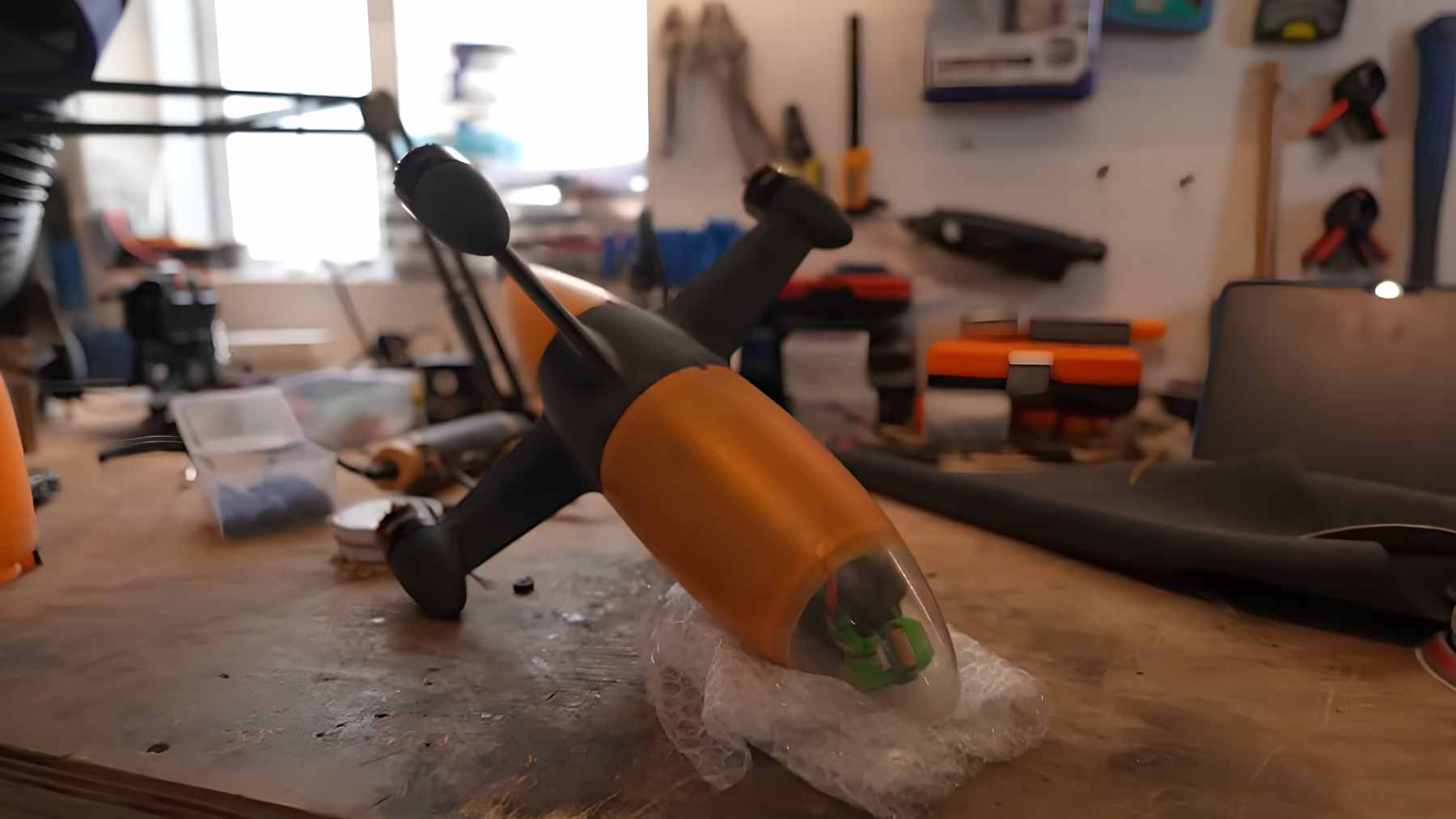
A homemade drone called Blackbird has reportedly reached nearly 454 mph, a speed that would make many highway speed limits look like walking pace. The aircraft was built by Australian aerospace engineer Ben Biggs and Aidan Kelly of Drone Pro Hub, and the run is already being treated as one of the most dramatic moments in the FPV drone world this year.
But here is the catch. The flight has not yet been certified by Guinness World Records, so for now it is a claimed breakthrough rather than an official title.
Still, the numbers matter because they point to something bigger than a hobby race, a future where small drones become faster, more efficient, and more useful for environmental monitoring, emergency response, and possibly defense.
A drone chasing aircraft speeds
Blackbird’s top run came in at about 454 mph, helped by a tailwind of around 34 mph. The same testing campaign also included an upwind run of roughly 397 mph, giving the team a two-direction average of about 426 mph.
That average is important because official speed records usually try to reduce wind advantage by looking at runs in opposite directions. The current Guinness World Records mark for a battery-powered remote-controlled quadcopter is 408.60 mph, set by Luke Bell and Mike Bell in Cape Town, South Africa, on December 11, 2025.
So, did Blackbird beat it? In practical terms, yes, if the reported flight data holds up. In official terms, not yet.
The secret was in the blades
The most interesting part of Blackbird may not be the speed number itself. It is the propeller design.
Biggs and Kelly used hand-made carbon fiber propellers with a very aggressive pitch, meaning the blades were angled more toward the direction of flight than ordinary drone props. At slow speeds, that makes takeoff and hovering harder, but at extreme speeds it can help the blades move air more efficiently.
Then came the unusual detail. The propellers had sawtooth leading edges, a jagged pattern that helps create tiny air vortices along the blade. That can keep airflow attached for longer and reduce the risk that the propeller starts acting less like a wing and more like a spinning paddle.
Speed came with a price
This was not a clean laboratory moment. During one early attempt, the drone reportedly lost its control link at around 393 mph and crashed after traveling a long distance. At that speed, a mistake is not a small bump in the grass.
The later successful run pushed the hardware brutally hard. Reports covering the Drone Pro Hub video say Blackbird drew about 400 amps for roughly 10 seconds, and that the landing left smoking batteries and melted wiring.
That detail is worth sitting with for a second. Faster drones may be exciting, but the energy demands are severe, and that matters for real-world uses where battery life, heat, safety, and reliability count more than one dramatic pass.
Why environmental teams should care
At first glance, this sounds like pure speed culture. A small machine, a big number, and a lot of risk.
But drone engineering rarely stays in one lane. NOAA says it uses uncrewed aircraft systems to collect environmental data, while the FAA says drones are already helping wildfire response through real-time situational awareness, hotspot detection, and safer operations in dangerous areas.
That does not mean a 454 mph racing drone is about to map a wildfire tomorrow. It probably would not be the right tool for that job. Still, better propellers, stronger lightweight structures, and more efficient high-speed flight can eventually shape the drones used to inspect coastlines, track smoke, survey storm damage, or reach remote areas quickly.
The defense angle is impossible to ignore
Blackbird is not a military program. It is an independent engineering project shown through Drone Pro Hub, and that distinction matters.
Even so, high-speed small drones sit inside a much larger dual-use conversation. The U.S. Department of Defense has warned that adversary unmanned systems are a long-term threat category, and it has built a department-wide strategy around countering them.
That is why engineers, regulators, and defense planners will all be watching this space closely. A fast drone can be a racing platform, a search tool, a sensor carrier, or something more troubling depending on who builds it and why.
A business lesson from a garage build
There is also a business story hiding under the carbon fiber. Drone Pro Hub is not a giant aerospace company, yet its work is getting global attention because online engineering communities can now move quickly, test publicly, and iterate in full view.
That is a big shift. The old model of aerospace innovation usually meant closed labs, expensive facilities, and years of development. Now a small team can publish a flight, explain the failure, redesign the part, and attract a global audience in days.
Of course, attention is not the same as certification. Guinness validation will require proper procedure, observers, and repeatable data. Until then, Blackbird remains an unofficial milestone, not the record book’s final word.
What comes next
The biggest lesson from Blackbird is not simply that a drone went very fast. It is that the line between hobby engineering and serious aerospace research keeps getting thinner.
For environmental work, the future probably belongs less to one-off speed runs and more to drones that can fly safely, carry sensors, conserve power, and return home every time.
For defense and public safety, the same technology raises harder questions about airspace, accountability, and how to stop small aircraft that move faster than expected.
Still, it is hard not to be impressed. A custom drone, a set of strange-looking carbon blades, and a risky test run have pushed the conversation forward.
The official video was published on YouTube.