Concrete usually does not sound flexible. It sounds heavy, gray, and stubborn, the kind of material that needs cranes, molds, scaffolding, and a lot of patience before it becomes anything more exciting than a flat slab.
Engineers at TU Wien in Austria have shown that hardened concrete can be shaped in a very different way.
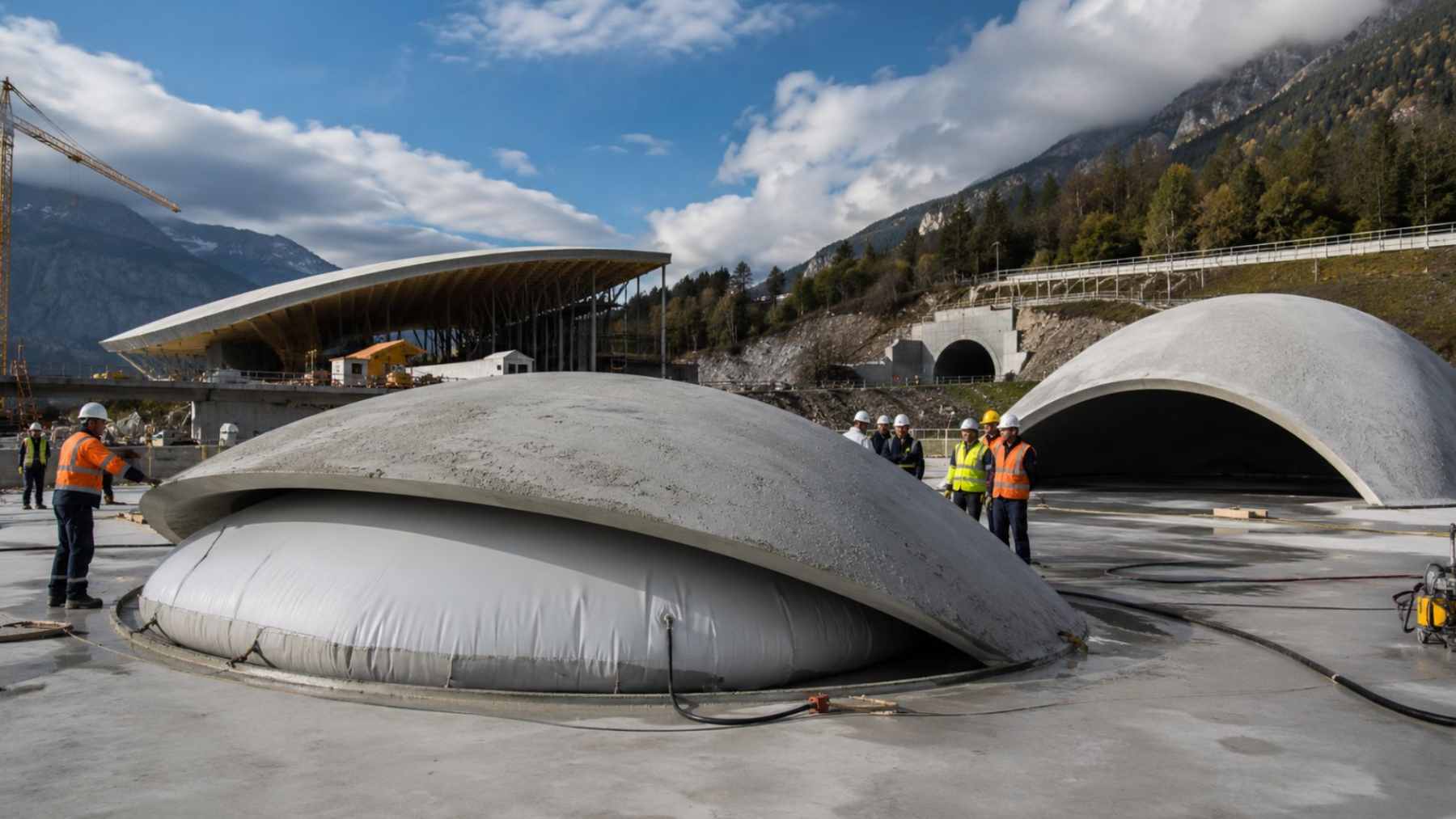
Their method, called Pneumatic Forming of Hardened Concrete (PFHC), uses an air cushion and post-tensioning cables to lift a flat concrete plate into a curved shell, cutting out much of the temporary formwork that usually makes domes, arches, and curved roofs so expensive.
Concrete that rises with air
The idea sounds almost too simple. First, builders create a flat concrete plate on the ground, using carefully shaped segments and wedge-like gaps. Once the concrete has hardened, an air cushion underneath is inflated while cables around the edge are tensioned until the structure rises into its final curved form.
This is not a soft balloon covered in concrete, but a controlled rearrangement of hardened concrete pieces, guided by geometry, pressure, and tension. The final result can be a double-curved shell, the kind of shape usually seen in domes, canopies, bridges, and large public buildings.
Professor Johann Kollegger compared the process to an orange peel that has been cut and flattened, only in reverse. “We do it the other way around, starting with a flat surface and then bending it to a shell,” he said in a TU Wien description of the technology.
Why this matters for builders
Curved concrete structures can be strong and elegant, but they have a problem. Traditional construction often requires elaborate timber or metal supports that must be built first, used once, and then removed. That takes time, money, material, and skilled labor.
PFHC attacks that problem directly. TU Wien says the method makes the complicated, spatially curved formwork and supporting framework redundant, because the concrete starts flat and gets its final shape later through pneumatic lifting.
In practical terms, fewer temporary structures crowd the worksite and less work is done high above the ground. Anyone who has seen a road or rail project drag on for months knows why that matters. Fewer supports can mean fewer obstacles, fewer risks, and potentially fewer long construction delays.
The environmental angle
Concrete is one of the world’s most important building materials, but it comes with a climate cost. The Global Cement and Concrete Association says cement, the key ingredient in concrete, accounts for around 7% of global CO2 emissions.
That is why construction methods that use material more efficiently deserve attention. TU Wien reported that, when the flat plate is produced with high accuracy, PFHC can save up to 50% of the concrete and 65% of the required reinforcement steel compared with conventional shell construction.
Will that solve concrete’s climate problem by itself? Of course not. But in a world full of bridges, stations, tunnels, and sports venues, even small improvements in material use can add up across thousands of projects.
From test dome to rail projects
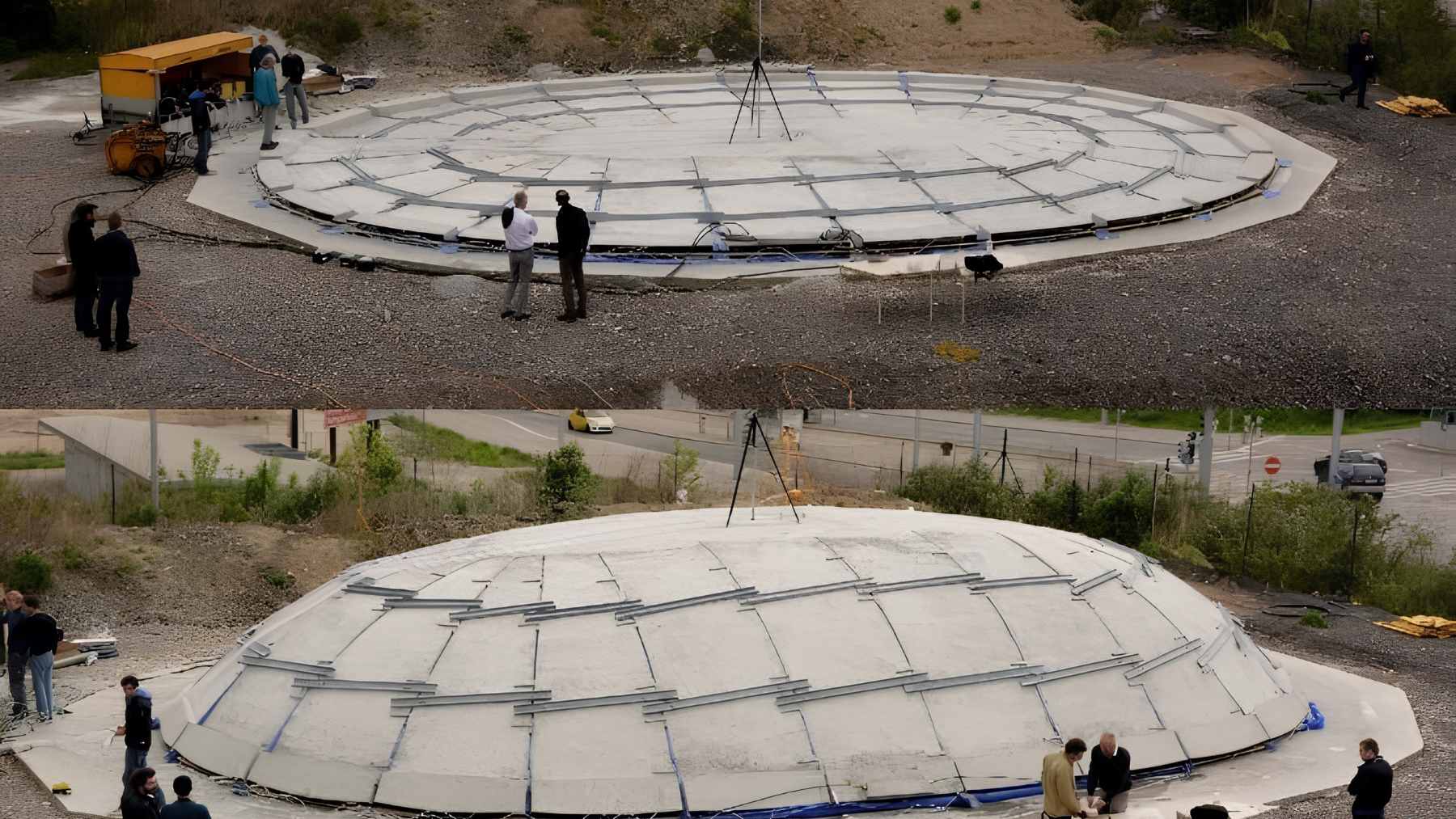
The technology has already moved beyond a classroom idea. TU Wien said Austrian Federal Railways Infrastructure (ÖBB Infrastruktur) used the method in a test construction in Carinthia, in southern Austria, as part of work connected to a later wildlife crossing over the Koralmbahn railway line.
That test dome measured 26.5 meters long, 19.1 meters wide, and 4.2 meters high. According to TU Wien, the 80-ton structure was lifted from a flat plate into a curved shell using only 20 to 22 millibar of pressure. That is a striking reminder that the heavy lifting here is not brute force, but careful engineering.
The possible applications are not limited to railways. TU Wien’s technology offers list shell structures for event and sports venues, pedestrian and bike bridges, viaducts for wildlife, and industrial bowl or basin shapes such as solar collectors.
What comes next
TU Wien says the technique can create shell structures with diameters of up to 52 meters, and an earlier university description said Kollegger considered 50-meter diameters achievable with the method. That scale opens the door to large roofs, bridge shells, station covers, and other curved structures that would otherwise be difficult or costly to build.
The technology has also been patented, and TU Wien noted that Austrian Federal Railways had already shown interest by commissioning a design project based on it. That does not mean every construction site will start inflating concrete tomorrow, but it does suggest that the idea is serious enough for infrastructure companies to watch closely.
At the end of the day, the appeal is easy to understand. Build flat, inflate carefully, and end up with a curved concrete structure that uses fewer temporary supports.
The official technology offer was published on TU Wien.