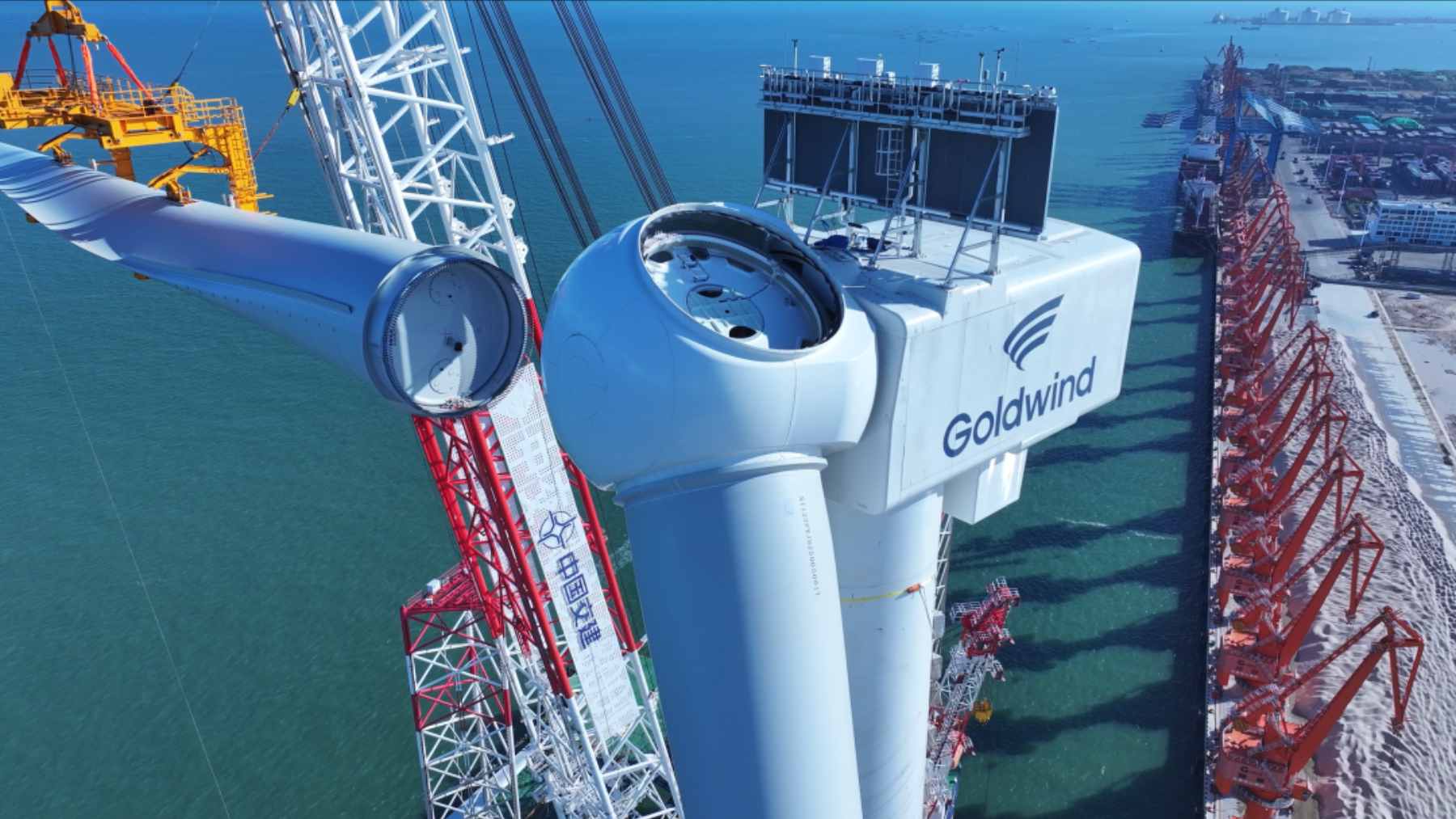
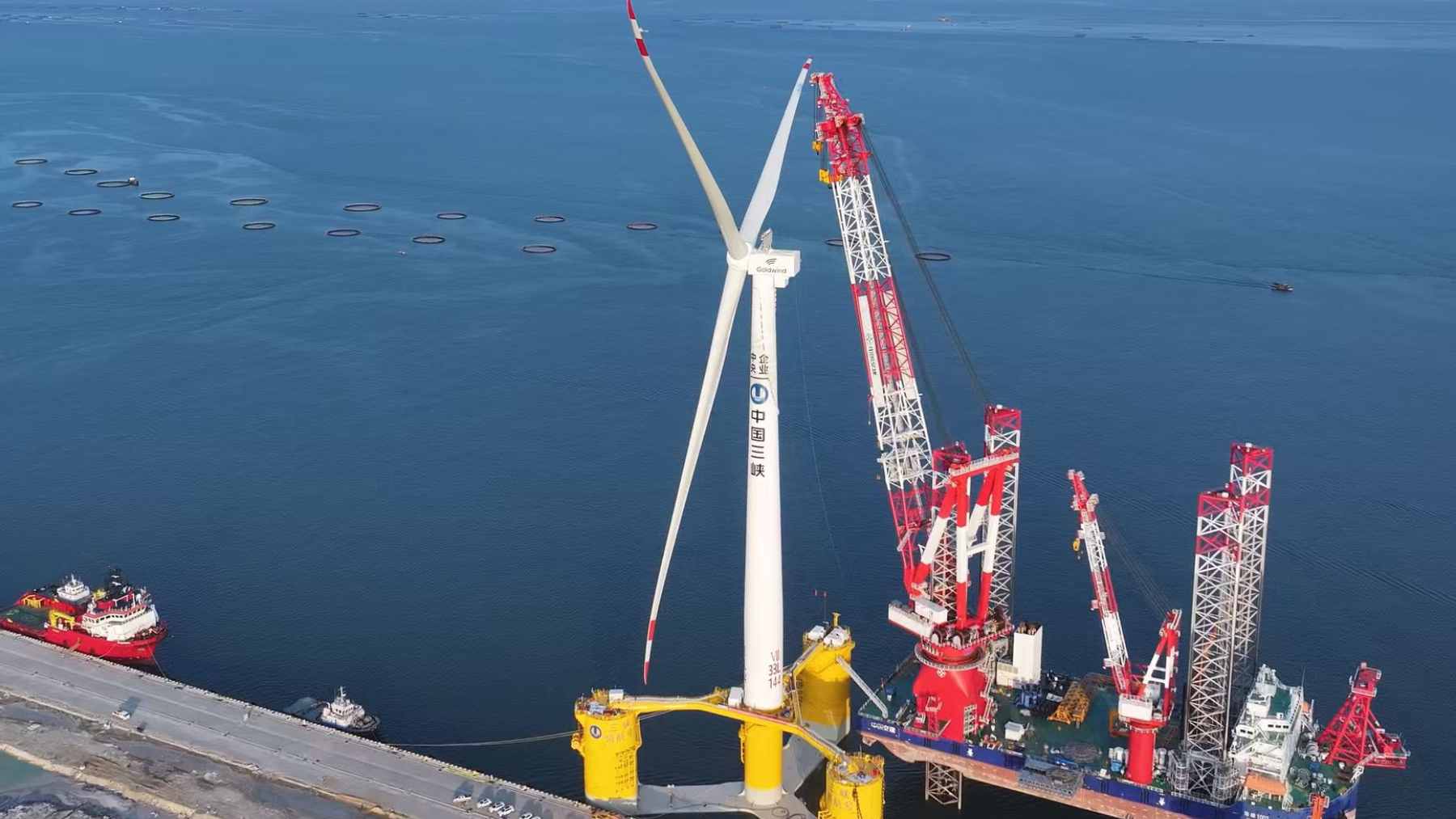
China has completed the installation of a massive floating offshore wind platform that shows just how far deep-sea renewable energy is being pushed. The project, called “Three Gorges Pilot” or “Sanxia Linghang”, carries a 16-megawatt turbine and was installed on May 2 in waters off Yangjiang, Guangdong, according to China Three Gorges Corporation.
The numbers are hard to ignore. The turbine has a 252-meter rotor, a blade tip rising more than 270 meters above the sea, and an expected annual output of about 44.65 million kilowatt-hours, enough by the company’s estimate to meet the yearly power needs of 24,000 three-person households.
That is not just a bigger windmill, it is a test of whether floating wind can move from eye-catching engineering to everyday electricity.
A turbine built for deep water
The platform sits more than 40 miles from shore in waters deeper than 50 meters. That matters because conventional offshore wind turbines are usually built on fixed foundations, which become harder and more expensive to use as the seabed drops away.
So, what does floating wind change? In practical terms, it lets developers chase stronger offshore winds in places where the ocean floor is too deep for normal foundations, without being tied to the shallow coastal zone.
The U.S. Department of Energy has said floating offshore wind can unlock far more technical potential than fixed-bottom projects in deep waters, though environmental and social constraints still matter. That is where China’s new project fits into the bigger race.
The scale is enormous
The turbine’s swept area is roughly the size of seven standard soccer fields. Picture that for a second. Every turn of the blades covers a patch of air so large it makes a normal city block feel small.
Goldwind, which jointly developed the GWH252-16-F floating turbine with China Three Gorges, confirms the 44.65 million kilowatt-hours per year estimate. The company also says the turbine’s key components have been localized, a detail that matters for cost, supply chains, and industrial competition.
For families, this kind of figure is easier to understand through the electric bill. One turbine will not solve a country’s energy demand, of course, but thousands of machines like this could change how coastal grids handle peak demand, especially in hot summer months.
How it stays upright
Floating wind sounds simple until the ocean gets involved. Waves, wind, currents, salt, and typhoons all push against the same machine at the same time–not exactly a gentle workplace.
China Three Gorges says the new platform is built around three main parts, a 16-megawatt turbine, a semi-submersible floating structure, and a new mooring system. The company said the surrounding sea area can face waves above 20 meters and wind speeds up to 160 mph.
Engineer Pan Hongguan from China Three Gorges Guangdong branch said the project uses a new mooring system, active ballast, smart monitoring, and a 66-kilovolt dynamic submarine cable, giving the platform the ability to withstand super typhoon conditions. That is the kind of detail that separates a demonstration from a serious offshore energy asset.
The mooring system is key
The platform itself measures 80.82 meters long and 91 meters wide, with a displacement of 24,100 tons. It is held in place by nine suction anchors, paired with high-performance polyester fiber cables and chains.
Each polyester cable can withstand up to 1,300 tons of pull, according to China Three Gorges. When the platform is hit by waves, those cables can stretch and absorb some of the shock, a bit like a giant safety line under constant pressure.
The active ballast system adds another layer of control. It adjusts water inside the platform’s columns to reduce swaying, helping the turbine stay steadier and lose less energy when the sea gets rough.
The business test
The environmental appeal is clear, to a large extent. Wind generation can add clean electricity without burning fuel at the point of production, and deep-water projects can open new zones away from crowded coastlines.
But the challenge is cost. Goldwind has noted that floating wind remains mostly in the pilot stage and that high development costs are still the core obstacle to full commercial deployment.
That is why size matters here. A larger turbine can spread fixed costs over more power output, use less sea area per megawatt, and reduce some engineering and maintenance expenses. Bigger is not automatically better, but in offshore wind, scale often decides whether a project can move beyond the demonstration phase.
What comes next
China Three Gorges says the new platform has nearly three times the single-unit capacity of its earlier anti-typhoon floating wind project and that the cost per kilowatt has fallen by more than 50%. The company also says key equipment has reached 100% domestic production.
This does not mean floating wind is suddenly easy. Marine ecosystems, fishing activity, cable routes, storms, grid access, and maintenance all have to be handled carefully. The ocean is not empty space.
Still, the direction is obvious. If the “Three Gorges Pilot” performs as expected, it could give developers another data point in the push to make floating offshore wind less of a futuristic idea and more of a working part of the energy mix.
The press release was published on China Three Gorges Corporation.