Alzheimer’s is often described as a disease of memory, but the new finding points to something more basic, blood flow. Researchers have detected tiny clots in the brain that may help explain why the disease worsens faster in some people.
The study does not replace the familiar story of amyloid plaques and tau tangles. Instead, it adds another layer, suggesting that a hidden traffic jam in the brain’s smallest blood vessels could be pushing damage along.
Dementia affected 57 million people worldwide in 2021, and Alzheimer’s disease is the most common form.
Tiny clots, big problem
Microthrombi are microscopic blood clots. They form inside very small blood vessels, the kind that help carry oxygen and nutrients to brain cells.
Why would that matter in a disease known for memory loss? If blood cannot move smoothly, nearby neurons may get less fuel. Over time, that shortage could make fragile brain tissue even more vulnerable.
What scientists found
The new work detected microthrombi in living mice bred to model Alzheimer’s disease.
The project brought together the Spanish National Center for Cardiovascular Research, the Spanish National Research Council, and the Fundación Jiménez Díaz Health Research Institute, with additional partners in Madrid.
The finding matters because these clots had largely been invisible during life. They were usually studied after death, when doctors and scientists examined brain tissue. In practical terms, that meant the problem could be seen only after the chance to intervene had passed.
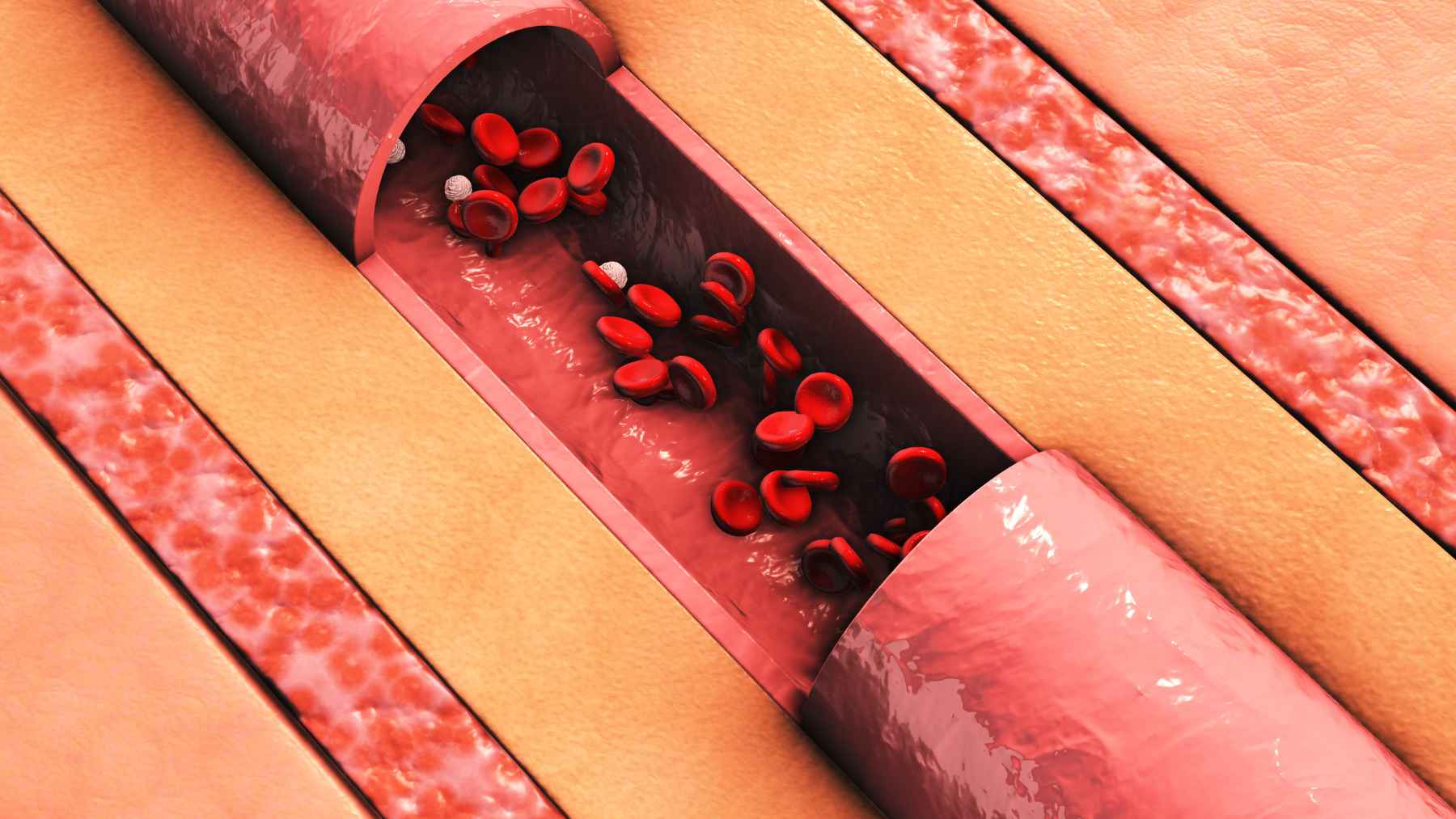
An illustration showing microscopic blood clots, or microthrombi, inside a blood vessel. New research suggests these tiny clots may disrupt blood flow in the brain, contributing to Alzheimer’s disease progression and offering a potential new target for diagnosis and treatment.
How the scan works
The team used positron emission tomography, or PET, a type of scan already used in hospitals. PET works by sending a small signal from a tracer, which is a substance designed to attach to a specific target in the body.
In this case, the targets were parts of clots, including fibrin and platelets. Fibrin is a protein that helps blood clot, and platelets are tiny blood cells that gather when a clot forms. When more of these clot markers were present, the scanner picked up a stronger signal.
A blood-flow angle
For decades, Alzheimer’s research has focused heavily on amyloid and tau. Amyloid forms sticky plaques outside brain cells, while tau forms tangled strands inside them.
But the brain is not only a collection of nerve cells. It is also packed with blood vessels, and even small changes in circulation can matter. Think of a neighborhood during a traffic jam. The buildings are still there, but getting around slows down and stress levels intensify.
A possible biomarker
A biomarker is a measurable sign of disease or wellness. In Alzheimer’s care today, doctors may use brain scans, spinal fluid tests, and blood tests to look for the biology of the disease, especially amyloid and tau.
The Alzheimer’s Association’s 2024 criteria also put more weight on biological signs, not only memory symptoms.
If microthrombi can be detected safely in people, they might become another biomarker. That could help doctors see which patients have a stronger blood-clotting component to their disease. It could also help explain why two people with similar memory symptoms do not always decline at the same pace.
Treatment questions remain
This is where the news gets interesting, but also where caution matters. The research points toward a future in which some patients might be considered for therapies that protect the brain’s tiny blood vessels.
That does not mean people with Alzheimer’s should start taking blood thinners on their own. Anticoagulants can cause bleeding, and the study was not a human treatment trial. The safer takeaway is that scientists may now have a better way to identify who should be studied next.
Earlier clues fit the picture
The vascular idea did not appear out of nowhere. A 2019 JACC study reported that long-term dabigatran treatment delayed Alzheimer-like disease processes in a mouse model, adding earlier support to the idea that clotting pathways may matter in this illness.
Still, mouse studies are not the same as patient care. Mice help researchers test mechanisms in a controlled setting, but human brains, bodies, medications, and risks are more complicated. That’s why the next steps will need careful clinical research.
Why this changes the story
Marta Cortés Canteli, who led work that included Carlos Cerón, Marta Casquero-Veiga, and Nicolás Lamanna-Rama, said the finding “opens the door to new diagnostic and therapeutic targets.”
That is a careful phrase, not a promise of a cure. It means the work may help researchers look beyond a single explanation of Alzheimer’s and study the disease as a mix of nerve damage, protein buildup, inflammation, and blood-vessel trouble.
At the end of the day, the study gives scientists a better roadmap. Not the fastest route to a definitive cure. The official study has been published in Alzheimer’s & Dementia.