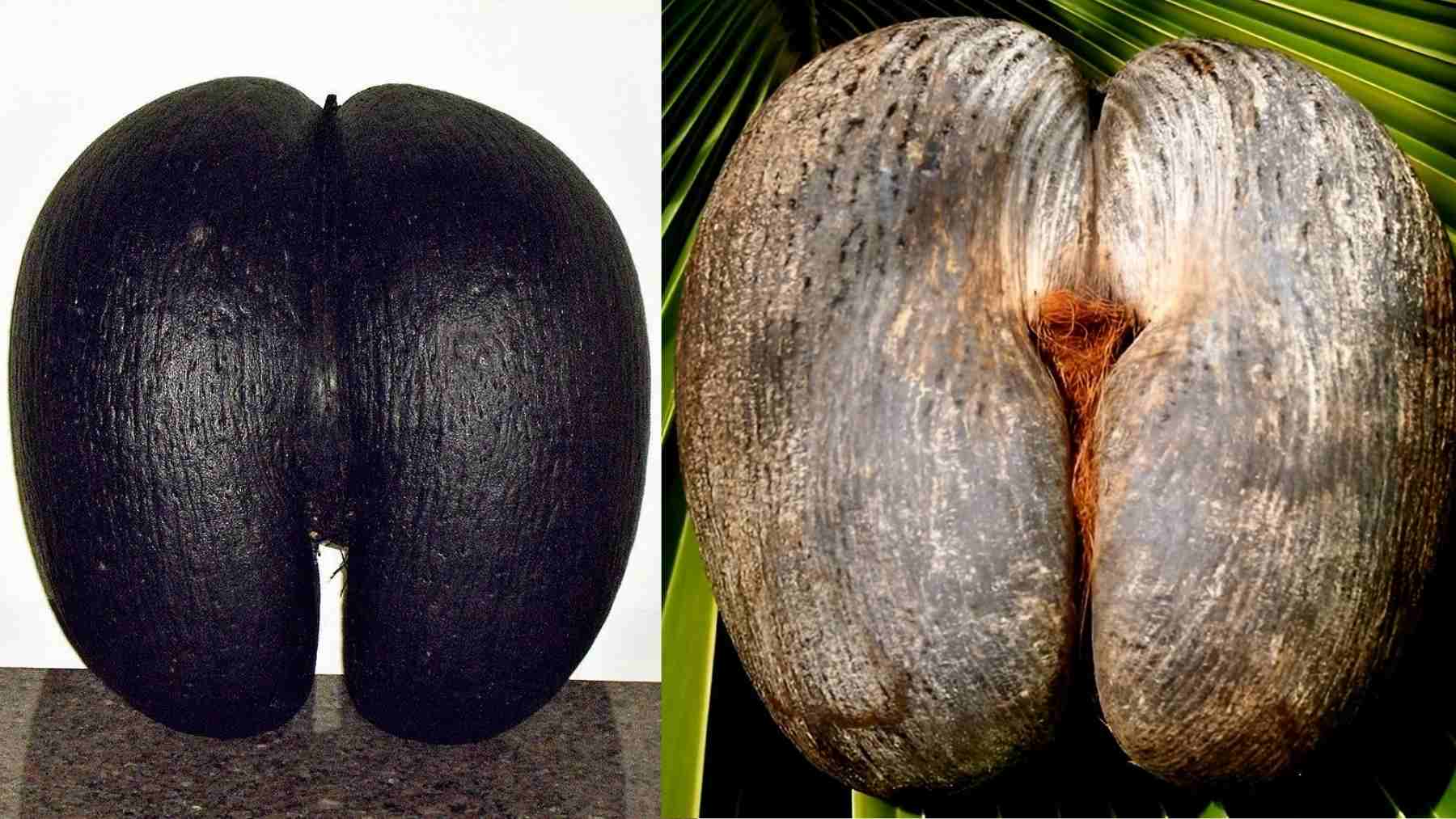
A seed that can weigh as much as 66 pounds and span nearly 20 inches sounds like something from a museum display, not a living forest. But that is everyday reality for the coco de mer, a rare palm found naturally on just two islands in the Seychelles, where its “double coconut” seed is the biggest on Earth.
So how does a tree pull off that oversized starter pack while growing on famously nutrient-poor ground? Researchers say the answer is surprisingly practical. The palm has effectively built a rain-harvesting and self-fertilizing system out of its own leaves, delivering water and nutrients right where its heavy seeds land.
A seed that breaks the usual rules
In a BBC Wildlife report, editors describe coco de mer seeds reaching about 16 to 20 inches across and weighing up to about 66 pounds. Other reputable sources put the upper end lower, partly because weights vary with moisture and partly because people sometimes mix up the seed with the larger fruit around it.
For example, the Royal Botanic Gardens, Kew notes that these seeds can weigh up to about 55 pounds and measure up to around 20 inches long. Either way, the scale is hard to picture. Think less “sunflower seed” and more “carry-it-with-two-hands” problem.
Why the seed stays close to its parent
Unlike many plants that rely on animals to carry seeds away, coco de mer does not get much help on its home islands. The seed is simply too heavy to travel far, so it drops near the parent tree, where young palms end up growing close together and competing for the same limited resources.
That pressure helps explain why size can be an advantage. Ecologist Christopher N. Kaiser-Bunbury of the Technical University of Darmstadt said in that report, “the larger the seed, the higher the chance of establishment and survival.” Big seeds are expensive to make, but they give a young plant a bigger built-in food supply when conditions are harsh.
Leaves that work like a roof gutter
A journal press release explains how the palm’s broad leaves act like a funnel and gutter system that redirects rain toward the trunk. If you have ever watched water race along a gutter after a storm, you already understand the basic idea.
The leaves can be huge, sometimes reaching about 108 square feet each, and their shape helps channel water into a tight area at the base of the tree. In the same report, he summed it up with a vivid line, saying, “Even in a torrential rain, you can walk through the palm forest almost without getting wet.” The water is not disappearing, it is being guided.
A nutrient “drop zone” for the next generation
As rainwater runs along the leaf surface and down the trunk, it picks up small bits of debris along the way. That can include pollen, animal droppings, and other organic material that contains phosphorus, a key plant nutrient also found in many garden fertilizers.
In the press release, the research team reports finding about three times as much available phosphate, a form of phosphorus plants can absorb, near coco de mer trunks compared with other palms nearby. They describe the result as a plant version of “parental care,” because the palm ends up enriching the nursery soil directly under its own canopy, right where the giant seeds germinate. The flip side is that soil just a few feet away can be drier and less nutrient-rich, which may keep would-be competitors out.
A high-cost strategy that still pays off
The study behind the press release was authored by Peter J. Edwards and Frauke Fleischer-Dogley, along with the same ecologist quoted earlier, working with ETH Zurich and the Seychelles Islands Foundation. To test their idea, they tracked how rainwater moved through the canopy and compared soil samples taken close to the trunk with samples several feet away.
Their fieldwork focused on the Vallée de Mai Nature Reserve, a protected palm forest of about 48 acres on Praslin that is listed by UNESCO. One striking takeaway is how heavily the palm seems to prioritize reproduction, especially when it comes to phosphorus, even in poor soil.
In the researchers’ measurements, flowers and fruits accounted for roughly nine-tenths of the phosphorus allocated above ground, leaving leaves unusually low in that nutrient. It is a tradeoff, but it helps explain how the palm can “afford” seeds that take years to develop. Over time, that same nutrient shortcut may also help the species dominate its patch of forest, a setup scientists call “monodominant” because one species is doing most of the dominating.
What it means for protection and long-term survival
Coco de mer is not built for speed. The California Academy of Sciences reports that the palm may take 25 to 50 years to reach maturity, with seeds that can take about two years to germinate and fruit that may need six to ten years to ripen. “Everything about this palm is prolonged,” says Frank Almeda, a senior curator at the museum, adding that this long timeline includes its lifespan.
That slow pace is one reason harvesting and habitat loss can hit hard, because replacement takes decades, not seasons. A 2010 Forest Ecology and Management study projected that current harvesting pressure could gradually reduce the population over the next 200 years if it is not managed carefully. In practical terms, protecting the places where these palms still dominate, and the water-and-nutrient system they create, is as important as protecting the seeds themselves.
The study was published on SONAR.