Moving an object without touching it sounds like the kind of trick you would expect in a science fiction movie. But researchers at Texas A&M University say they have now used lasers to lift and steer tiny devices called “metajets” in three dimensions, without motors, physical contact, or traditional fuel.
That matters because spaceflight has an environmental problem that is easy to overlook from the ground.
NOAA has warned that rocket soot injected into the stratosphere can affect ozone and atmospheric circulation, especially if launch activity keeps growing. So a propulsion idea that reduces the need to carry fuel in space deserves attention, even if it is still a long way from replacing rockets on the launchpad.
Tiny devices, big idea
The new work focuses on micron-scale devices, smaller than the width of a human hair. These metajets are made from metasurfaces, which are ultrathin materials covered with tiny engineered patterns that control how light behaves.
Think of it like changing the shape of a road before the traffic arrives. When laser light hits the surface, the material redirects that light in a carefully planned way, and the change in momentum creates a small push. Small, yes, but controlled.
How light becomes thrust
Light may feel weightless in everyday life, but it can still exert pressure. The force is usually so tiny that we never notice it while walking under a lamp or sitting by a sunny window.
The Texas A&M team found a way to make that small force useful by building control into the material itself. Instead of only shaping the laser beam, the metajet’s surface helps decide where the force goes.
Essentially, that means the devices can move sideways, rise, and be steered in multiple directions. The researchers also reported that the force depends on light power rather than simply on the size of the device, which is one reason the work is drawing interest beyond the lab.
Why space agencies will care
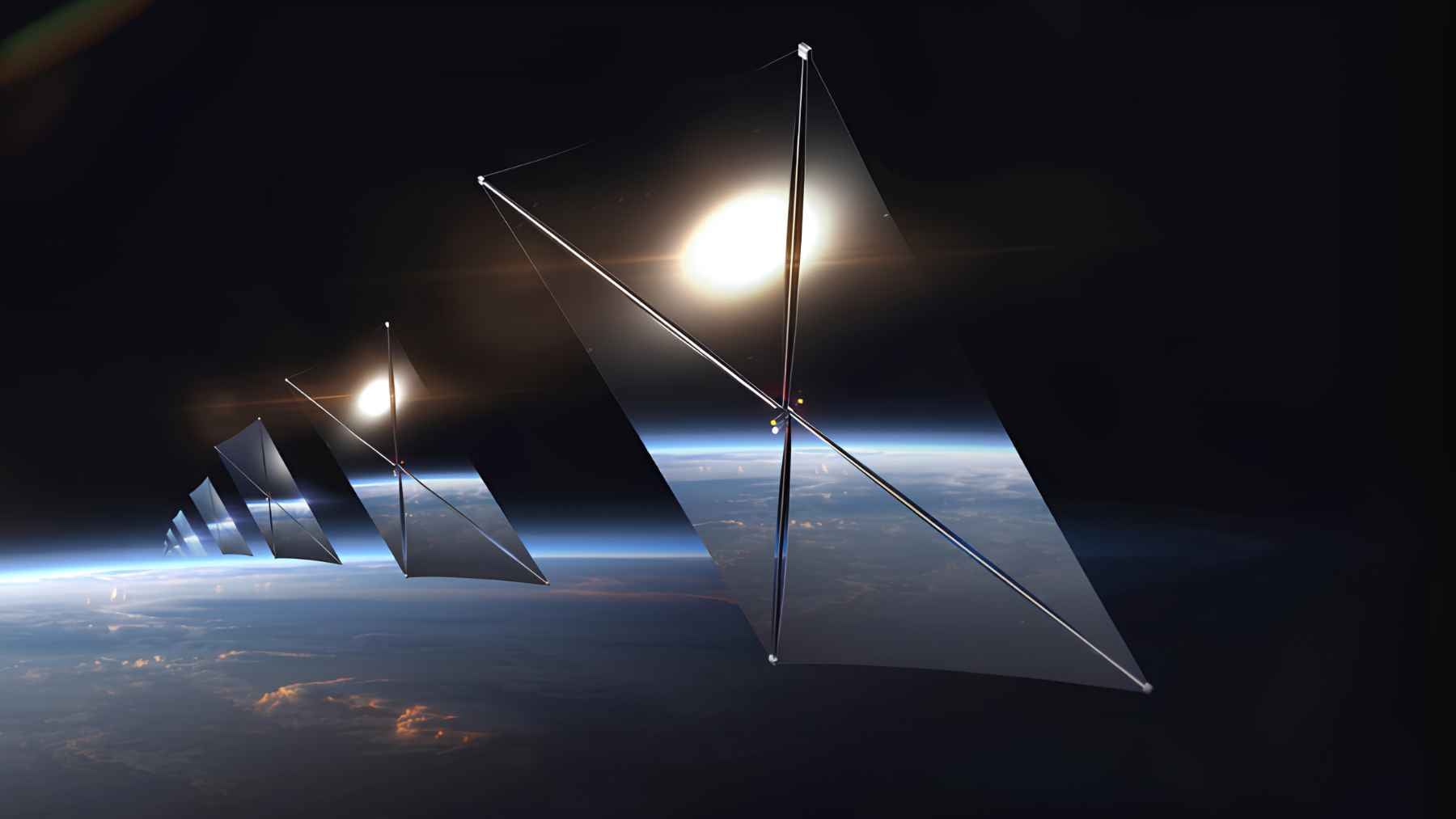
The most eye-catching claim is about deep space. Texas A&M says current rocket propulsion would take hundreds of thousands of years to reach Alpha Centauri, while a future light-driven system could, in theory, cut that trip to roughly 20 years.
That is not a travel plan yet, it is a signpost. The experiments were done at microscopic scale and in controlled conditions, so no one should imagine a laser sail leaving Earth next week.
Still, the logic is powerful. Rockets have to carry propellant, and carrying propellant adds mass. A spacecraft pushed by light from an outside energy source would change that equation in a major way.
The environmental angle
This is where the story becomes more than a flashy space headline. NOAA says current spaceflight activity contributes about 1,000 tons of rocket soot to the stratosphere each year, and launch rates have more than tripled in recent decades.
Metajets would not erase the emissions from launching hardware off Earth. That sticky problem remains, much like the electric bill still matters even when a device becomes more efficient.
But after a spacecraft is deployed, fuel-free maneuvering could reduce dependence on onboard propellants for certain missions. For the most part, that is the cleaner promise here: not magic, but less mass and fewer consumables once the vehicle is already in space.
Uses closer to home
The space angle grabs attention, but the first useful applications may be much closer to Earth. Contact-free movement could help microrobotics, precision manufacturing, and the handling of delicate materials that cannot be touched without damage.
That may sound small compared with interstellar travel. But many technologies start that way. The lab bench comes first, then the factory floor, and only later the mission concept.
For business and defense planners, this kind of control could also matter in future sensors, microdevices, and space systems where every gram counts. The trouble is, engineering does not move as fast as imagination.
What comes next
The researchers are now looking toward microgravity testing, where light-driven propulsion can be studied without Earth’s gravity getting in the way. That step will be important because a controlled lab setup is very different from the harsh environment of space.
There are still major questions about scale, power needs, stability, and cost. But the basic achievement is hard to ignore–scientists have shown that light can lift and steer engineered objects with precision, and that opens a new door for cleaner space technology.
The study was published on Newton.