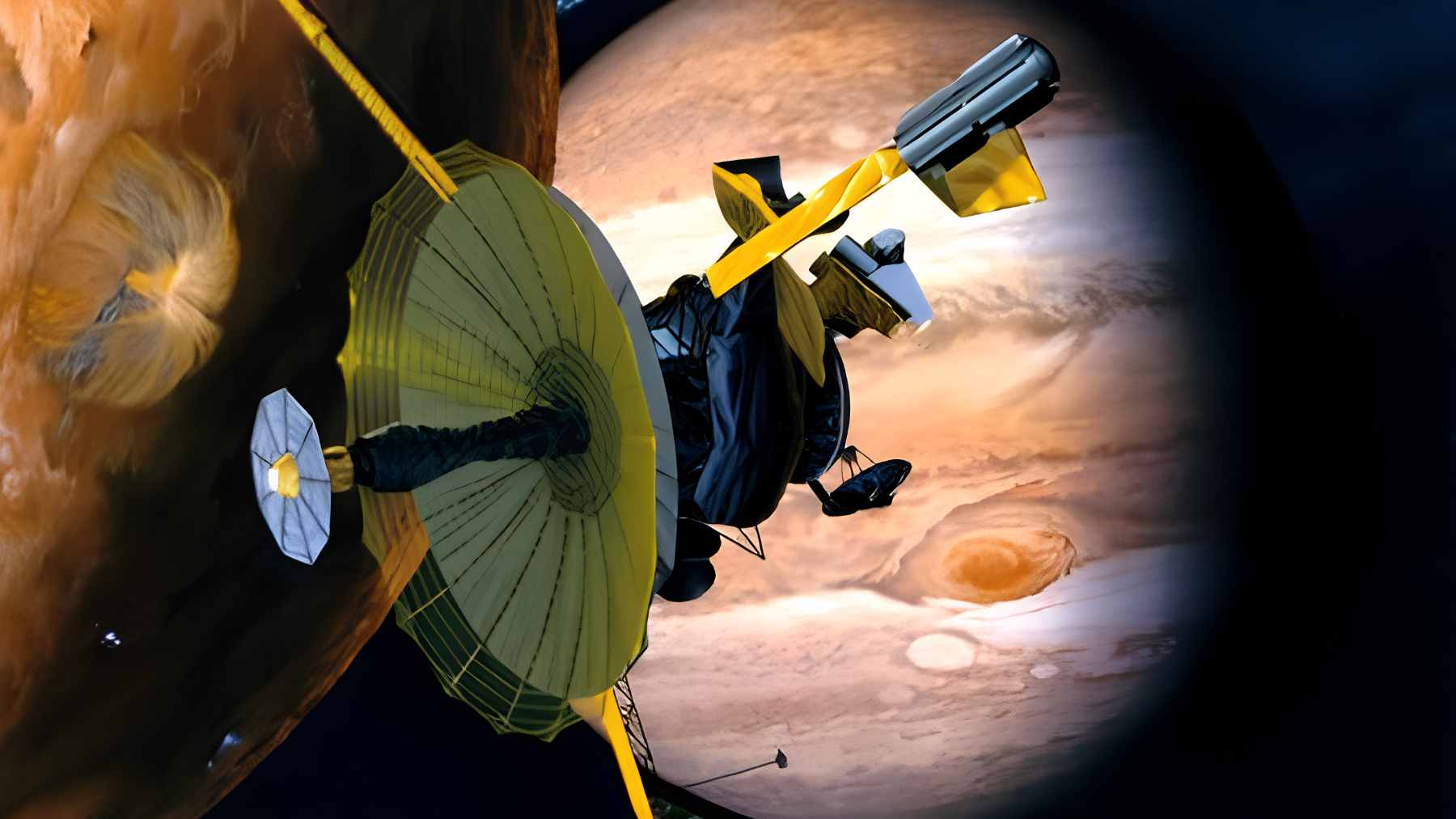
In September 2003, NASA didn’t just end the Galileo mission to Jupiter, it disposed of it on purpose. Controllers deliberately guided the aging spacecraft into Jupiter’s atmosphere so it would never accidentally hit Europa, a moon where evidence points to a salty ocean hidden under ice.
That choice now reads like an early chapter in space environmental policy. As new missions and private contractors push deeper into the Solar System, “planetary protection” is becoming less of a niche rulebook and more of a real factor in budgets, schedules, and even national security planning.
It sounds abstract, until you understand how fast microbes spread when we get careless here on Earth.
Galileo’s last maneuver was a cleanup job
Galileo launched in October 1989 and entered orbit around Jupiter in December 1995, opening a long-running front row seat on the biggest planet in our neighborhood.
NASA extended the mission three times, and the spacecraft ultimately completed 34 Jupiter orbits and dozens of moon flybys. By the early 2000s, radiation damage and dwindling fuel forced a hard question about what an uncontrolled spacecraft might do next.
So why destroy a probe that was still returning valuable science? NASA’s answer was about risk management, not drama, because an out-of-fuel spacecraft could eventually become a navigation problem. The agency
says it wanted to reduce the chance of a future collision with Europa, a world viewed as especially sensitive because of its potential for liquid water and habitability.
At impact, Galileo was moving about 30 miles per second, nearly 108,000 miles per hour, which NASA compares to traveling from Los Angeles to New York City in 82 seconds. It was the space equivalent of taking hazardous waste to the right facility instead of dumping it somewhere you might regret later.
A probe that survived extreme heat for one hour of data
The mission’s most daring moment came years earlier, when the orbiter released an atmospheric probe in mid-1995. That probe slammed into Jupiter’s upper atmosphere on December 7, 1995 at about 106,000 miles per hour and endured brutal heating during entry.
NASA reports peak temperatures around 28,832 °F , or 16,000 °C, before the parachute phase began and the instruments started sampling the air.
For a little over an hour, the probe transmitted winds, pressure, and chemistry data before going silent roughly 61 minutes after entry. By that point it was about 112 miles below its entry level, where pressure was about 22.7 times Earth’s at sea level, far beyond what its transmitters could survive.
These were not just numbers, they were the first direct “weather report” from inside Jupiter’s atmosphere.
Meanwhile, the orbiter kept working for years, tracking volcanic activity on moon Io and building evidence that Europa, Ganymede, and Callisto may have subsurface saltwater layers. Essentially, it turned Jupiter’s moons into a short list of places where future missions might search for environments that could support life.
Planetary protection is space’s environmental law
When environmental agencies on Earth worry about invasive species, the logic is simple, a foreign organism can rewrite an ecosystem. Planetary protection applies that same logic to spaceflight, with two main concerns called forward contamination (carrying Earth life outward) and backward contamination (bringing unknown material back).
NASA says every mission is evaluated, and requirements depend on the destination and what the spacecraft is designed to do there.
For Europa-class destinations, the standards can get strict because even a tiny microbial hitchhiker could muddy future life detection work. You can think of it like a lab test during flu season–if your sample is contaminated, the result may be useless. That is why cleanrooms, sterilization processes, and bioburden testing are treated as mission-critical hardware.
NASA’s Europa Clipper team gives a concrete example of how detailed this gets. JPL says the spacecraft is expected to launch with fewer than 350,000 bacterial spores, a quantity it notes could fit on the tip of a ballpoint pen. Small number, big consequence, because it is meant to protect both Europa’s environment and the integrity of future science.
Business and defense are tied to the same rules
Planetary protection is also showing up in the balance sheets. NASA is increasingly relying on private companies for lunar deliveries, including a Commercial Lunar Payload Services award to Firefly Aerospace worth about $176.7 million for a Moon south pole mission planned for 2029, according to Reuters.
NASA’s own planetary protection handbook is explicit that its guidance is meant for NASA and NASA-partnered missions, and it is written to be useful to commercial and international teams as well.
On the technology side, the “keep it clean” problem often collides with the “make it survive” problem, especially for atmospheric entries.

A thermal protection systems white paper describes how NASA leveraged U.S. military investment in carbon phenolic heat shield materials developed for intercontinental ballistic missile reentry vehicles, and it names Galileo as one of the missions that benefited from that heritage.
It is a reminder that space tech supply chains often straddle civil science and defense-driven engineering.
Even national space strategy is explicit about mixing commercial growth with security priorities. A 2025 White House executive order calls for “commercial development” while also emphasizing defense of U.S. interests in and through space, including cislunar awareness and missile defense technology goals.
The more crowded the space economy gets, the harder it becomes to treat planetary protection as a side issue.
The rulebook is being rewritten for icy worlds
That tension is exactly why international guidelines keep evolving. COSPAR, the scientific body behind widely used planetary protection policy, released a 2026 version approved in November 2025 and highlights new guidelines aimed at “Icy Worlds.”
The update is framed as a way to improve consistency and clarity as missions target places like Europa and other ice-covered bodies that may have special contamination sensitivity.
COSPAR also pushes for transparency that would feel familiar in many regulated industries. It recommends that mission teams share their planetary protection plans for review before launch, then report key details within six months after launch, followed by another report within one year after a mission ends.
Boring paperwork on the surface, but it is really a way to keep possible alien habitats from becoming accidental dumping grounds.
For the public, the takeaway is that “space pollution” is not only about orbital debris you might picture streaking across the night sky, it also includes microscopic contamination that can compromise decades of exploration.
The official policy update was published on COSPAR.