Could the air around your body help power the next medical sensor you wear? A research team with Harbin Institute of Technology affiliations has developed a stretchable hydrogel-based moisture-electric generator that turns humidity into electricity while surviving thousands of bends and stretches.
That matters because wearable tech has a quiet battery problem. The U.N.-backed Global E-waste Monitor reported that the world produced about 68 million tons of electronic waste in 2022, and that figure is on track to reach roughly 90 million tons by 2030.
A self-powered sensor will not fix that by itself, of course, but it points toward a future where tiny devices need fewer battery swaps and less disposable hardware.
Why humidity matters
Moisture-electric generators are designed to harvest energy from water vapor in the surrounding air. That means a soft patch on skin, a face mask, or a small health monitor could draw power from everyday humidity instead of depending only on a conventional battery.
The problem has been durability. Existing fully stretchable hydrogel moisture-electric generators often suffer from low electrical output and mechanical fragility because the hydrogel and electrode layers do not stick together strongly enough. Once those layers separate, performance drops.
That is a big deal for wearables. A sensor on your wrist, chest, or face does not sit still like a lab sample. It bends when you walk, stretches when you breathe, and gets exposed to sweat, dry rooms, cold air, and heat.
How the sticky hydrogel works
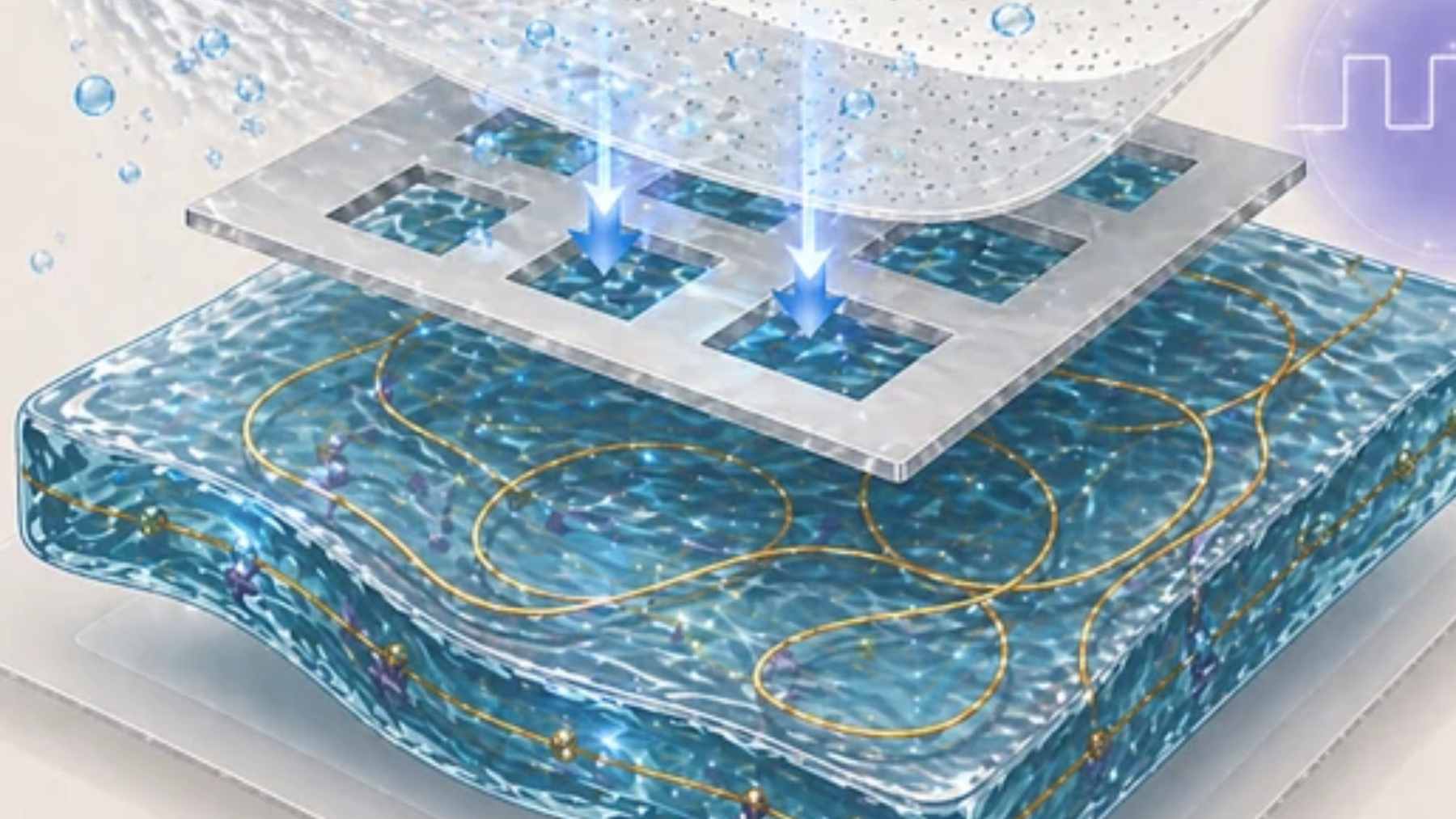
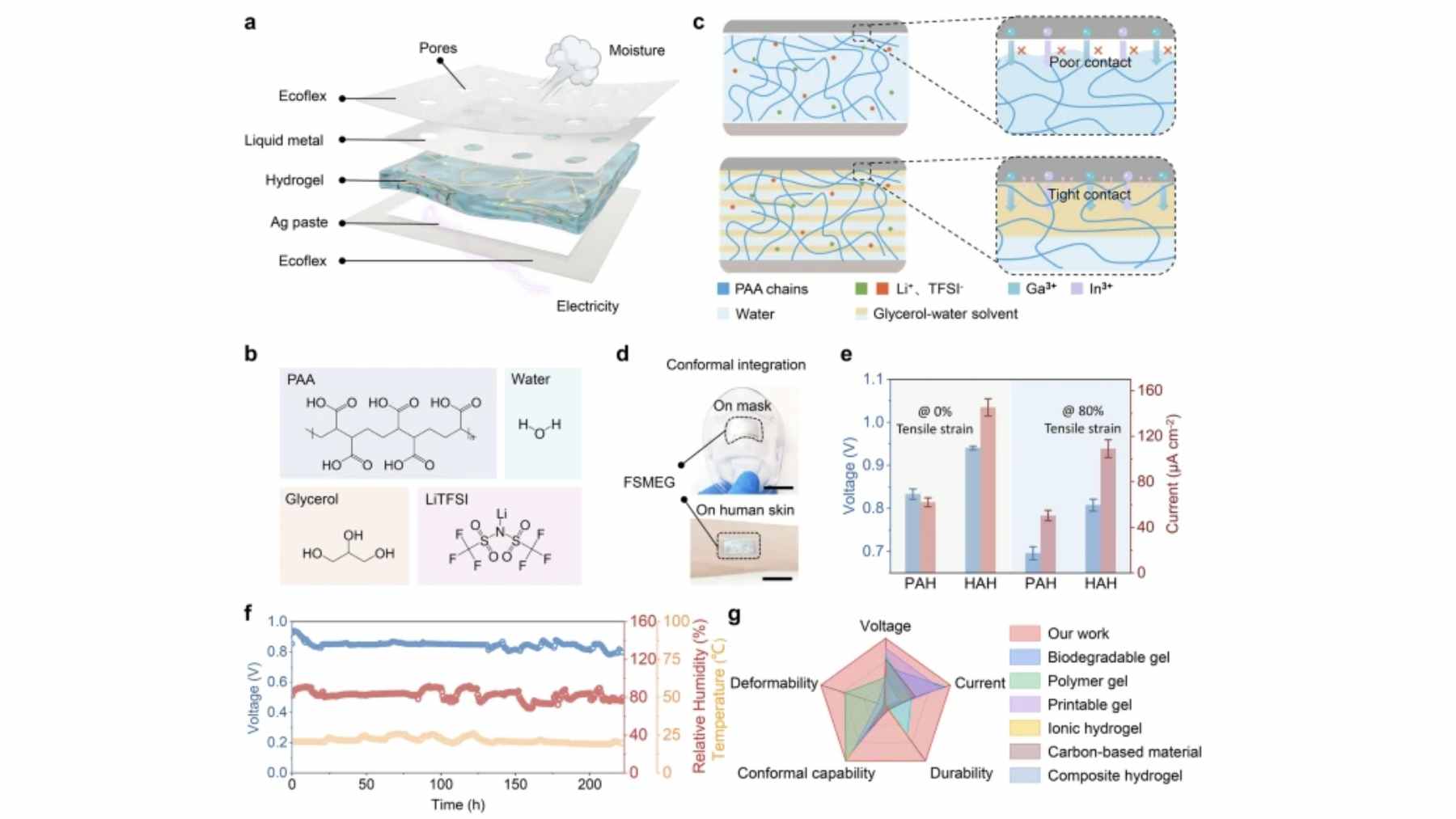
The new design focuses on the interface, which is the contact zone where the hydrogel meets the electrodes. The researchers used a highly adhesive hydrogel swollen in a water-glycerol mixture, then integrated it with liquid metal and a stretchable silver electrode.
Glycerol is the key ingredient here. According to the report, it increases hydrogen-bonding groups, creates more effective contact points with the electrodes, improves adhesion, and cuts resistance at the interface. That helps ions move through the device even while it is being stretched.
The team also found that glycerol helped the hydrogel resist drying, freezing, and swelling. That is where the environmental angle becomes practical–a green device still has to work outside ideal lab conditions.
What the tests showed
The numbers are small compared with a phone charger, but strong for this class of soft electronics. At 85% relative humidity, the device reached an open-circuit voltage of 0.94 volts and a current density of about 0.91 milliamps per square inch. It also maintained stable output for more than 220 hours.
The mechanical results may be even more important. The official study highlights long-term stability after 8,000 folding cycles and 1,000 stretching cycles at 80% strain, while the release notes stable operation after 1,040 stretching cycles and 8,000 bending cycles at a 180° angle.
Why does that matter? Because a wearable power source is only useful if it survives the ordinary abuse of daily life. Putting on a jacket, jogging, sleeping, or tightening a medical patch can all stress a soft device more than people may realize.
Simulations backed the idea
The researchers did not rely only on bending and stretching tests. They also used ab initio molecular dynamics simulations and density functional theory calculations to examine how ions moved at the reinforced interface.
Those simulations showed faster ion migration and a lower energy barrier when glycerol was part of the hydrogel system. Put simply, the stickier interface did not just hold the device together, it also helped charges move more efficiently.
That combination is the heart of the advance. The same design choice improved both toughness and electrical performance, which is not always easy in soft materials.
Where it could be used
The study points to wearable and implantable electronics as the main targets. The device was demonstrated for non-invasive respiration monitoring and for powering wearable electronics such as electrocardiogram sensors.
That could be useful in health care, sports monitoring, elderly care, and remote medicine. Imagine a soft patch that tracks breathing without needing frequent charging, or a medical sensor that remains comfortable through normal movement.
Still, this is not a commercial product yet. The device must be scaled, packaged safely, tested over longer periods, and evaluated under real-world conditions before anyone expects to see it in a clinic or a consumer wearable.
The bigger catch
The promise is clear, but so is the caution. Humidity-powered hydrogels are not magic batteries. Their output depends on environmental conditions, device area, material stability, and how well the electronics around them are designed.
That said, the direction is important. As small sensors multiply in homes, hospitals, factories, and military systems, powering them cleanly becomes part of the larger sustainability puzzle. Fewer replacements and longer-lasting components can matter, especially at scale.
At the end of the day, the breakthrough is less about one hydrogel and more about a design lesson. In soft electronics, the weakest point is often not the active material, it is the place where two materials meet.
Small power, bigger signal
This hydrogel generator will not replace large batteries or grid power. But for low-power wearable sensors, it shows a practical path toward devices that are lighter, softer, and less dependent on disposable energy sources.
That is the kind of progress that can slip under the radar because it looks small–a fraction of a volt here, a flexible patch there. If the next generation of health sensors can harvest energy from humidity while surviving real movement, the impact could add up quickly.
The study was published on Nano-Micro Letters.