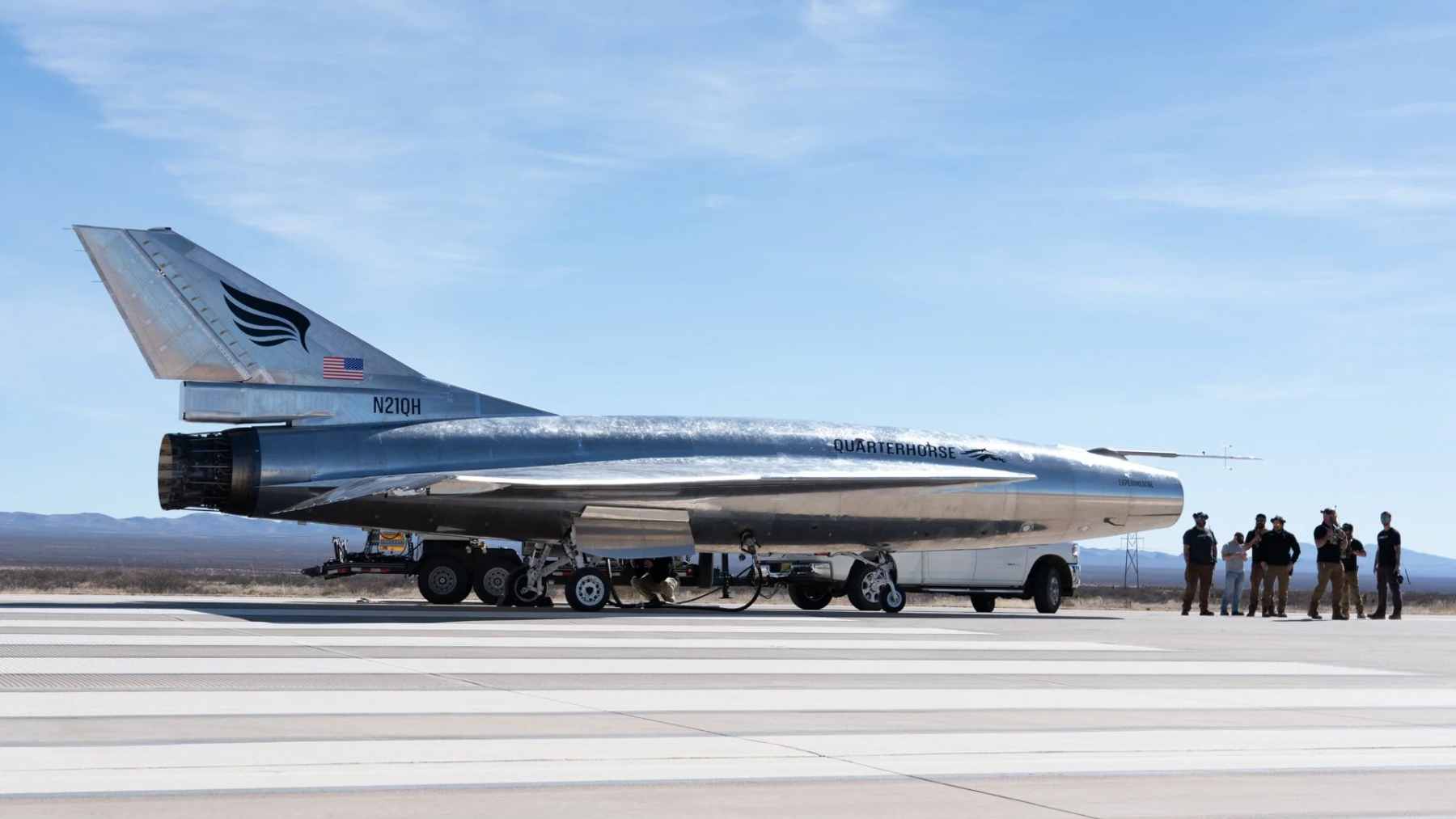
Hermeus has turned one of aviation’s biggest promises into real flight data. Its uncrewed Quarterhorse Mk 1 flew at Edwards Air Force Base in May 2025, and the follow-on Quarterhorse Mk 2.1 has since reached Mach 1.21 on its third test flight at Spaceport America, according to the company.
That matters because the long-term vision is not only military speed. The bigger public hook is Halcyon, a proposed 20-seat passenger aircraft that could one day use conventional runways and cross the Atlantic at around Mach 5, turning New York to London from a long workday into something closer to a lunch break.
Why Quarterhorse matters
At first glance, Quarterhorse Mk 1 looked like a stepping stone. That is exactly the point.
Hermeus built the remotely piloted aircraft to test high-speed takeoff and landing, one of the least glamorous but most important parts of any future hypersonic aircraft.
The Mk 1 used a General Electric J85 engine, and Hermeus says the campaign validated aerodynamics, stability, control, propulsion, fuel systems, hydraulics, thermal management, avionics, flight software, telemetry, and command systems.
In practical terms, the company is trying to move at a startup pace in a field that usually crawls. Hermeus describes its model as building multiple aircraft in quick succession, using one flight campaign to feed the next.
The engine problem
The shiny aircraft gets the attention, but the engine is the real puzzle. Hermeus calls its system Chimera, a turbine-based combined cycle engine that behaves like a regular jet at low speed and then shifts the airflow around the turbine so a ramjet can take over at higher speed.
What makes that so hard? A normal jet engine and a ramjet want very different flight conditions, so the handoff between the two is the dangerous middle ground.
Hermeus says it demonstrated turbojet-to-ramjet transition in November 2022, which it called one of the key technical milestones for operational hypersonic flight. Still, doing that in flight, repeatedly and safely, is the test that would move the program from impressive prototype work toward a usable high-speed aircraft.
Defense money speeds it up
The business story is just as important as the engineering one. Hermeus is not trying to build a commercial airliner first, then hope the military notices.
The Defense Innovation Unit contract now has a total ceiling of $219 million after a $159 million modification announced in May 2026. Hermeus says the expanded work will involve the U.S. Air Force and Navy and will test high-Mach flight plus high-speed payload release in 2026 and 2027.
That defense-first path can make the program move faster. It also makes the environmental question more complicated, because the same technology could feed both military drones and future premium passenger travel.
The climate test
This is the part that cannot be brushed aside. Aviation already accounted for 2.5% of global energy-related carbon dioxide emissions in 2023, according to the International Energy Agency, and the sector was still listed as “not on track” for net-zero goals.
Faster flight can also mean tougher physics. Supersonic and hypersonic aircraft are usually more energy-hungry than conventional jets, and some fly at altitudes where emissions and water vapor may have different atmospheric effects than they do lower down.
That does not mean hypersonic travel is dead before takeoff. It means fuel, altitude, noise, route planning, and passenger load will matter just as much as top speed.
Noise is still a roadblock
There is another everyday issue, and anyone who has lived near an airport understands it. Noise is not just a technical nuisance, it is a public acceptance problem.
The FAA says civil aircraft are currently prohibited from flying faster than Mach 1 over land in the United States without special authorization, and those authorizations require environmental review under the National Environmental Policy Act.
The agency has already listed a special authorization for Hermeus testing of the Quarterhorse Mk 2.1 unmanned aircraft at White Sands Missile Range.
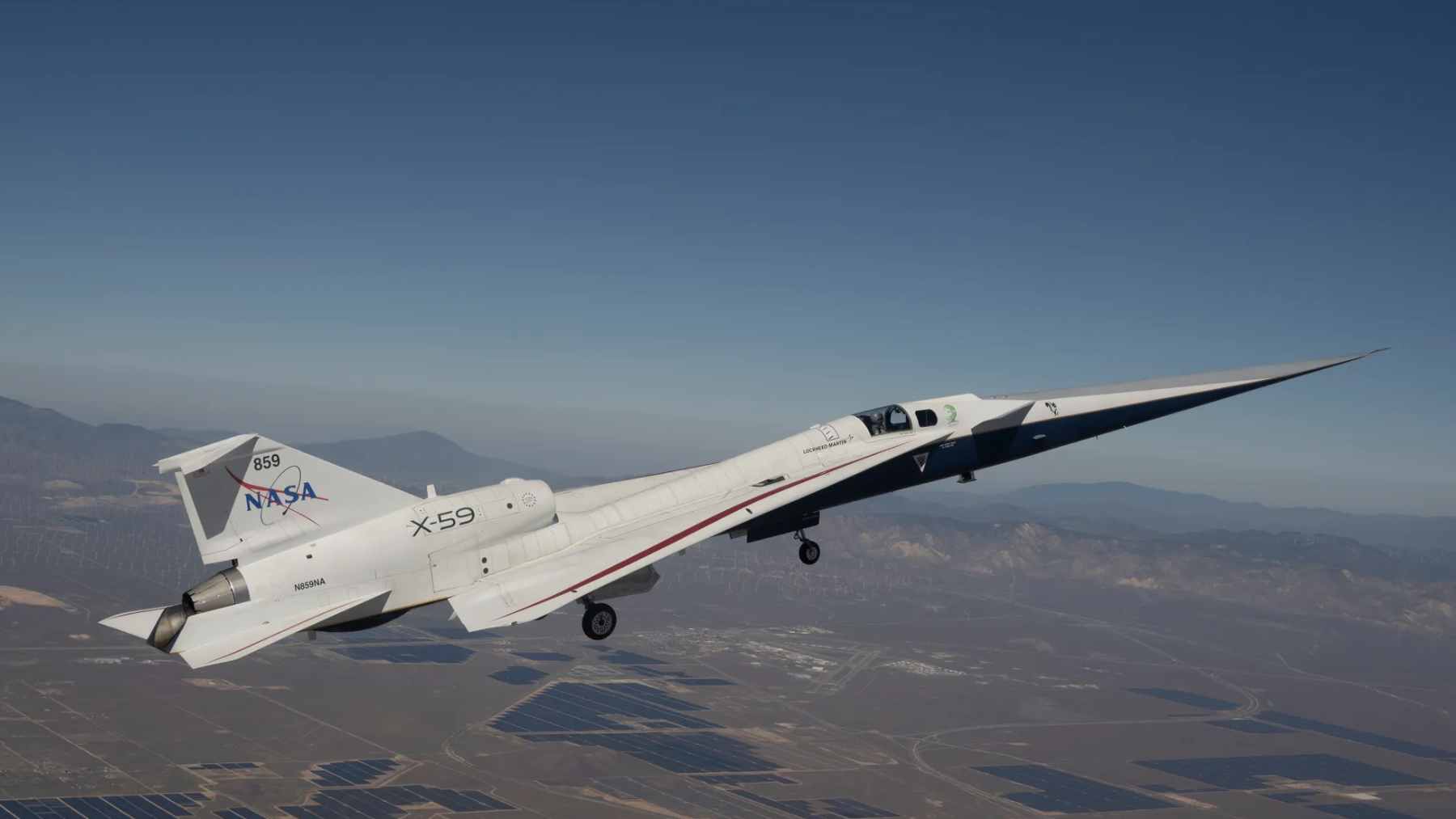
NASA is working on a different piece of the same puzzle with its X-59 quiet supersonic aircraft. On June 12, 2026, NASA said the X-59 reached Mach 1.4 at 55,000 ft., the speed and altitude planned for future community response flights that will measure reaction to a quieter sonic “thump.”
Sustainable fuel is not magic
Could cleaner fuel make the speed dream easier to accept? To a large extent, that depends on whether sustainable aviation fuel can scale far beyond today’s supply.
IATA says sustainable aviation fuel could provide up to 65% of the emissions reductions needed for aviation to reach net-zero carbon emissions by 2050. However, it also says 2026 global production is expected to be about 2.6 million tons, or just 0.8% of annual jet fuel consumption.
That gap is huge. At the end of the day, a Mach 5 passenger jet would have to prove not only that it can save time, but that the time saved is worth the fuel, money, noise, and environmental tradeoffs.
What happens next
Hermeus has already moved past the paper-airplane phase. The Mk 1 flew, the Mk 2.1 has gone supersonic, and the company says Mk 2.2 and Mk 2.3 are already part of the roadmap toward higher-speed regimes.
For now, the near-term prize is not a passenger cabin full of executives crossing the Atlantic in under an hour. It is reliable high-Mach flight data, followed by the harder step of proving that turbine-to-ramjet transition can work outside a test stand.
If that happens, aviation will face a very modern tradeoff. The same aircraft family that could shrink the map may also force regulators, investors, and travelers to ask what speed is really worth.
The official statement was published on Hermeus.