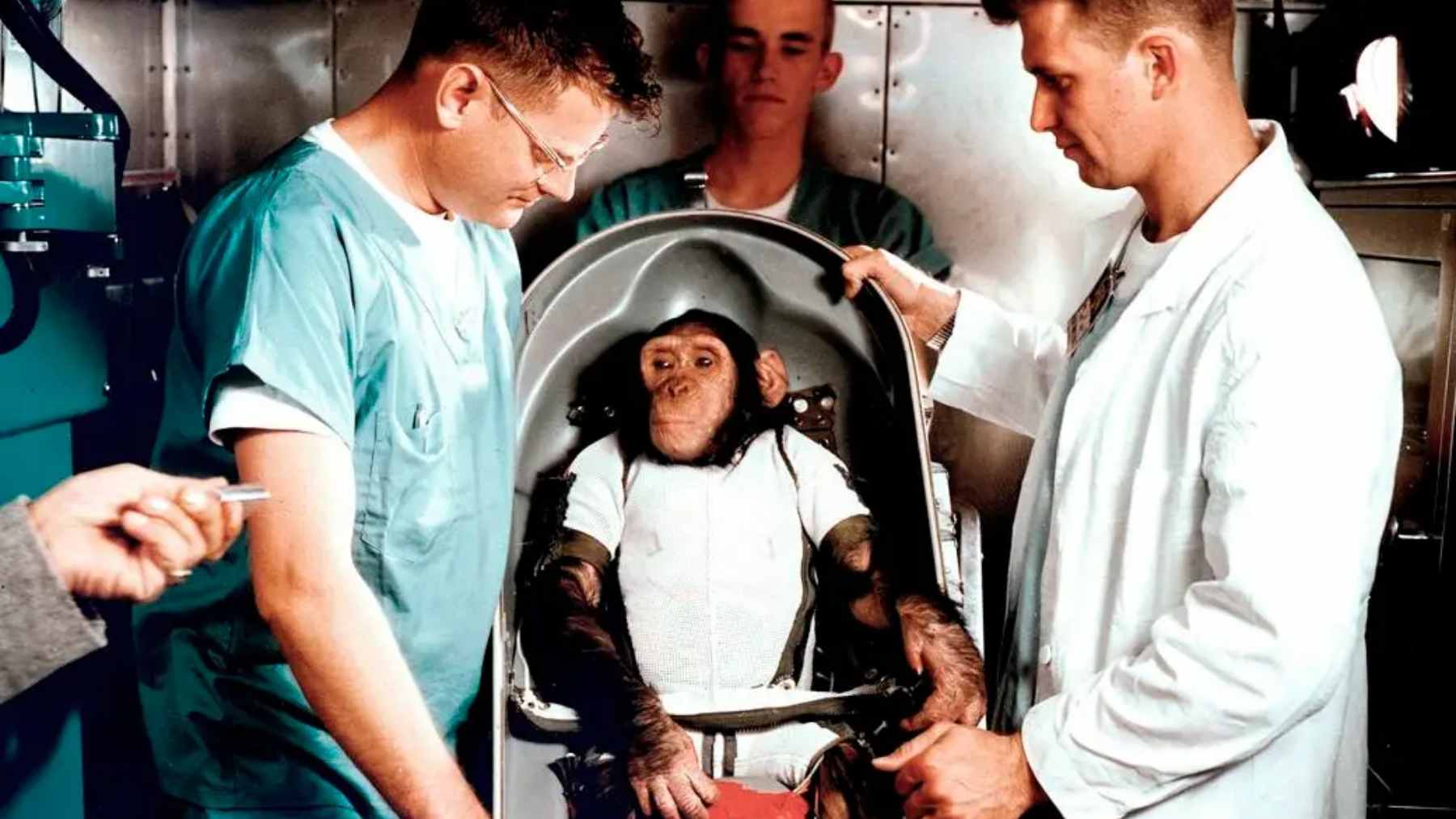
Before Alan Shepard became the first American in space, the United States sent up a much smaller passenger with no choice in the matter. His public name was “Number 65,” but after he survived the mission, the world learned his real name was Ham.
On Jan. 31, 1961, Ham rode a Mercury-Redstone rocket into space and returned alive. The flight helped NASA prove that a living being could function during launch, weightlessness, and reentry, but it also left behind a question that still matters in modern science. How much should animals be asked to carry for human progress?
A risky test before humans
Ham’s mission came at a tense moment in the space race. NASA wanted to know whether an astronaut could perform basic tasks in space if automatic systems failed, so the agency trained chimpanzees to respond to lights and sounds by pulling levers.
This was not just a ride in a capsule. Ham had to work during the flight, responding to signals while his body was pushed through acceleration, weightlessness, and reentry. In practical terms, NASA was testing both the spacecraft and the brain inside it.
The chimpanzees were rewarded with banana pellets when they responded correctly. If they failed to react in time, they received a mild shock to the soles of their feet, a detail that feels very different today than it likely did during the Cold War rush to space.
Who Ham really was
Ham was born in July 1957 in what was then the French Cameroons in West Africa. According to NASA’s account, he was brought to Holloman Air Force Base in New Mexico in 1959, after earlier passing through the exotic animal trade in the United States.
At Holloman, he became part of a group of chimpanzees selected for aerospace medical research. The Smithsonian National Air and Space Museum notes that “Number 65” was one of 40 chimps chosen for the space program and that his nickname came from the Holloman Aerospace Medical Center.
That naming detail matters. NASA did not initially present him to the public as Ham. For the most part, the number kept the story clinical, and it also made the risk easier to manage if the flight ended badly.
The flight went wrong
The original flight plan called for Ham’s capsule to reach 115 miles in altitude and speeds up to 4,400 mph. Instead, because of technical problems, the spacecraft reached 157 miles and 5,857 mph before landing 422 miles downrange rather than the expected 290 miles.
That’s a major difference. Imagine planning a rough car ride and getting a roller coaster instead, except the roller coaster is a rocket capsule dropping back through Earth’s atmosphere.
Ham still performed well. NASA says he experienced 6.6 minutes of weightlessness during a 16.5-minute flight, splashed down in the Atlantic Ocean, and was found slightly fatigued and dehydrated but otherwise in good shape.
Why NASA cared
The central finding was simple and powerful: Ham could still perform tasks in space, even during a flight that did not go as planned.
For NASA engineers, that was a turning point. His performance gave the Space Task Group more confidence that a human astronaut could survive a ballistic mission and still complete basic actions inside the spacecraft.
Just over three months later, on May 5, 1961, Alan Shepard flew America’s first human suborbital mission. Ham’s flight did not make that moment inevitable, but it helped clear one of the last major doubts before NASA put a person inside a Mercury capsule.
The welfare question
Today, Ham’s story lands differently. It is still a milestone in space history, but it is also a reminder that scientific breakthroughs often come with costs borne by animals that cannot consent.
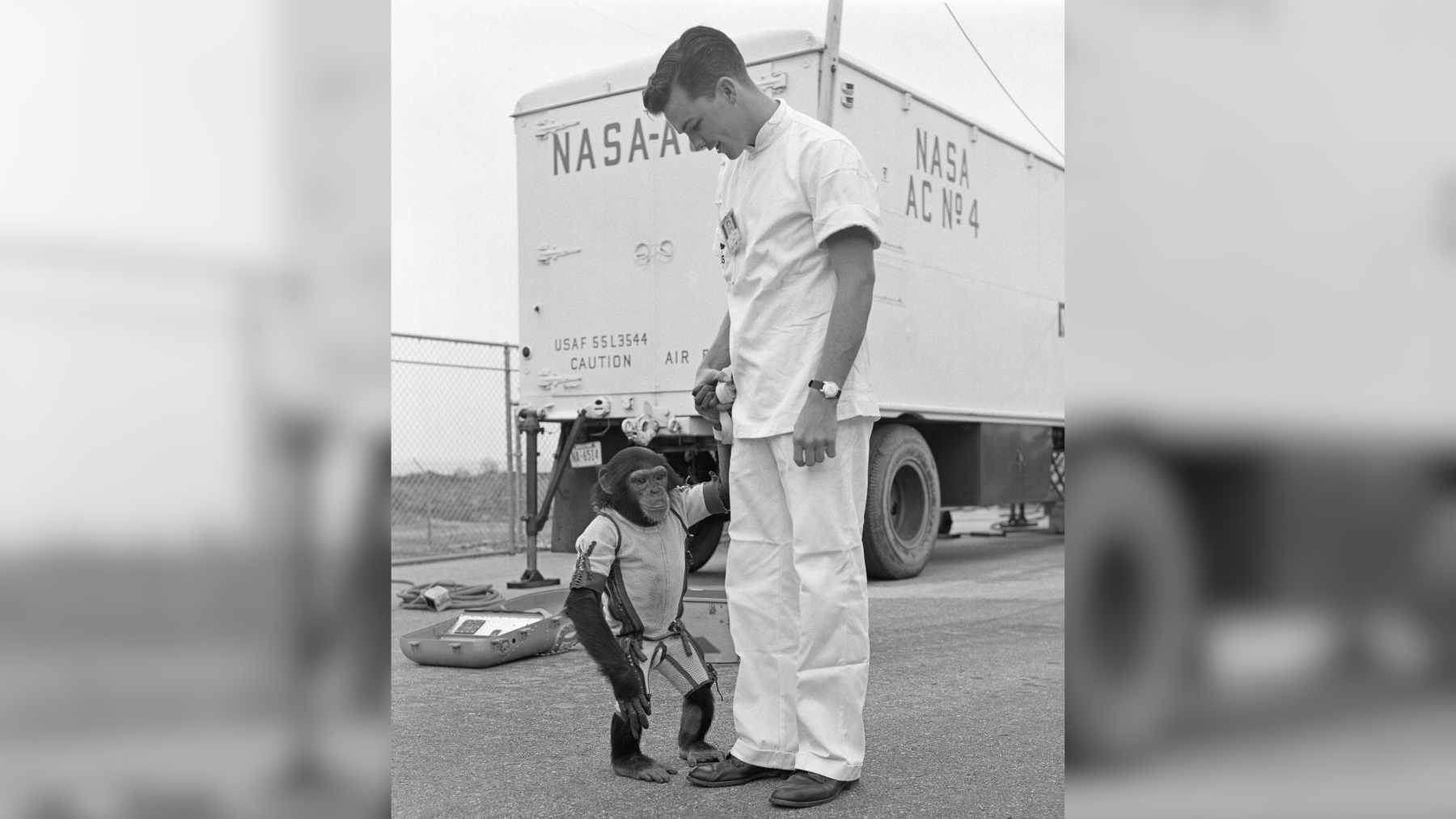
Modern NASA animal research is now governed by layers of oversight that did not exist in the same way in 1961. NASA says its Flight Institutional Animal Care and Use Committee oversees animal research in flight and space and that NASA-supported animal work must follow federal animal welfare laws, Public Health Service policy, and other care standards.
NASA’s current animal care directive also names “respect for life,” “societal benefit,” and “nonmaleficence” as key principles. It says animals should be used in the minimum number needed for valid science, and that models, simulations, and in-vitro systems should be considered whenever possible.
Chimpanzees and changing rules
The broader legal landscape has changed, too. In 2015, the U.S. Fish and Wildlife Service finalized a rule listing all chimpanzees, both wild and captive, as endangered under the Endangered Species Act. The agency said the change aligned captive chimpanzees with wild populations and restricted certain commercial activities.
The reason was not only laboratory ethics. Chimpanzees also face habitat loss, poaching, disease, deforestation, and pressure from expanding human settlements across parts of equatorial Africa. In other words, the question is not just what happens inside a lab, it is also what happens to the forests they come from.
That’s where Ham’s life becomes more than a space story. He was part of a technological race between superpowers, but he was also a young chimpanzee taken from a wild environment and placed into a human-made system built around risk, performance, and national ambition.
What happened after
Ham never flew again. NASA says he was later placed at the Washington Zoo in 1963, where he lived until 1980, before being moved to the North Carolina Zoological Park in Asheboro.
The National Museum of Health and Medicine says Ham died in January 1983 after chronic heart and liver disease. His skeleton became part of the museum’s collections, while his other remains were buried at the International Space Hall of Fame in Alamogordo, New Mexico.
It is a strange legacy–part hero story and part cautionary tale. Ham helped open the door to human spaceflight, but his life also shows why modern science now has to ask harder questions before it opens the next door.
The lesson today
Ham’s mission proved something NASA urgently needed to know in 1961. A living body, and a working mind, could survive spaceflight well enough to act.
But the way we remember him should be bigger than a handshake photo or a line in a space race timeline. He was not equipment, he was a living animal whose story connects technology, military ambition, animal welfare, and the natural world.
At the end of the day, that may be the real lesson. Progress matters, but so does the cost of getting there.
The official historical account was published on NASA.