Japan has moved a small but important piece of the hypersonic puzzle from theory into a test facility. A research team led by Waseda University with JAXA, the University of Tokyo and Keio University have completed Japan’s first Mach 5 combustion experiment using a hypersonic experimental aircraft at JAXA’s Kakuda Space Center in Miyagi Prefecture.
Why should anyone outside aerospace care? Well, this was not just a speed stunt. The test used a hydrogen-fueled ramjet, checked whether the vehicle could survive extreme heat, and gathered environmental data for future aircraft that could one day cross the Pacific in about two hours.
A Mach 5 test with a climate question
The experimental vehicle was only about 2 meters long (6.5 ft.), but the conditions around it were anything but small. Waseda University said the test simulated Mach 5 flight, about five times the speed of sound, roughly 5,400 km/h (3,355 mph).
At that speed, air does not simply flow around a vehicle. It slams into it, compresses, and heats up until the air around the aircraft can reach about 1,000°C (1,832°F). For anyone who has watched heat shimmer over an airport runway, this is that everyday idea pushed into much harsher conditions.
Why the ramjet matters
A ramjet is different from the jet engine most passengers know. NASA explains that a ramjet has no compressor, using the forward motion of the aircraft to ram air into the engine before combustion.
That makes the design lighter and simpler in some ways, but there is a catch. A ramjet cannot produce thrust while sitting still, so another system must first push the vehicle to high speed. NASA also notes that above Mach 5, conventional ramjets become very inefficient, which is why scramjet research becomes so important.
Heat is the real enemy
The Japanese test was not only about making combustion happen. The team also needed to prove that the aircraft’s shape, engine, heat protection, and steering surfaces could work together inside a brutal hypersonic flow.
That is where the project gets especially interesting. Waseda said the team designed a lightweight heat-resistant structure that combined thermal materials and insulation so onboard electronics could keep operating in the simulated Mach 5 environment. No electronics, no control; no control, no aircraft.
Cleaner fuel does not mean simple answers
Hydrogen is the big environmental hook here. JAXA says it is developing hydrogen fuel technologies for aircraft and future space transportation systems in a carbon-neutral society, and notes that a hydrogen aircraft would not emit carbon dioxide during operation.
The green promise comes with a few footnotes, however. ICAO has noted that hydrogen can eliminate in-flight CO2 emissions, while broader aviation climate impacts can still involve non-CO2 effects such as water vapor, nitrogen oxides, and contrails.
That’s why Waseda’s release specifically mentions measurements of exhaust temperature fields to study the environmental effects of a hydrogen-fueled ramjet.
The race is getting crowded
Japan is not working in a vacuum. In the United States, Hermeus is developing high-Mach and hypersonic aircraft, and says its Quarterhorse program is meant to unlock unmanned, high-speed flight step by step.
Still, Japan’s latest test should not be confused with a passenger jet ready for boarding. Waseda describes the next phase as a possible Mach 5-class flight experiment using a sounding rocket or similar vehicle. In practical terms, this is a foundation, not a launch schedule.
What comes next
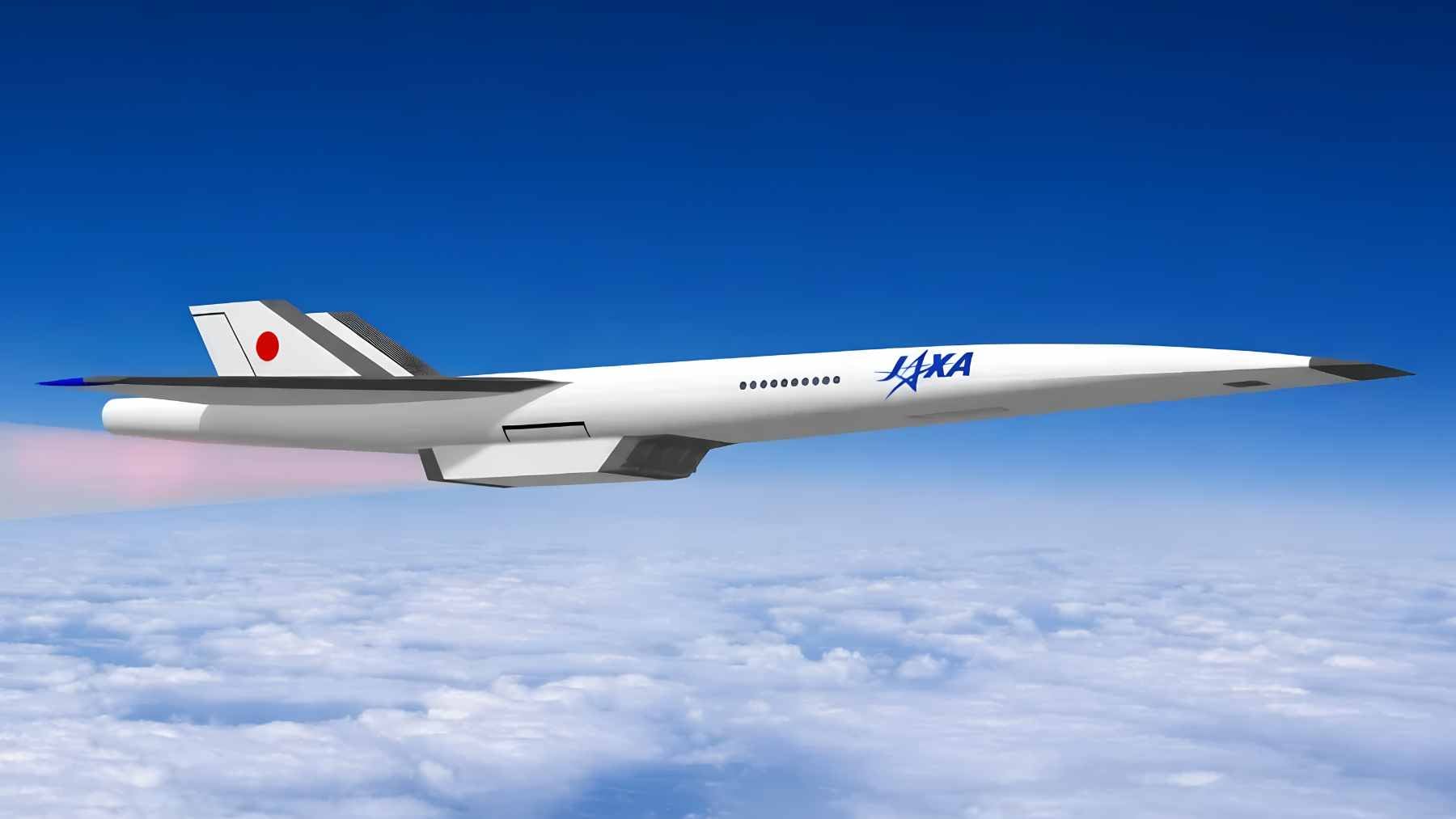
If the technology matures, JAXA and its partners see two big possibilities. One is a hypersonic passenger aircraft that could cross the Pacific in about two hours. The other is a spaceplane capable of reaching altitudes near 60 miles, around the edge of space.
For now, the most important takeaway is more grounded. Japan has shown that a small hydrogen ramjet test vehicle can burn fuel, manage heat, and collect useful data in simulated Mach 5 conditions, but that is not the end of the story. It is the part where the hard engineering starts to look a little less imaginary.
The press release was published on Waseda University.