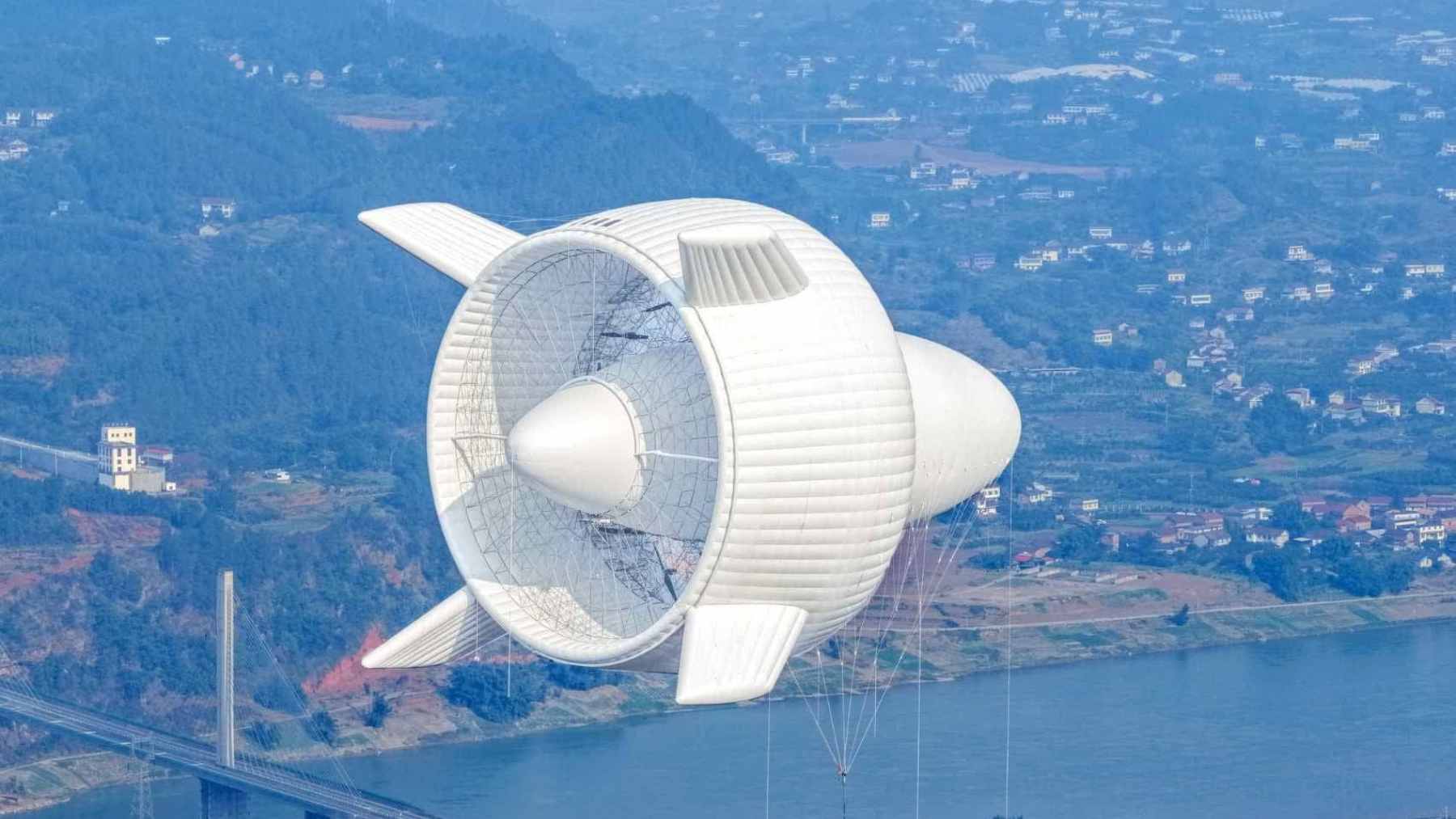
What if clean power could show up the way a cell tower does, fast, modular, and ready to plug in when a storm knocks out the lights? In early January, a blimp-like wind system called the S2000 Stratosphere Airborne Wind Energy System (SAWES) rose over Yibin in China’s Sichuan Province and sent electricity down a tether into the local grid.
The idea is easy to describe and hard to prove. By lifting turbines to about 2,000 meters where winds are typically stronger and steadier, the developer says it can deliver cleaner power with less steel and concrete. But turning one successful flight into something utilities, insurers, and air traffic regulators will trust is the real hurdle.
What actually flew over Sichuan
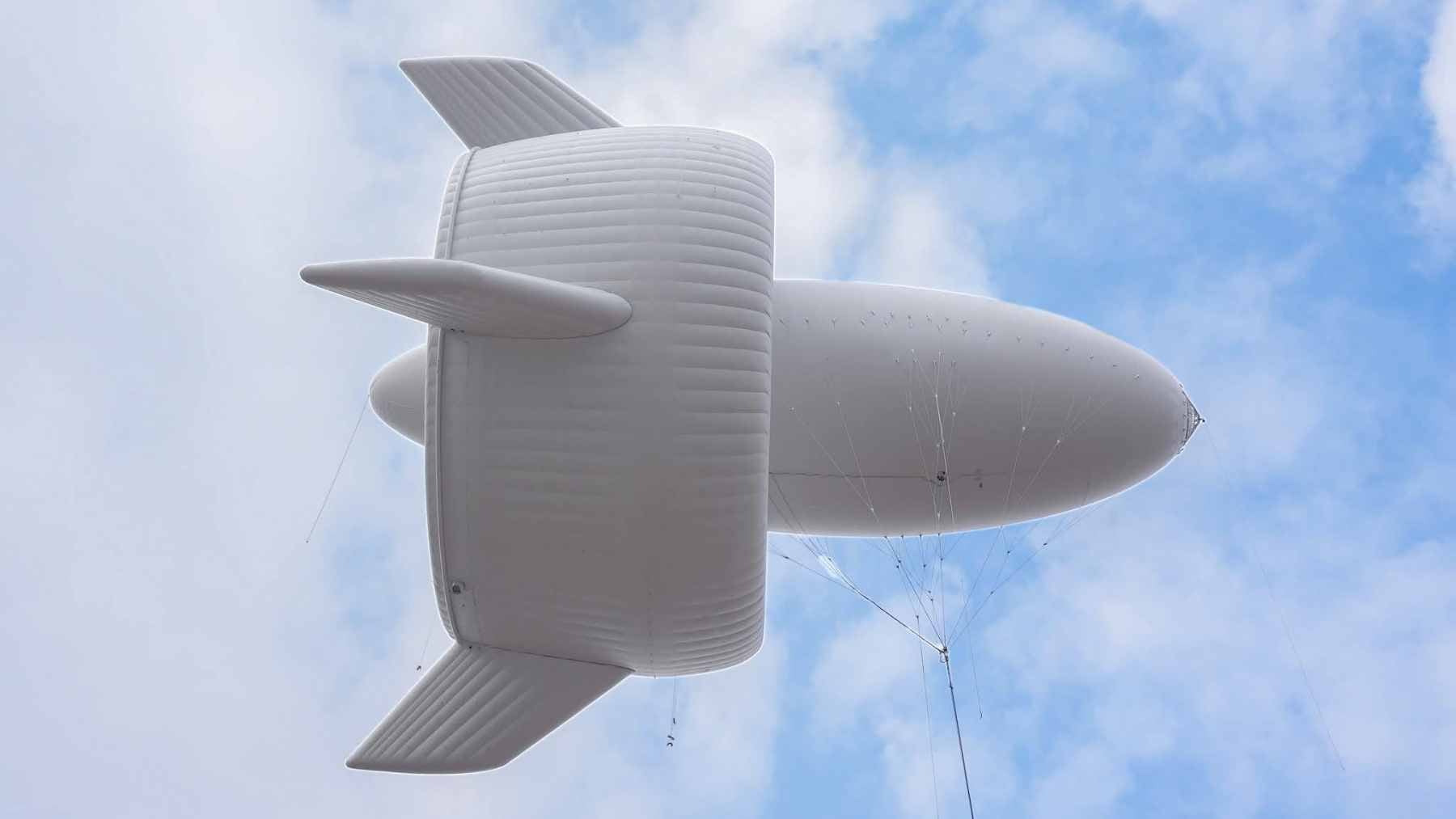
The S2000 looks like a giant white airship, about 60 meters long and 40 meters wide and tall, with turbines integrated into its body. In its test, it climbed for about 30 minutes, hovered around 2,000 meters, and generated 385 kilowatt-hours that were fed into the grid.
Engineers describe it as a hybrid of mature wind tech and an airborne platform. A helium-filled aerostat provides lift, and electricity travels back to the ground through the tethering cable, which also helps keep the system in position.
Company executives say the aerodynamic design supports a maximum rated output up to 3 megawatts. Chief designer Dun Tianrui also claimed that one hour of operation can fully charge about 30 “top-spec” electric vehicles, a catchy comparison that still needs long-run data behind it.
Why “wind above the skyline” keeps tempting investors
There is a physics reason this concept refuses to die. The energy available in wind rises with the cube of wind speed, so a stronger breeze at altitude can change output dramatically if the platform can stay up there safely.
Then there is the infrastructure angle, which matters for both emissions and budgets. The developer says the S2000 can be transported in standard containers and inflated on site in about eight hours, or four to five hours with local lifting gas.
The timing is not accidental, either. Wind power additions hit a record 165 gigawatts globally in 2025, which raises the bar for any new entrant claiming lower costs.
The business case hinges on the boring details
China is not short on conventional wind turbines. Official data cited in Chinese media put the country’s installed wind capacity at about 600 million kilowatts by the end of November 2025 and about 660 million kilowatts by the end of March 2026.
That matters because SAWES is not competing against “no wind,” it is competing against a mature industry with falling costs and established supply chains. Wang Yanan, editor-in-chief of Aerospace Knowledge magazine, put the challenge plainly, the costs of building, deploying, retrieving, and transmitting power must be covered by the electricity produced.
Early business signals are real, though still small compared with utility-scale wind farms. A February update from Beijing’s Dongcheng District described the company as having nearly RMB 500 million ($73 million) in orders for its S1500 and S2000 platforms, and it says small-batch production is underway.
Cleaner power also brings new environmental questions
On paper, lifting generation into the air can reduce land disturbance. Fewer roads and less excavation can mean fewer local habitat impacts in places where building tall towers is politically or geographically difficult.
But the sky is not an empty workplace. A 2,000-meter tether demands controlled airspace, and large airborne systems raise practical questions about lightning, storms, maintenance, and what happens if a retrieval goes wrong.
There is also the supply chain question. Some coverage has pointed to helium availability and cost as a possible bottleneck, so “green” performance may depend on materials choices that do not show up in a one-day flight test.
Why defense planners and disaster teams are watching
The S2000 pitch is not only about decarbonization, it is about energy access. The company has pointed to off-grid settings like “border outposts” and to complementing traditional wind farms with a layered approach that adds power from higher altitudes.
That logic maps neatly onto disaster response, too. When roads are blocked and fuel deliveries slow to a crawl, a quickly deployed renewable source could help keep critical services running.
Still, a flying power plant is also a high-value target and a regulatory headache. If this tech scales, expect debates about airspace rules, grid cybersecurity, and how to protect critical clean energy assets during crises.
The next milestone is not higher, it is longer
Airborne wind energy has a long history of promising prototypes that never turned into everyday infrastructure. Even New Atlas notes that earlier efforts, including Google-backed Makani, struggled to move past the prototype stage or prove commercial viability.
So the next proof point is months of operational data, not another dramatic launch video. Capacity factor, downtime, maintenance cycles, grid integration, and real delivered cost per kilowatt-hour will decide whether “wind above the skyline” becomes a niche tool or a mainstream option. If those numbers hold up, the payoff could be huge as more of daily life goes electric.
The official statement was published on Beijing Dongcheng official release.