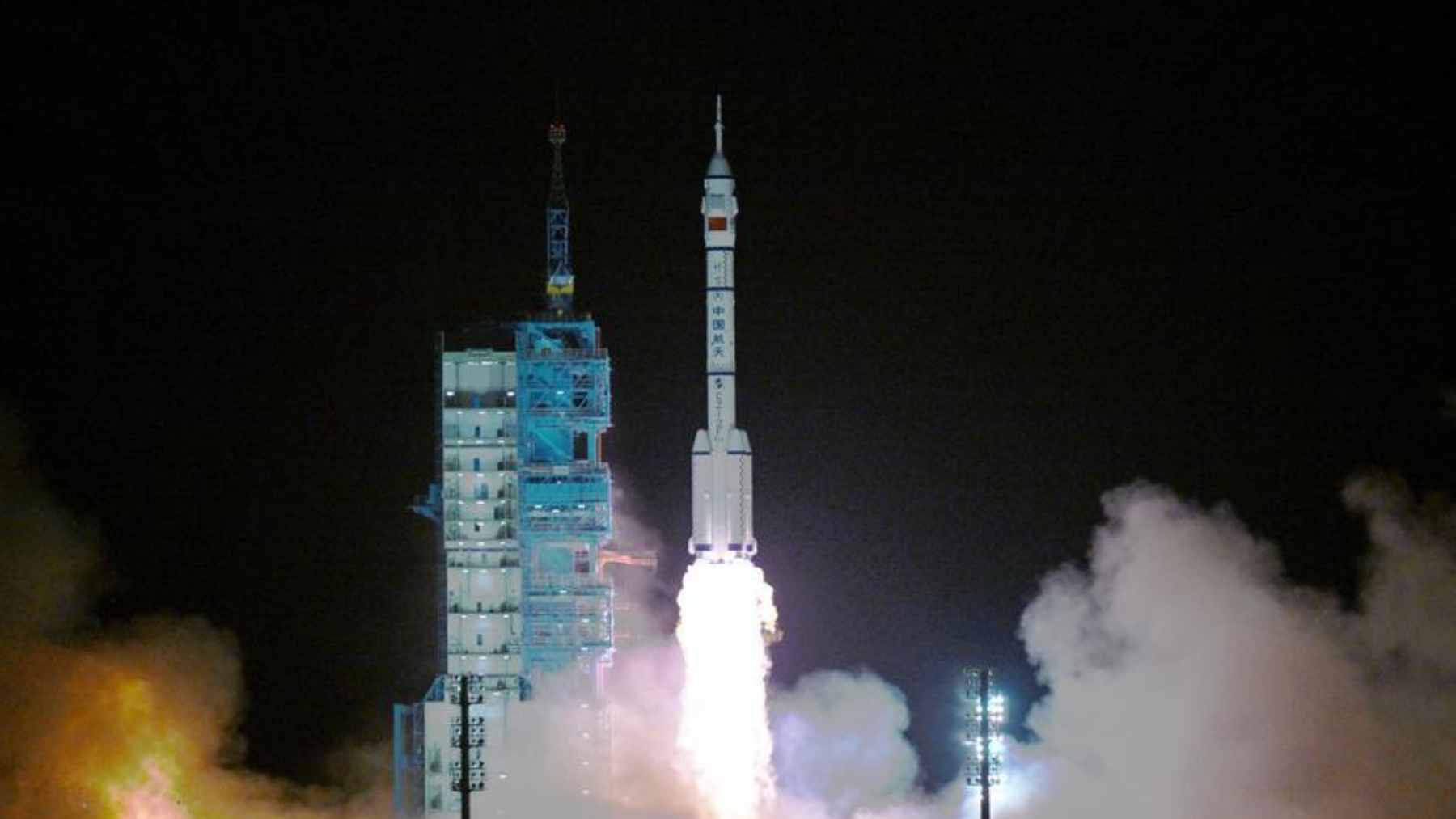
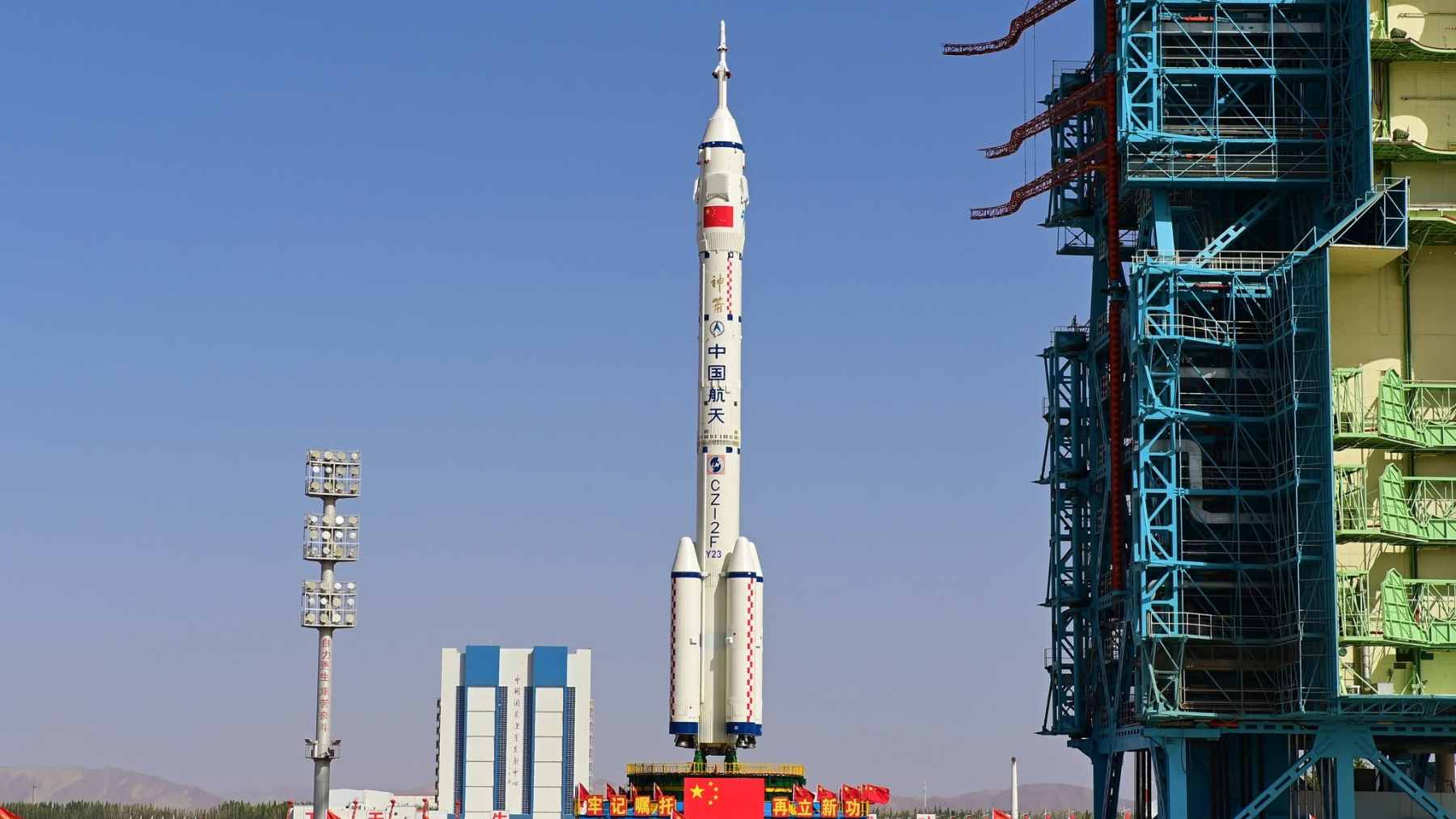
China’s Shenzhou-23 mission is not a Moon landing, but it may be one of the rehearsals that decides whether Beijing can get there before 2030. The crewed spacecraft launched from the Jiuquan Satellite Launch Center on May 24 aboard a Long March-2F rocket, then docked with the Tiangong space station about 3.5 hours later.
The eye-catching part is simple. One of the three astronauts is expected to stay in orbit for about a full year, which would set a new national record for China and give its space program valuable data on how people, machines, and life-support systems behave when a mission stops feeling like a trip and starts feeling like a way of life.
A new crew reaches Tiangong
The Shenzhou-23 crew includes commander Zhu Yangzhu, spacecraft pilot Zhang Zhiyuan, and payload specialist Lai Ka-ying, also identified in Mandarin as Li Jiaying. Zhu previously flew on Shenzhou-16, while Zhang and Lai are making their first trips to space.
Lai’s presence also gives the mission a historic note. She is the first astronaut from Hong Kong to fly into space, a milestone that China is presenting as both a scientific and symbolic step for its space program.
After docking, the new arrivals began the handover with the Shenzhou-21 crew already aboard Tiangong. That kind of orbital relay may sound routine, but it is exactly the kind of choreography a country needs to master before sending crews farther away from Earth.
A full year in orbit
China is not about to break the world record for the longest single human spaceflight. NASA astronaut Frank Rubio spent 371 days in orbit, Russian cosmonaut Valeri Polyakov still holds the single-mission record at more than 437 days, and Oleg Kononenko holds the cumulative record with about 1,111 days in space.
So what is the point? For China, the milestone is less about beating everyone else and more about proving that Tiangong can support longer, more demanding missions. China Manned Space Agency (CMSA) spokesperson Zhang Jingbo said the year-long resident will be chosen based on how the mission unfolds in orbit.
Zhang also warned that “assigning an astronaut to a one-year in-orbit stay is not simply doubling” a six-month mission. In everyday terms, it is the difference between camping for a weekend and living out of a cabin through every season.
Science with a practical edge
The crew is expected to carry out more than 100 science and application projects aboard Tiangong. These experiments span space life science, materials science, microgravity fluid physics, aerospace medicine, and new space technologies.
Some of the work sounds futuristic, but it has a very practical core. Researchers plan to study zebrafish and mouse embryos, stem cell-derived “artificial embryos,” and rice seeds grown across two consecutive generations in orbit. The big question is how microgravity and radiation reshape life over time.
The station will also test perovskite solar cells under real space conditions. That may matter far beyond one spacecraft, because lightweight, efficient solar systems are central to satellites, deep-space missions, and any future lunar base that needs steady power without constant resupply.
The Moon is the real prize
At the end of the day, Shenzhou-23 is part of a bigger race. China has repeatedly said it wants to land astronauts on the Moon before 2030, and its space station is becoming the training ground for that goal.
The country is also tying together its robotic Chang’e lunar work and its human spaceflight program through a broader Lunar Exploration Program. Officials have pointed to future tests of the Long March-10 rocket, the Mengzhou crewed spacecraft, and the Lanyue lunar lander as key pieces of that plan.
That is where the long stay matters. A Moon mission is not just about launching a rocket, planting a flag, and coming home. It is about keeping people healthy, power systems stable, equipment protected, and crews calm when Earth is no longer right outside the window.
Why this matters on Earth
There is also an environmental angle hiding in the hardware. Tianzhou-10, the cargo craft that supplied Tiangong ahead of Shenzhou-23 and Shenzhou-24 operations, delivered about 6.8 tons of supplies, including flexible solar cells and a greenhouse gas monitoring instrument.
That monitor is designed to track carbon dioxide and methane across global mid and low-latitudes. For the most part, these tools are not meant for a family rooftop or a backyard weather station, but they can feed into better ways to observe emissions from above.
Space programs often look distant from daily life. But power storage, solar efficiency, materials research, and emissions monitoring are all areas where hard lessons learned in orbit can eventually matter closer to home.
What happens next
The Shenzhou-23 astronauts are expected to conduct spacewalks, transfer cargo, and install or retrieve equipment outside the station. The longest part of the story, though, will unfold quietly, day after day, as one crew member pushes China’s human spaceflight endurance further than ever before.
Will that be enough to help China reach the Moon before 2030? Not by itself, but it is another piece of the machine, and right now, that machine is moving with purpose.
The official statement was published on Qiushi Theory, citing Xinhua and the China Manned Space Agency.