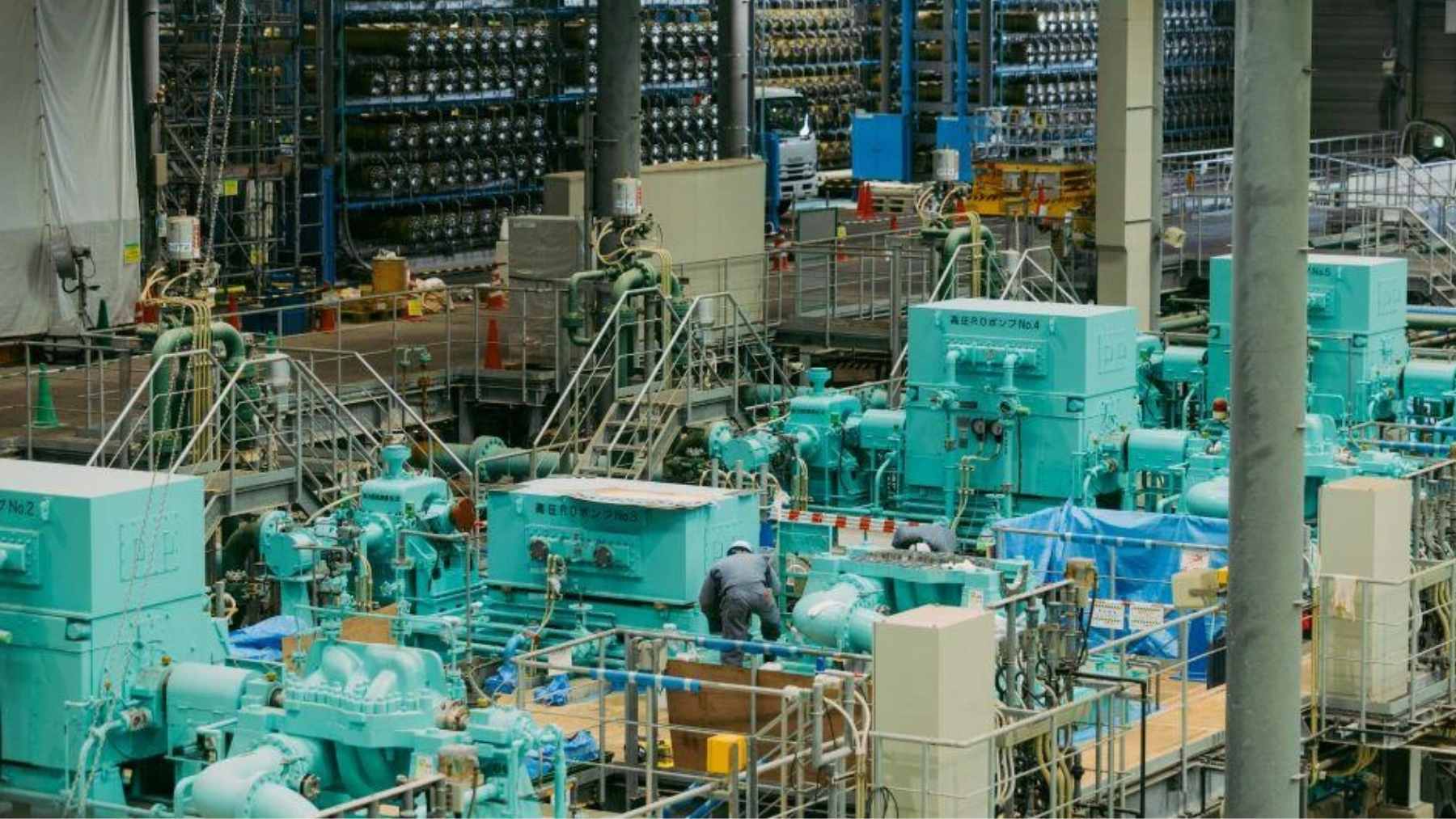
A small plant in Fukuoka, Japan, is doing something that sounds almost like a classroom science trick. It is making electricity from the space between salty water and cleaner water, using a natural force that usually works quietly inside trees, cells, and the human body.
The facility began operating at the Uminonakamichi Nata Seawater Desalination Center, known as Mamizupia, on August 5, 2025. It is Japan’s first practical osmotic power plant and only the second of its kind in the world, following Denmark’s SaltPower project.
The big lesson is simple: this is not a giant power station, but it may show coastal cities a new way to squeeze clean energy out of infrastructure they already have.
Power from a salt gap
Osmotic power works because water naturally moves from a less salty solution toward a saltier one when the two are separated by a special membrane. That movement builds pressure on the salty side, and if engineers route that pressure through a turbine, it can spin a generator–easy to picture.
In Fukuoka, the salty side is not ordinary seawater. The plant uses concentrated brine left over after desalination, which JapanGov says is about 8% salt, more than twice the salt content of regular seawater. The other stream is treated wastewater from a nearby sewage plant, so the system puts two previously underused waste flows to work.
That detail matters. The wider the salt gap, the more energy is available, at least in theory. In practical terms, Japan is not just testing a new renewable power source, it is testing whether desalination plants and wastewater systems can be connected like pieces of one cleaner machine.
A modest plant with one big advantage
The numbers are not huge, but they are important. Kyowakiden Industry, one of the project partners, says the facility has a net power output of about 110 kilowatts and can generate up to 880,000 kilowatt-hours per year. JapanGov says that is enough electricity for about 300 average households.
So no, this plant will not light up Tokyo, but it has one feature solar panels and wind turbines cannot promise on their own. It can run day and night, almost regardless of weather, with JapanGov placing its utilization rate at around 90%. That is the part grid planners will notice.
Think about the energy habits of everyday life. Phones charge overnight, water plants run before dawn, and data centers do not sleep when clouds roll in. A steady trickle of clean power can be more useful than it looks on paper.
Why Fukuoka needed this
Fukuoka is a good place to try this because the region has long had water supply challenges. JapanGov notes that Mamizupia has served the Greater Fukuoka metropolitan area since 2005 and can produce about 13.2 million gallons of freshwater per day, enough for roughly 250,000 people.
Desalination solves one problem, but it creates another. After freshwater is removed from seawater, concentrated brine remains. JapanGov says Mamizupia had already been mixing that brine with discharge from a nearby sewage processing plant before release, partly because dumping concentrated seawater directly could harm marine ecosystems.
That is where the new plant changes the story. Instead of treating those two streams only as waste, Fukuoka uses their difference in salinity as an energy source. It is a small shift, but a clever one.
Norway tried first and walked away
There is a catch, of course. Osmotic power has been promising for decades, and promise alone does not pay electric bills.
Norwegian utility Statkraft opened a prototype osmotic power facility at Tofte, near Oslo, in 2009 after years of research. Then in December 2013, the company said it would stop developing the technology because it was “not sufficiently developed to become competitive within the foreseeable future.”
That warning still hangs over every new osmotic project. The physics works, but the economics are harder. A 2021 analysis in ACS ES&T Engineering estimated the median cost of salinity-gradient power using seawater at about $2.37 per kilowatt-hour under realistic assumptions, which is far above what most power markets can easily absorb.
Membranes are the real battleground
The heart of this technology is the membrane. It must let water pass through while blocking salt and other materials, and it has to do that under pressure, for long periods, without costing too much. That is a lot to ask from a thin barrier.
Toyobo says its forward-osmosis membranes are used in Denmark’s SaltPower plant, which was built at Nobian’s saltworks and designed around brine with a much higher salt concentration than seawater. Nobian says that stronger brine improves the economics compared with ordinary seawater, and that point helps explain why Fukuoka’s use of desalination brine is so important.
At the end of the day, Fukuoka is not trying to beat solar farms on price tomorrow morning. It is trying to prove that a plant already making drinking water can recover some energy from a process that used to end with discharge pipes.
What comes next
The future depends on whether membranes get cheaper, tougher, and more efficient. Hirokawa Kenji, who heads Mamizupia for the Fukuoka District Waterworks Agency’s Facilities Department, said the long-term hope is to make osmotic power work with ordinary, non-concentrated seawater. That would open the door far wider.
For now, the most realistic early markets may be places with the right ingredients already sitting side by side. Desalination plants, sewage treatment facilities, saltworks, and industrial brine streams could all matter.
The Middle East is one obvious target because of its heavy use of desalination, and JapanGov says project officials see strong potential there.
Still, expectations should stay grounded. This is a demonstration of useful clean energy, not a miracle machine, but sometimes the next chapter in renewable power does not arrive as a giant turbine on a hill or a glittering solar farm in the desert. Sometimes it shows up inside a water plant, quietly turning waste streams into electricity.
The official statement was published on JapanGov.