A hidden tunnel under a road or railway is not the kind of danger most drivers think about on the morning commute. Yet underground voids can weaken soil, shift loads, and create silent risks that may only become obvious when pavement cracks, tracks move, or the ground starts to fail.
Now, researchers at the Department of Energy’s Oak Ridge National Laboratory in Tennessee have demonstrated a new way to look for those buried structures.
Instead of sending signals down from the surface, the team sent acoustic energy upward from below and detected a distinctive low-frequency response that appeared only when a tunnel was present.
A blind spot under infrastructure
For decades, engineers have searched for hidden underground structures by transmitting signals from the surface into the ground. That sounds simple enough, but soil is messy, especially when clay, water, rock, old utilities, and construction debris are all part of the underground picture.
Ground-penetrating radar, seismic surveys, and electrical resistivity can all help, but ORNL notes that these tools have limits in clay-rich or complex subsurface environments. In practical terms, a dangerous void can sometimes sit beneath a road, rail line, or facility without being easy to spot from above.
That is where this new approach gets interesting. “Our hypothesis was that if we reversed direction, sending the signal from below a potential tunnel instead of above, we could improve detection by capturing signal scatter that otherwise is lost,” said ORNL lead researcher Mike Kass.
How the test worked
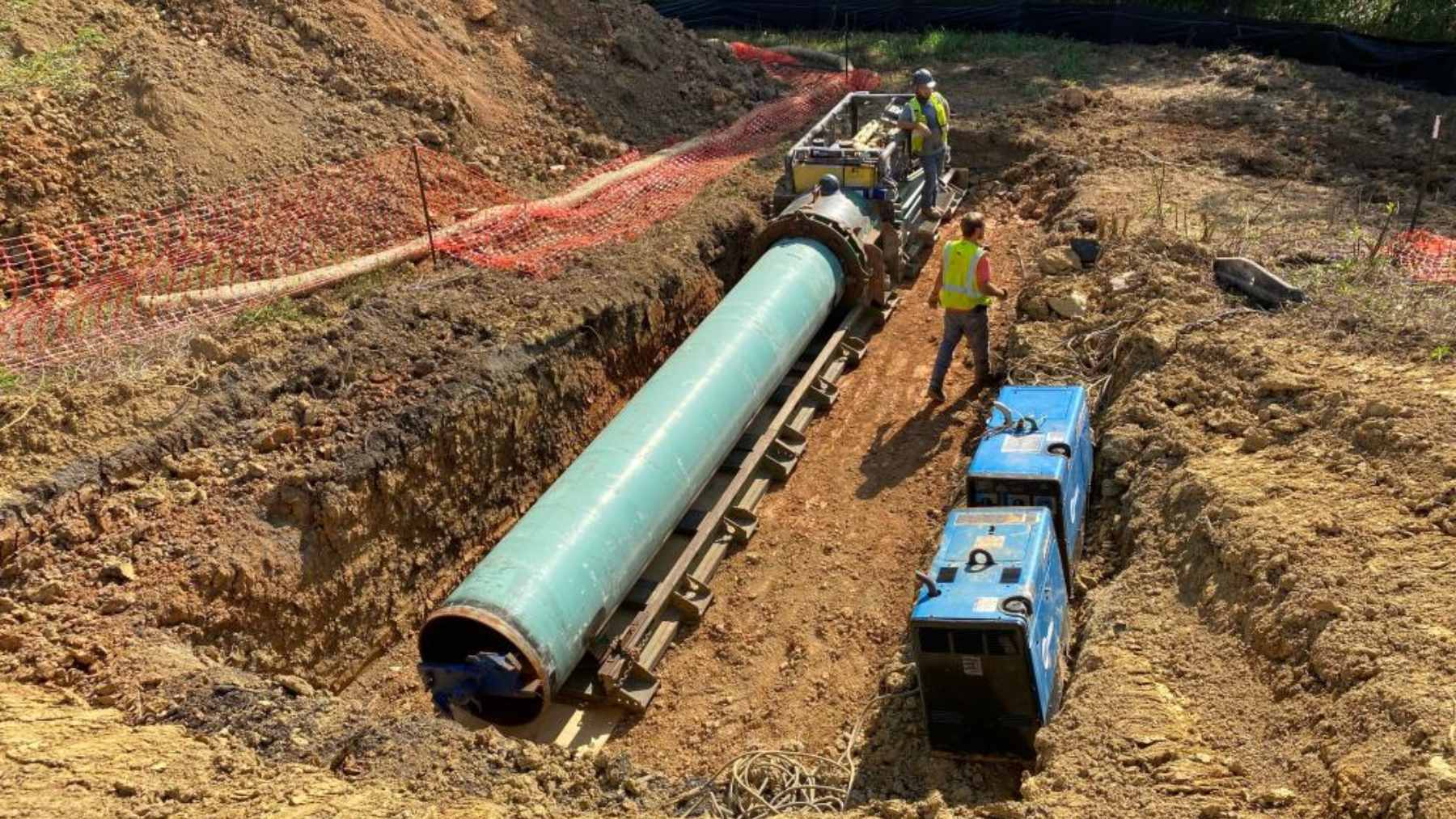
For the field experiment, the ORNL team built a 40-ft.-long steel tunnel roughly 10 ft. below the surface on the laboratory’s campus. Through vertical boreholes, researchers placed an acoustic sound source as deep as 30 ft. underground.
On the surface, they used geophones, which are sensitive vibration sensors, to listen for how sound moved through the ground. The team compared measurements taken before and after the tunnel was installed, giving them a clearer way to separate ordinary ground response from the signature of the hidden structure.
“During testing, the geophones detected a distinct subharmonic signal,” said ORNL’s Charles Finney, a senior research and development researcher. “Subsequent measurements showed the signal consistently appeared only when the tunnel was present and only when the sound originated beneath it.”
Why the signal matters
The key detail is the subharmonic signal, a lower-frequency response created when sound waves bend around the tunnel. Think of it like hearing an echo from an unexpected corner of a room. The sound is not just traveling straight ahead, it is being shaped by what it encounters.
Surface-based methods often face a trade-off. Higher-frequency signals can pick up smaller features, but they fade quickly underground. Lower-frequency signals travel farther, but they can miss finer details.
By moving the acoustic source below the target, the ORNL team tried to catch signal scattering that surface methods may lose. The DOE technical report says the work adapts vertical seismic profiling to acoustic-range frequencies and describes this as a novel tunnel detection approach.
Roads, railways, and security
The public-facing concern is easy to understand. Nobody wants hidden ground movement beneath a bridge approach, a rail corridor, or a busy highway. Even a small void can become a serious engineering problem if it affects how weight is carried through the soil.
There is also a national security angle, though it should not be overstated. ORNL frames the work as a way to identify man-made underground structures that could threaten transportation and critical infrastructure, and the laboratory lists national security among the science areas connected to the work.
For infrastructure managers, the value would be practical. A more reliable underground scan could help crews decide where to dig, where to reinforce, and where to keep watching. Less guesswork matters when every excavation can disrupt traffic, budgets, and the ground itself.
The environmental side
There is an environmental story here, too, even if ORNL is careful not to oversell it. Better subsurface detection can help engineers understand what is happening underground before they disturb more land than necessary.
Road and rail work often means heavy equipment, lane closures, material use, and soil disturbance. A tool that narrows the search area could, to a large extent, support more targeted investigations. That does not make it a silver bullet, but it could become one more instrument in the toolbox.
At the end of the day, protecting infrastructure is also about protecting the places around it. When roads collapse or rail beds shift, the damage can spill into nearby neighborhoods, waterways, and work sites. Prevention is rarely flashy, but it is often cheaper and cleaner than repair.
What comes next
The researchers are not claiming that the method is ready to map every hidden tunnel in the country. The DOE technical report says the study confirms improved detectability, but accurate localization and imaging still require more research.
That next step matters. The ORNL team plans to test different soil types, refine signal analysis, and study whether timing and signal strength can produce more detailed underground images. Clay on a test site is one thing. The real world is much less polite.
Still, the early result is promising. By flipping the direction of the signal, researchers may have opened a new path for finding hidden underground structures before they become public hazards.
The official statement was published on Oak Ridge National Laboratory.