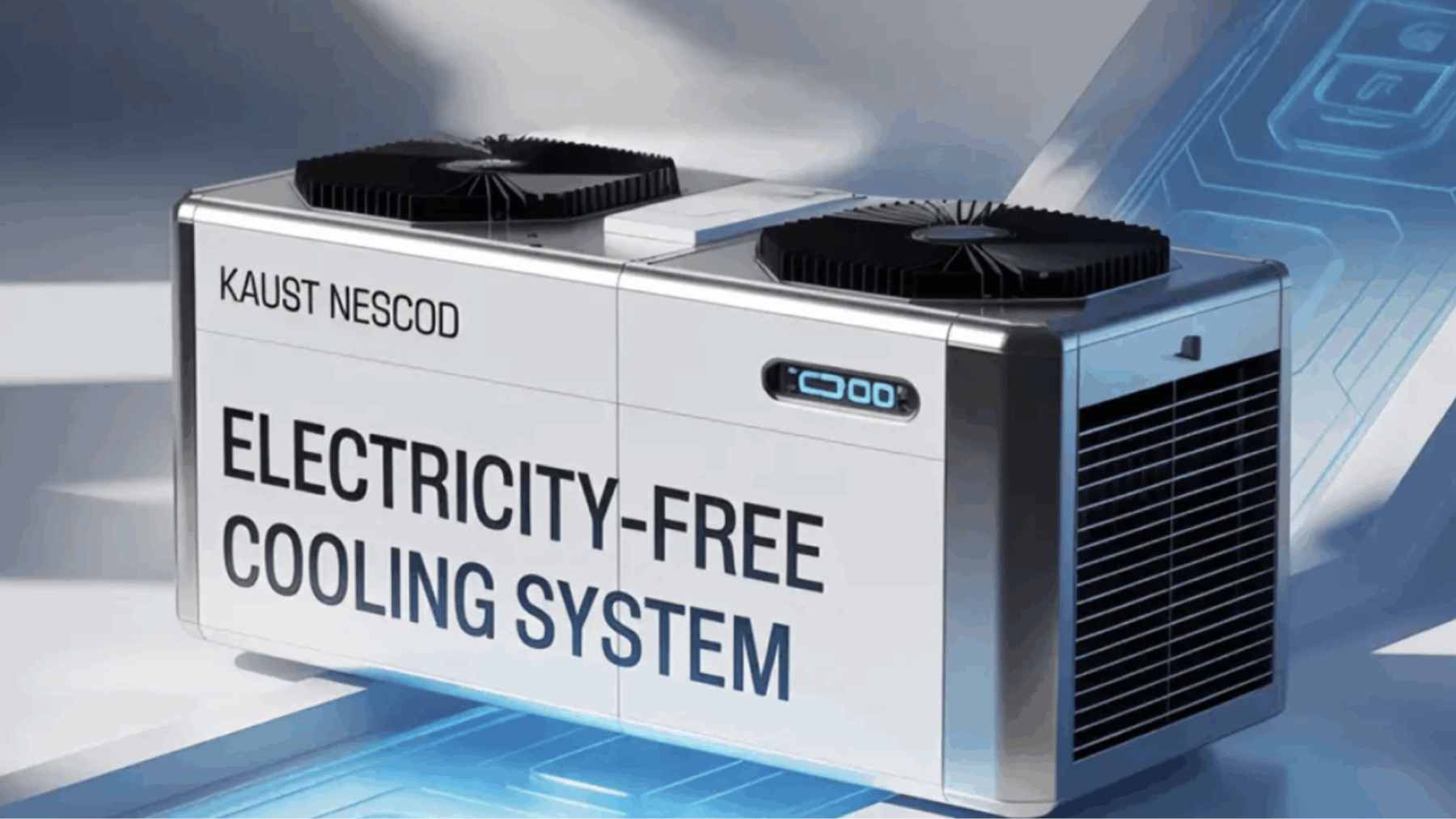
As heat waves push more households toward air conditioning, a team of researchers in Saudi Arabia has developed a cooling system that works without a single plug in the wall. The device is called NESCOD, short for no electricity and sustainable cooling on demand, and it uses salt, water, and sunlight instead of compressors or grid power.
It is still a research concept, but the idea is big enough to make engineers take notice.
The team at King Abdullah University of Science and Technology built the system around a simple chemical trick. When ammonium nitrate dissolves in water, it absorbs heat from its surroundings, creating a cooling effect that can be stored and released when needed. Then sunlight helps recover the salt so it can be used again.
Why cooling needs a reset
Cooling is becoming one of the quiet pressure points of the climate era. The International Energy Agency says space cooling is the fastest growing source of building energy demand, rising almost 4% a year through 2035 under current policies.
Its earlier Future of Cooling report warned that, without stronger efficiency action, space cooling energy demand could more than triple by 2050.
That matters because air conditioning is not just about comfort anymore. It protects food, vaccines, computers, farm yields, and people working through extreme heat. But what happens when the communities that need cooling most have weak grids, high energy costs, or no reliable electricity at all?
The World Bank and partner agencies estimated that more than 666 million people still lacked electricity in 2023. For those households, a conventional air conditioner is not an option, even if heat is becoming more dangerous. That is where a passive cooling device starts to look less like a clever lab project and more like a public health tool.
How the Saudi system works
NESCOD has two main steps. First, the salt dissolves in water and pulls heat out of the area being cooled. In practical terms, it behaves a little like the cold sensation people feel when something evaporates off their skin, although the science is different.
Second, the used salt solution is exposed to sunlight in a specially designed solar regenerator. The water evaporates, the ammonium nitrate crystallizes again, and the salt becomes ready for another cooling cycle. The study says this separation of cooling and regeneration could allow the stored cooling effect to be used later, even across seasons.
There are no fans, no high-pressure compressor, and no moving mechanical parts in the basic concept. KAUST described the system as having no electrical components, while the study called it a fully passive design. That simplicity is the whole point.
The numbers are hard to ignore
In KAUST’s food storage test, the temperature inside a metal cup placed in a foam box fell from room temperature to about 38.5°F. More importantly, it stayed below 59°F for more than 15 hours, which is the kind of range that matters for food and some temperature-sensitive supplies.
The study calculated that NESCOD could reach up to about 17.8 watts of cooling power per square foot under one-sun illumination.
During regeneration, the solar device stabilized near 0.45 pounds of water evaporation per square foot per hour, while the solute regeneration rate reached about 0.94 pounds per square foot per hour. Those are lab numbers, but they show the system is not just symbolic.
The researchers also found that ammonium nitrate outperformed the other tested salts. KAUST said its cooling power was more than four times greater than ammonium chloride, helped by its unusually high solubility.
In plain English, more of it can dissolve, and that lets the system absorb more heat.
A climate tool for hot places
Saudi Arabia is a fitting place for this kind of invention. KAUST noted in 2025 that air conditioning is estimated to consume about half of the Kingdom’s electricity demand, a level that shows how deeply cooling is tied to energy planning in desert economies. Hot countries do not just need more cooling, they need smarter cooling.
One of the most interesting parts of NESCOD is that it turns harsh sunlight into an asset. Wenbin Wang, a postdoctoral researcher in Peng Wang’s lab, put it simply when he said, “Hot regions have high levels of solar energy, so it would be very attractive to use that solar energy for cooling.”
That sentence gets to the heart of the project. The same sun that makes rooms unbearable can help reset the salt for the next cooling cycle. It is a neat loop, and in very hot places, neat loops can matter.
What it could actually be used for
NESCOD is not being presented as a drop-in replacement for a whole-house air conditioner, at least not yet. The more realistic first uses are targeted cooling, such as food storage, small indoor zones, beds, medicine boxes, emergency shelters, and off-grid buildings.
The study even points to building cooling as a possible application, with the solar regenerator installed on a roof and the cooling unit placed indoors. That picture is easy to imagine, a rooftop device quietly recharging the material while a room or storage box stays cooler later in the day.
Still, there are questions. Ammonium nitrate is widely used as fertilizer, but any real-world product would need safe handling, clear rules, and durable packaging. The science looks promising, but turning it into everyday hardware is a different challenge.
The catch and the promise
The biggest promise is not that NESCOD will make electric cooling disappear. It will not. Modern cities, hospitals, and data centers will still rely heavily on powered refrigeration and air conditioning.
The bigger point is choice. If a low-cost, passive system can protect food, medicine, or sleeping spaces without drawing from the grid, it could reduce pressure on power systems and offer basic cooling where conventional equipment is out of reach. That is not a small thing.
At the end of the day, this Saudi invention shows that the future of cooling may not only be bigger air conditioners. Sometimes, it may be a smarter use of chemistry, sunlight, and a material that can be cycled again and again.
The study was published on the Royal Society of Chemistry’s Energy & Environmental Science site.