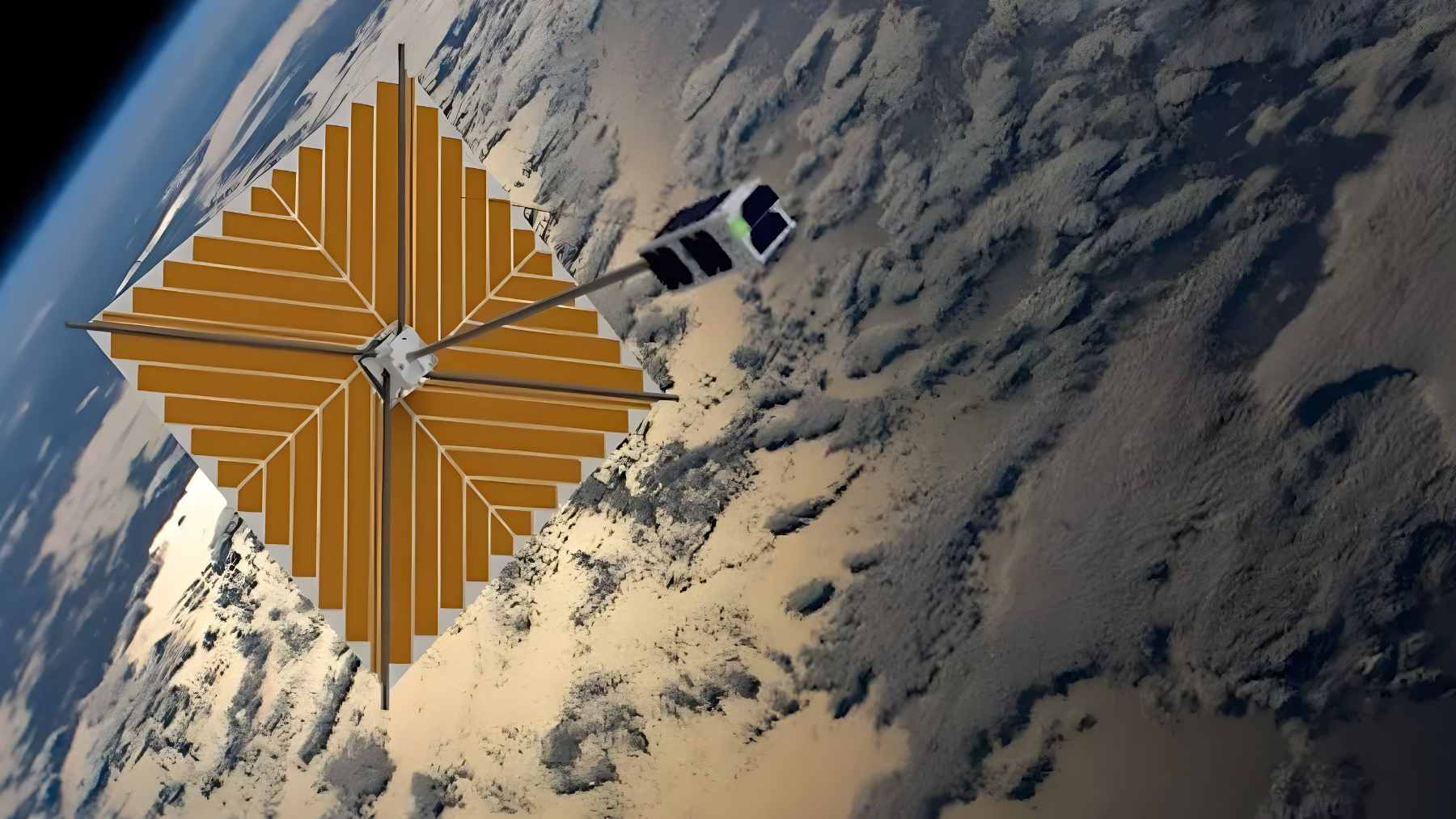
A Japanese CubeSat, a small satellite built in standardized cube-like units, has reached orbit with an “origami” style antenna that unfolds after launch. It lifted off from Mahia, New Zealand on Rocket Lab’s Electron for JAXA’s Innovative Satellite Technology Demonstration-4, and the deployable antenna is designed to expand to about 25 times its stowed size.
Why should anyone outside a space lab care? Because this was not just a flashy deployment, it was a bundle of ocean, climate, and space sustainability tech demos, plus a few capabilities that sit close to maritime security, and these are the same kinds of tools that later end up informing storm outlook and coastal risk maps.
OrigamiSat-2 and the science of packing big hardware
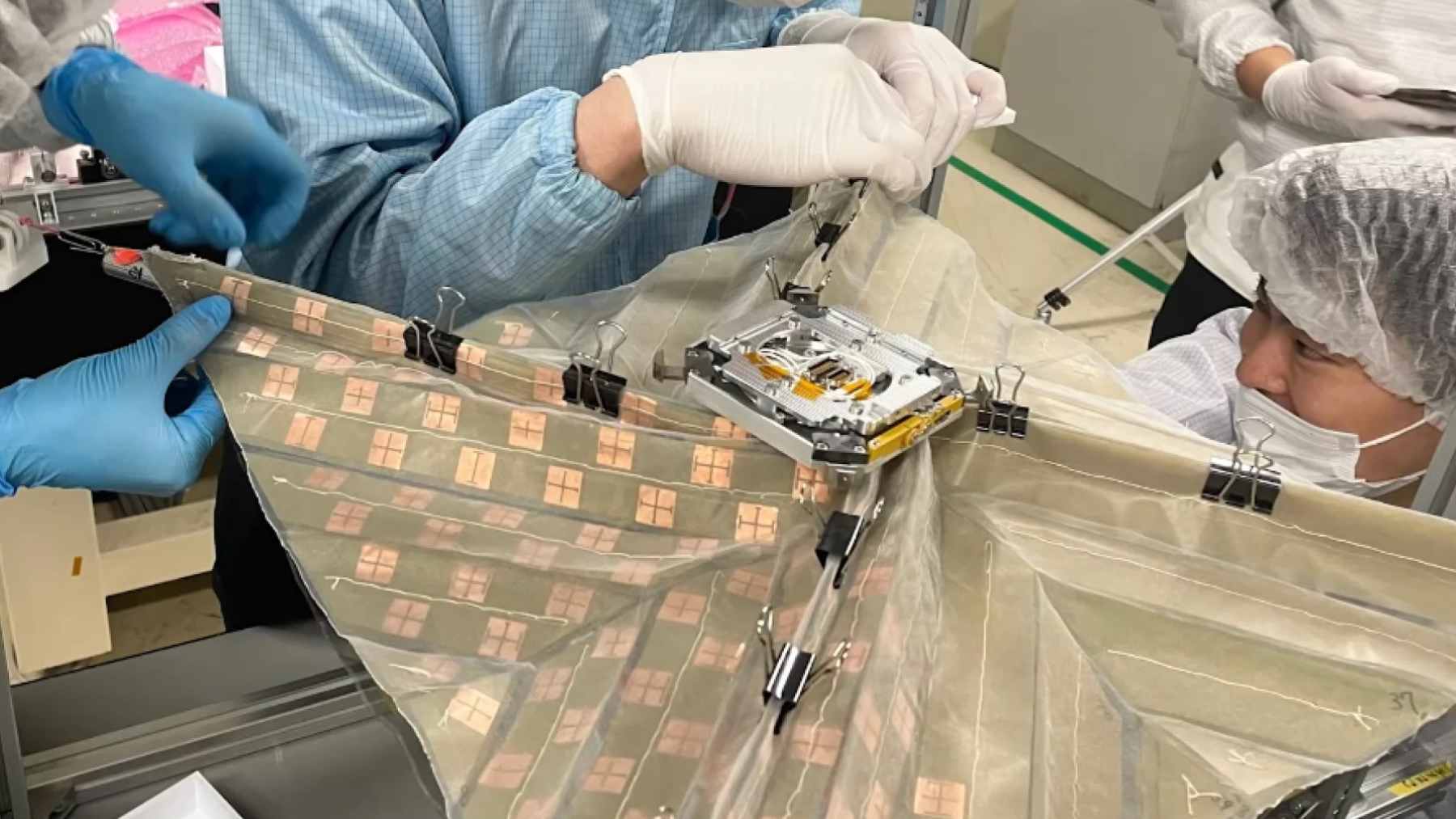
The headline payload is OrigamiSat-2, a 3U CubeSat (roughly shoebox-sized) built around a two-layer deployable membrane with antenna elements attached to it–essentially a fold-out reflectarray antenna.
JAXA says it expands from a 10-cm. cube-class stowage into about 25 times the projected area, and lists a deployed size of about 500 mm by 500 mm by 1,740 mm with a mass of about 4.4 kg (9.7 lbs.).
Some coverage has described this as a roughly 2.5-meter-class deployment, which likely reflects different ways of describing “size” rather than a disagreement about the underlying concept. Either way, the goal is familiar in satellite communications: get higher antenna gain from a smaller package so a tiny spacecraft can push more data to the ground.
A Japanese folding trick with a long space pedigree
This is not the first time engineers have borrowed from paper folding to solve a hard packing problem. The Miura fold was devised in 1970, became famous as an efficient way to fold maps, and later flew in space for deployable structures such as solar arrays.
JAXA has been pushing beyond the classic Miura approach, and reporting around this launch notes that the satellite can be stowed in a spiral-deploying “flasher” pattern. That kind of detail sounds niche until you remember the real constraint–that rockets charge by volume, so every smart fold can turn into a real savings line item.
Where the environmental payoff shows up
The rideshare also includes a CubeSat called KOSEN-2R, which JAXA describes as an “ocean observation data collection” technology demonstration.
It uses a LoRa receiver (a low-power radio standard often used for sensor networks) and a directional antenna to collect seafloor crustal deformation observation data, the kind of measurement that helps researchers track how the seabed shifts over time.
FSI-SAT2 adds a more familiar environmental tool: an ultra-small multispectral camera demo that includes blue, green, red, and near-infrared bands (446 nm, 532 nm, 646 nm, and 750 nm).
Its published target specs include a 423-km by 270-km (263 by 168 miles) observation range and about 562 m by 562 m surface resolution, and it also plans to send Earth images using amateur radio slow-scan television.
The business logic behind JAXA’s demo rides
Rocket Lab says “Kakushin Rising” lifted off just after 3 p.m. New Zealand time and successfully deployed eight spacecraft for JAXA, marking Rocket Lab’s 8th launch of 2026 and 87th overall. Rocket Lab CEO Peter Beck summed up the pitch in one line, “Two successful missions in a matter of months.”
Those two missions matter because the first was a December 2025 Electron flight that carried JAXA’s RAISE-4 technology demonstrator, and this April 2026 launch carried the CubeSat set into a roughly 540-km sun-synchronous orbit (an orbit that repeats passes at consistent local times) with about 97.5° of inclination.
In plain English, JAXA is buying real-world proof so companies and universities can point to on-orbit performance when they try to raise funding or sell the next version.
Climate data and defense often share the same orbit
The overlap shows up in the payload list, even when nobody says the quiet part out loud. On RAISE-4, one demonstration called AIRIS is built around onboard-AI object detection for ships, with the goal of sending down only the data that matters and updating the model through re-learning.
That can support environmental enforcement, search and rescue, or maritime domain awareness, depending on who is holding the contract and what problem they are trying to solve.
Also, another RAISE-4 demo called HELIOS-R is tied to a large membrane structure that combines power and antenna functions and references high-capacity communications such as “5G,” with partners that include Japan’s National Defense Academy.
Space sustainability is part of the environmental story
More satellites for Earth monitoring can be a win, but only if orbit stays usable. Axelspace’s D-SAIL device on RAISE-4 is designed to shorten how long a satellite remains in orbit after operations by deploying a thin membrane of about 2 m² (on the order of tens of micrometres thick) to increase drag, with an in-orbit demonstration planned about a year after launch.
This fits a tightening regulatory mood, including the FCC’s “five-year rule” adopted in 2022 that requires faster post-mission disposal for many low-Earth orbit satellites.
JAXA’s CubeSat list even includes WASEDA-SAT-ZERO-II, which explicitly aims for “screw zero” and “debris zero” through additive manufacturing and will test deployment of an origami-like membrane.
The official statement was published on Rocket Lab.