New satellite imagery suggests Russia is upgrading a drone launch site near Ukraine to support jet-powered, one-way attack drones. Launch rails near the village of Tsimbulova in Russia’s Oryol region appear to be roughly 80 to 85 meters long, a detail linked to these newer variants. What does a longer rail have to do with the environment?
The conflict is also racking up emissions and ecological damage, from burning fuel to ruined power grids and landscape fires. A recent assessment puts the war’s greenhouse gas footprint at roughly 332 million tons of CO2 equivalent since late February 2022.
What the satellites show
Ukrainian reporting based on satellite images says the Tsimbulova area now has multiple rail-style launch installations, storage garages, and new facilities still under construction.
RBC-Ukraine reported that two longer rails were under construction from late December 2025, while additional shorter rails appeared in spring 2026, with the site around 100 miles from the Ukrainian border.
Analysts say rail length matters because jet-powered variants need greater acceleration before takeoff. Ukrainian reporting has also pointed to temporarily occupied Donetsk as another known launch area for this setup, while imagery shows drones stored in the open and vehicles near garages that may support launch operations.
Jet drones change the air defense race
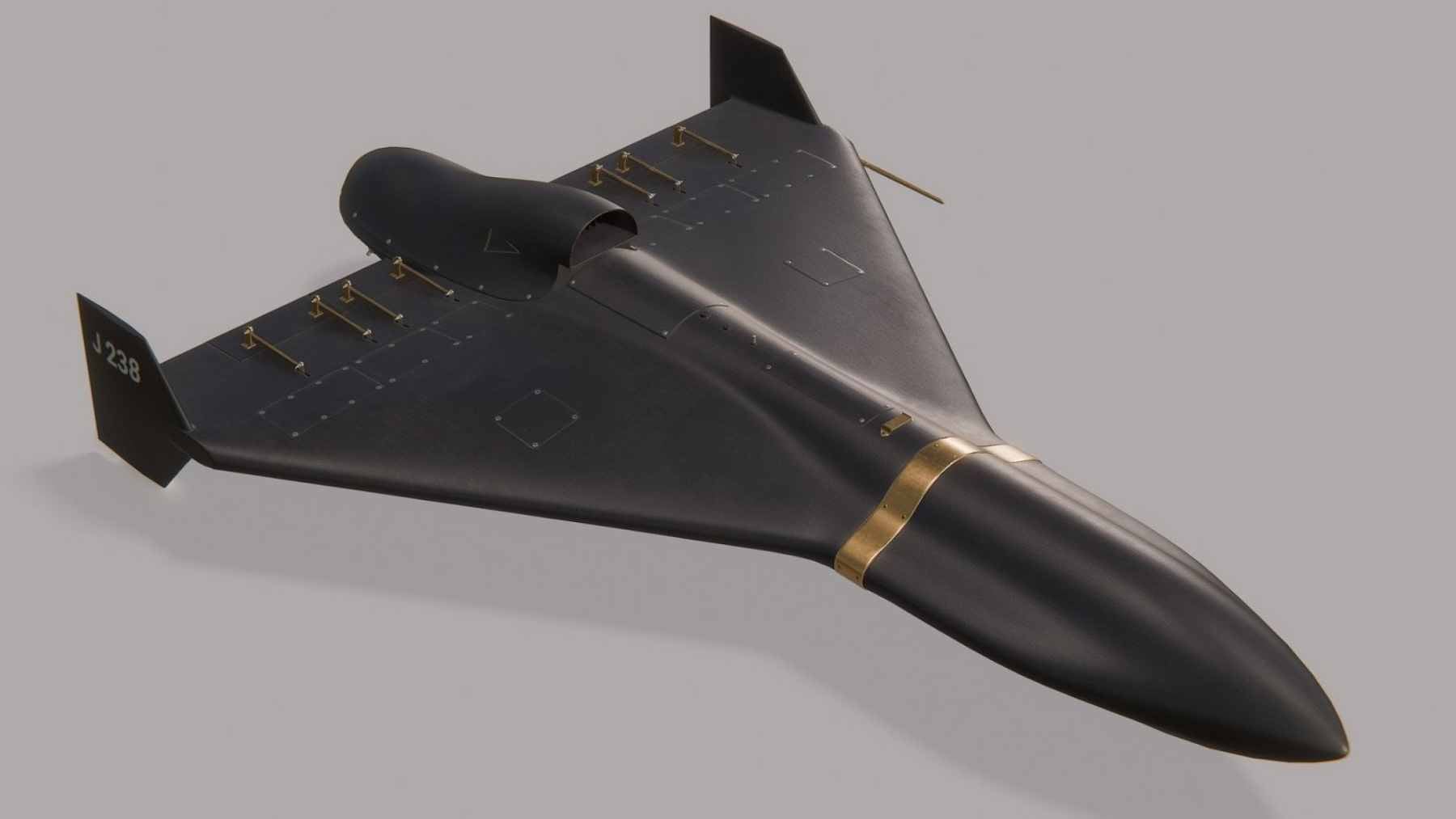
Open reporting describes the early Geran-2 as a propeller-driven Russian copy of Iran’s Shahed-136, while later variants are linked to jet engines and a profile closer to a small cruise missile. Ukraine’s Defense Intelligence has said the Geran-5 has a maximum takeoff weight around 1870 lbs., cruises at roughly 280 to 370 miles per hour, and can reach targets up to about 590 miles away.
An AFP analysis using Ukraine air force daily reports found Russia fired at least 6,462 long-range drones into Ukraine in March 2026, up nearly 28% from February.
Zelenskiy has said Ukraine could produce up to 2,000 interceptor drones per day if funding allows, and Ukraine’s defense minister has said remote-controlled interceptors can engage threats from hundreds to thousands of kilometers away.
The environmental bill behind the drone surge
Drones may look “clean” compared with artillery, but their emissions sit inside a much larger war footprint.
A February 2026 climate impact assessment by Ecoaction and partners estimated about 311.4 million tons of CO2-equivalent linked to the war since February 24, 2022, with large shares coming from direct warfare, landscape fires, and reconstruction.
Fires are a major driver, and hotter, drier seasons raise the stakes. The same assessment said war-related landscape fires burned about 3.4 million acres in 2025, while fighting and damaged infrastructure made fire suppression harder.
Energy infrastructure is another climate multiplier. Ecoaction pointed to at least 15 large attacks on Ukrainian gas production and storage facilities between March and December 2025, followed by another wave in January and February 2026, plus prolonged blackouts that pushed communities toward diesel generators.
It also counted more than 140 Ukrainian attacks on Russian oil refineries and depots over the same year, showing how the energy system itself becomes a battlefield.

A booming drone economy with messy side effects
Reuters reported that Ukraine produced about 4.5 million drones last year, and officials say output is still rising as the country tries to match Russia’s mass production. That scale is turning low-cost drone interception into a marketable capability, not just a wartime necessity.
Europe is racing to harden its airspace, too. Reuters reported that Romania tested an AI-powered drone defense system called Merops, built around autonomous interceptor drones, with deployment planned within days along NATO’s eastern flank.
More hardware also means more manufacturing and replacement, which adds to the overall footprint.
Satellites can measure damage as well as targets
Commercial imagery is not only fueling open-source military analysis, it is also becoming an environmental accountability tool. UNDP says about 30% of Ukraine’s protected areas have been affected by the war, covering more than 3 million acres, and its supported projects focus on evidence recording and environmental damage assessments.
UNEP has warned that Ukraine faces a multi-dimensional environmental crisis and that much of the damage needs field-level verification, even when satellites can flag hotspots. That mix of satellite triage and on-the-ground sampling is slow and expensive, but it is often the only way to separate rumor from reality.
Policy is slowly catching up
Ecoaction says Ukraine has announced plans to file a climate damage claim under the Register of Damage for Ukraine, estimating it exceeds $57 billion using a social cost of carbon of $185 per ton of CO2-equivalent.
Whether courts adopt that logic broadly is still an open question, but carbon accounting is clearly entering wartime diplomacy.
On April 21, 2026, the Council of the EU approved conclusions on energy and climate diplomacy that frame climate impacts and energy security risks as threats to sovereignty and peace. They also argue the clean transition can boost innovation and competitiveness while strengthening defense readiness.
The press release was published on Consilium.