
Alzheimer’s disease may begin long before a loved one forgets a name, misses an appointment, or asks the same question again. New research points to a small brain peptide called AETA that may help explain how the disease starts by damaging synapses, the tiny contact points where brain cells talk to each other.
The work was led by Jade Dunot and Hélène Marie at the Institute of Molecular and Cellular Pharmacology, a lab associated with CNRS, Inserm, and Université Côte d’Azur in Valbonne, France.
The finding does not mean a new treatment is ready, but it gives scientists a fresh target at a stage when the brain may still be easier to protect.
What AETA does
AETA is a small fragment made from APP, short for amyloid precursor protein, a larger brain protein already known because it can also produce amyloid beta, one of the substances linked to Alzheimer’s disease.
For decades, most Alzheimer’s research has focused on amyloid beta and Tau. But a 2015 Nature study described another APP processing route that can produce AETA-related fragments and change activity in the hippocampus, a brain region central to memory.
A 2024 Neuron study then showed AETA can tune NMDA receptors. These receptors act like gates on brain cells and help control learning, memory, and how strongly neurons connect.
A signal in human brains
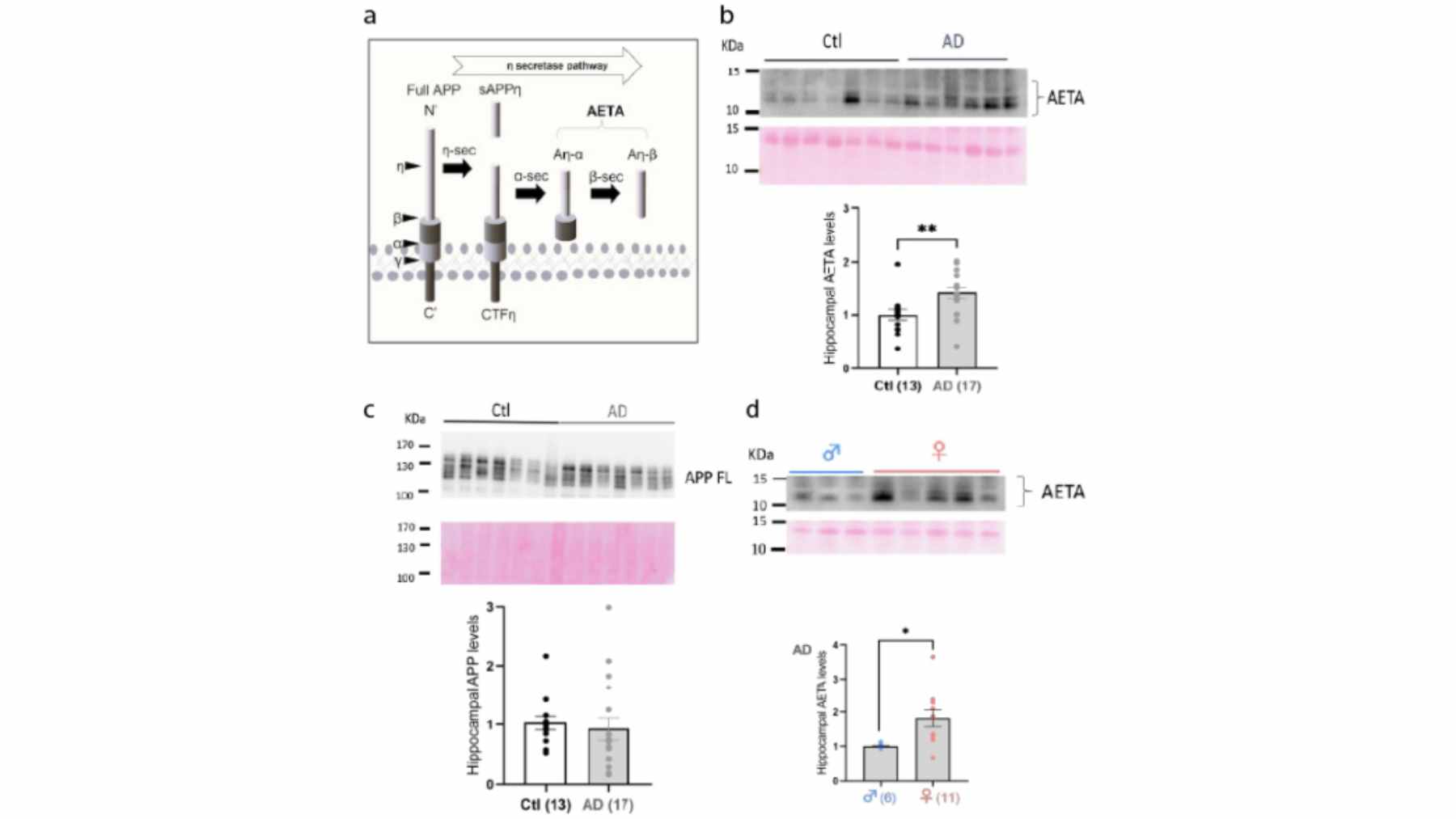
To test whether AETA mattered in disease, the team compared postmortem brain tissue from 23 control brains and 38 Alzheimer’s brains.
The samples came from specialized brain banks in Paris and Amsterdam, giving the researchers access to memory-related regions that cannot be studied this way in living people.
The results were striking but still measured with scientific caution. AETA was much higher in the hippocampus and the prefrontal cortex, an area involved in attention, planning, and decision-making.

That increase was not simply explained by more APP. In practical terms, it suggests the brain may be making, processing, or clearing AETA differently during Alzheimer’s disease.
Why synapses matter
Synapses are not wires exactly. They are more like busy handoff points, where one neuron passes a chemical message to another and the brain keeps the conversation moving.
If those handoff points weaken, brain cells may still be alive, but their communication becomes less reliable. That is why early synapse damage matters so much–it may come before the kind of memory loss families notice in everyday life.
The study found fewer dendritic spines in mice with chronically high AETA. These spines are tiny bumps on neurons where many synapses form, so losing them is a bit like removing seats from a classroom before the lesson even starts.
A stronger effect in females
The mouse experiments added another layer. Both male and female mice with high AETA showed signs of weakened synapse function, including problems involving NMDA receptors.
Female mice, though, showed extra changes that males did not. These included altered genes tied to synapses, more astrocytes and microglia, and weaker performance in memory tasks that depend on the hippocampus.
That caught the researchers’ attention because women are heavily affected by Alzheimer’s. In the United States, almost two-thirds of people living with Alzheimer’s are women, according to 2026 figures from the Alzheimer’s Association.
Not the whole answer
Does this explain why more women live with Alzheimer’s? Not by itself.
Age, life span, hormones, genetics, and social factors may all play a role. The AETA finding is better understood as a new clue, not a complete answer to a very complicated disease.
Still, it is an important clue. If female brains respond differently to excess AETA, future research may need to look more closely at sex differences before testing treatments.
A possible early target
The next step is not a pill at the pharmacy. Researchers first want better diagnostic tools that can detect AETA in blood or cerebrospinal fluid, the liquid that surrounds the brain and spinal cord.
They also want to design molecules that can trap AETA or reduce its activity, but there is a catch: AETA appears to have a useful job at low levels in a healthy brain.
So the goal would not be to wipe it out completely, but to control excess AETA before synapses are pushed too far.
Why this matters now
The World Health Organization estimates that 57 million people were living with dementia worldwide in 2021, and Alzheimer’s disease may account for 60% to 70%of cases. That is a lot of families balancing doctor visits, daily routines, and the fear that ordinary forgetfulness may mean something more.
This study shifts part of the spotlight toward the brain’s earliest communication failures–not just plaques, not just tangles. The trouble may also begin in the tiny spaces where memories are built.
The official study has been published in Acta Neuropathologica.