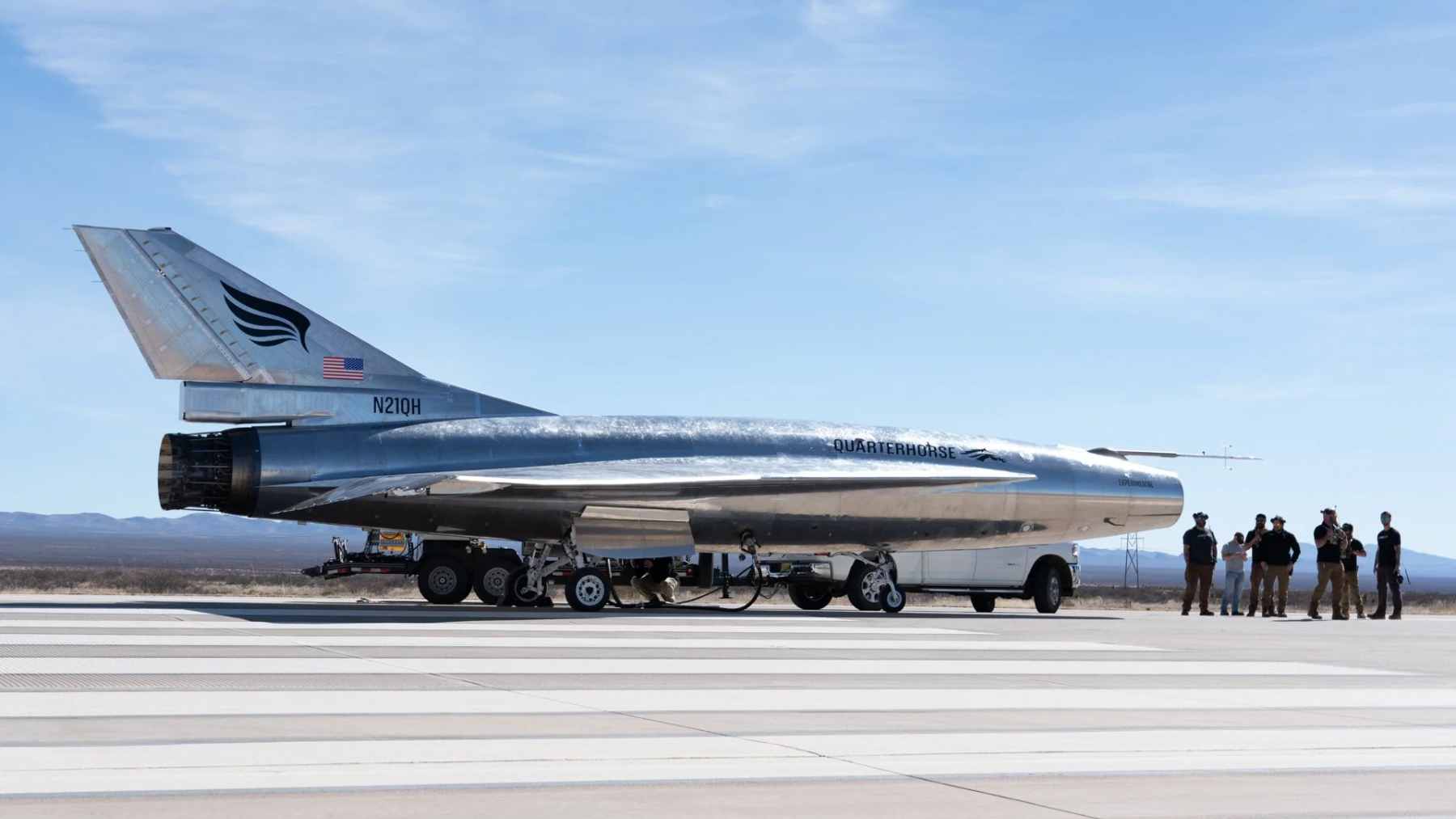
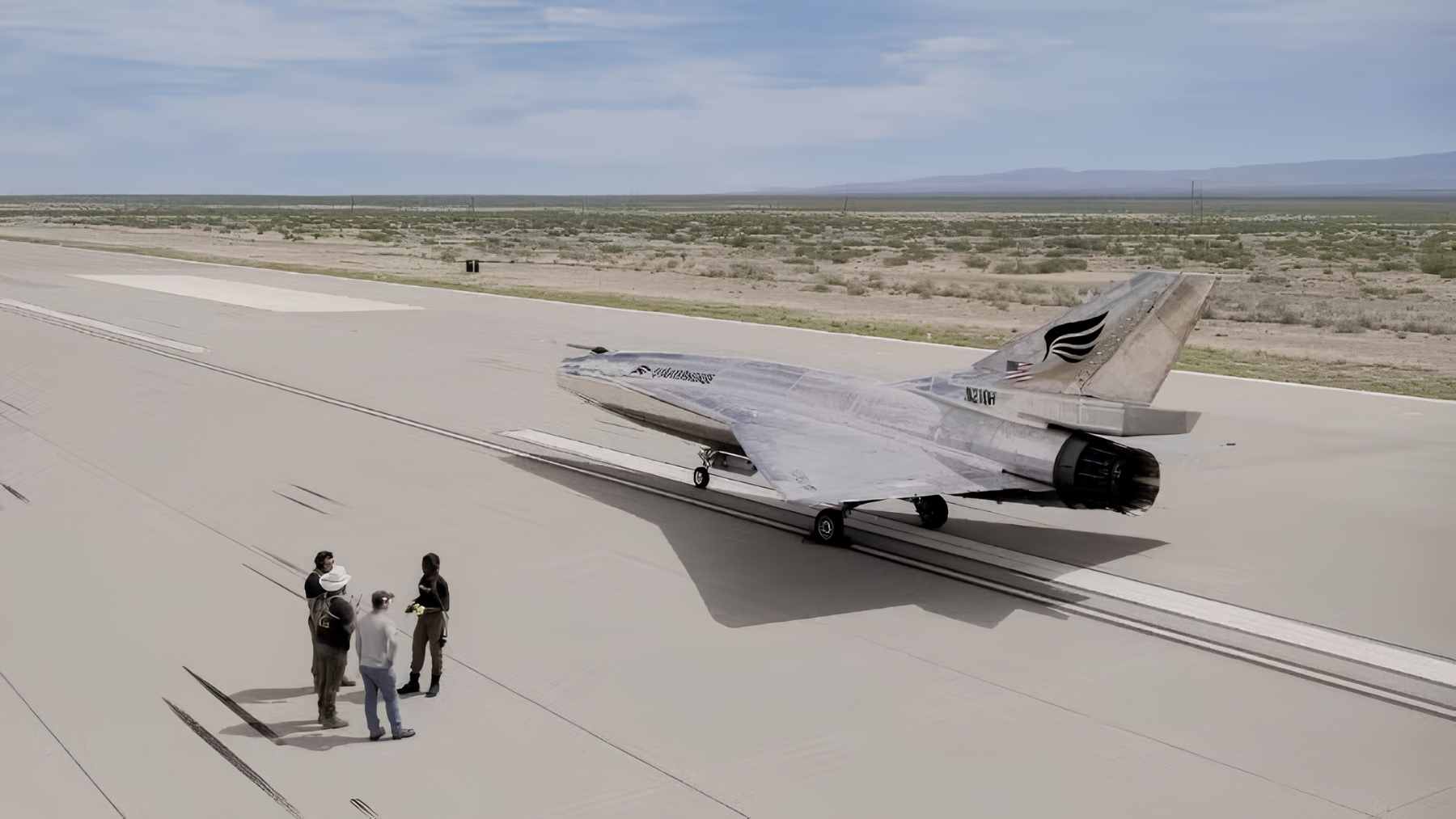
Hermeus has pushed its Quarterhorse Mk 2.1 past the sound barrier, reaching Mach 1.21 during a test campaign from Spaceport America over White Sands Missile Range airspace in New Mexico. The company described the aircraft as the world’s first privately developed unmanned supersonic jet, a claim that puts the flight at the center of a fast-moving race in defense aviation.
What happens when a private company can move from a first flight to supersonic speed in less than three months? That is the real shock here. This is not just about speed, but about how quickly the U.S. military and its contractors may be able to test, learn, and build the next generation of high-speed aircraft.
A private sprint past Mach 1
The Quarterhorse Mk 2.1 made the leap to supersonic speed on only its third test flight. Hermeus said the aircraft flew supersonic less than three months after its first flight and 364 days after the maiden flight of the earlier Quarterhorse Mk 1.
That pace matters because aerospace usually moves slowly, especially when engines, flight controls, structures, and safety rules all have to work together in the real world. In this case, Hermeus is trying to prove that aircraft can be developed more like modern hardware, with quick iterations and frequent flight data instead of waiting years between major steps.
AJ Piplica, Hermeus co-founder and CEO at the time of the announcement, put the point plainly: “This flight demonstrates a pace of execution that is extremely rare in modern aviation.”
What the aircraft is proving
The Quarterhorse Mk 2.1 is not a passenger jet, and it is not meant to be the final product. It is a test aircraft, about the size of an F-16, with a variable inlet, a delta wing design, and a Pratt & Whitney F100 engine.
In practical terms, the aircraft is a flying lab. Every takeoff, acceleration, gear movement, and landing can feed engineers fresh information about aerodynamics, propulsion, control systems, and how the airframe behaves as it approaches and crosses Mach 1.
That is why Hermeus is not stopping with Mk 2.1. The company says Quarterhorse Mk 2.2 is already being built and tested, with Mk 2.3 expected to follow as the roadmap moves toward sustained high-Mach flight.
The defense angle
This milestone lands in a very specific moment. Hermeus is building for defense customers, and its public message is tied closely to the Pentagon’s growing interest in high-speed aircraft for contested environments.
Why does speed matter so much? For the military, it can shrink response times and make it harder for an adversary to predict where an aircraft will be next. An unmanned design also changes the risk equation, since the aircraft can be pushed through demanding test points without a pilot sitting in the cockpit.
Still, there is a long gap between one successful supersonic test and a fleet of operational hypersonic aircraft. The hard part is not only going fast once. It is doing it repeatedly, affordably, and with systems reliable enough to be useful outside a test range.
A crowded speed race
Hermeus is not moving in a quiet corner of aviation. Boom Supersonic’s XB-1 demonstrator broke the sound barrier on January 28, 2025, reaching Mach 1.122, or 750 mph, at 35,290 ft. over Mojave, California.
NASA is also preparing the X-59 for its first supersonic flight. After its first flight in October 2025, the aircraft returned to the skies in March 2026 and completed 14 additional flights, reaching up to 43,000 ft. and Mach 0.95, about 627 mph.
The three efforts are not the same. Boom is pointing toward commercial travel, NASA is focused on quiet supersonic technology, and Hermeus is leaning into unmanned defense capability. But together they show something simple and important: supersonic flight is no longer a museum story.
The environmental catch
This is where the excitement gets more complicated. The Hermeus flight was a military-linked unmanned test, not a commercial airline trial, but every serious return to supersonic flight has to face the same two questions: how loud will it be, and how much fuel will it burn?
The FAA says civil aircraft are currently prohibited from operating above Mach 1 over land in the United States. Companies need special authorization for testing, and the agency says issuing those authorizations counts as a major federal action under the National Environmental Policy Act.
Fuel is the other big issue. The International Council on Clean Transportation has projected that the supersonic transports it studied would burn 7 to 9 times more fuel per seat-mile than a subsonic baseline, which is why cleaner fuels and low-boom designs may not be optional if passenger supersonic travel comes back at scale.
What comes next
Hermeus says it will keep flying the Quarterhorse Mk 2.1 while building later aircraft that add capability and push into faster speed regimes. That sounds neat on paper, but the next steps are the challenging ones. More speed means more heat, tighter margins, and less room for small mistakes.
The company is also changing leadership as the program expands. Zach Shore was appointed CEO effective June 1, 2026, while Piplica moved to executive chairman, a shift Hermeus framed as part of its move into more complex flight campaigns and business execution.
At the end of the day, this flight does not mean hypersonic passenger trips are around the corner, and it does not settle the environmental questions around faster-than-sound travel. What it does show is that the testing clock is moving faster. For defense aviation, that may be the biggest signal of all.
The official statement was published on Hermeus.