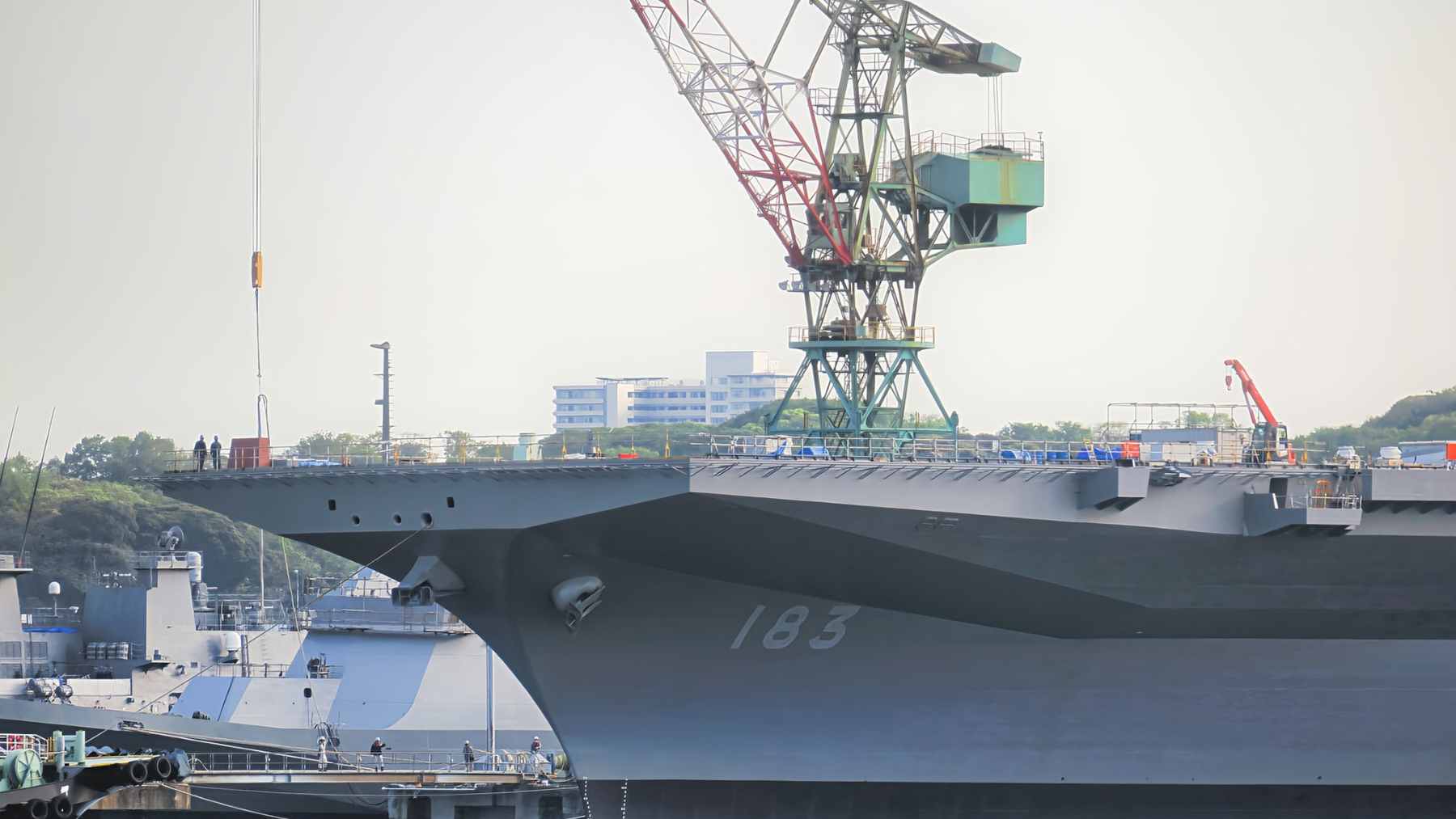
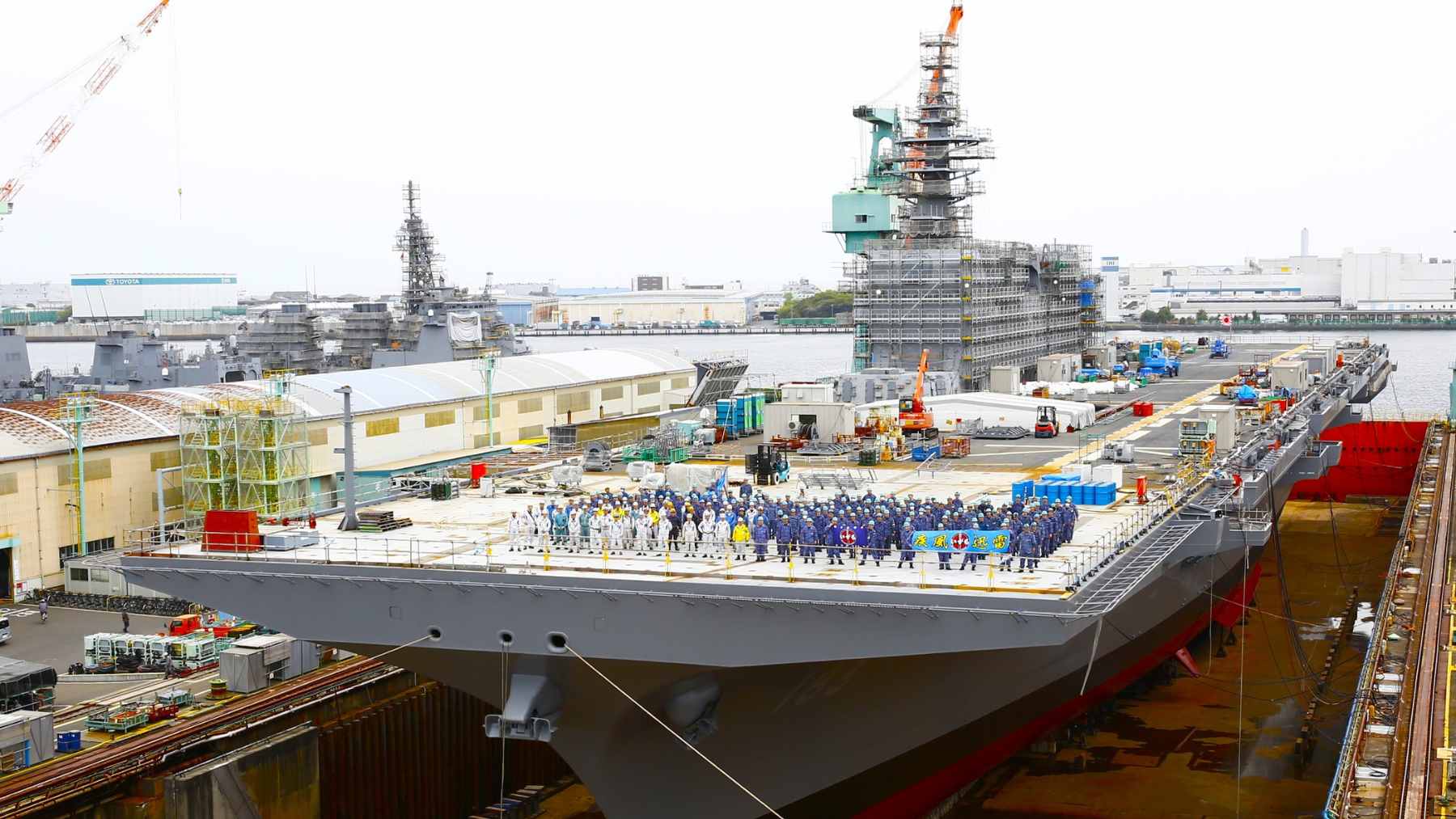
Japan’s JS Izumo has resurfaced with a striking new rectangular bow, a visible milestone in its ongoing conversion to operate the F-35B stealth fighter.
The Japan Maritime Self-Defense Force (JMSDF) says the redesign is meant to reduce airflow turbulence and make short takeoff and vertical landing operations safer, turning what used to be a helicopter-focused deck into something much closer to a small carrier flight line.
But there’s another story riding alongside the defense headlines. A “floating air base” is also a floating fuel problem, and the climate math is getting harder to ignore as more militaries modernize and expand activity.
Estimates cited in a UNFCCC Global Stocktake submission suggest the world’s militaries account for about 5.5% of global greenhouse gas emissions, even with major gaps in reporting and with warfighting emissions excluded from that figure.
The new bow is about airflow and safety
The most obvious change on Izumo is the forward flight deck, now squared off and widened compared with its original tapered shape. According to Naval News’ reporting, the JMSDF position is that the redesign helps “suppress airflow turbulence around the bow” and improves safety for F-35B flight operations.
In practical terms, it’s a smoother runway in the spot where wind and ship motion can turn small problems into big ones.
This isn’t a quick paint job. Naval News reports Izumo’s conversion has been structured in phases, with an earlier stage completed in 2021 that included heat-resistant deck coatings and other landing aids, followed by a second phase that began when Izumo entered dry dock on November 1, 2024.
The full conversion is expected to be completed by the end of Japan’s fiscal year 2027, which runs through March 2028.
Carrier aviation has a carbon and noise footprint
Why does a ship’s bow shape matter to the environment? Because it’s part of a wider shift toward operating high-performance jets at sea, and that means more fuel burn across training, logistics, and deployments.
A UNFCCC submission on military and conflict emissions says data is “poor,” but still points to estimates of roughly 5.5% of global greenhouse gas emissions coming from militaries, while emphasizing voluntary and inconsistent reporting across states.
Then there’s the local impact, which people feel before they ever see a carbon chart. When Japan began deploying its first F-35B aircraft to Nyutabaru Air Base, the Associated Press reported protests tied to concerns about aircraft noise, especially as training plans face delays at another site.
If you’ve ever lived under a flight path, you already know the rhythm of it, the sudden roar that cuts through dinnertime or a phone call.
Synthetic fuels are turning into real hardware decisions
So, can a stealth fighter ever be “greener”? Not in the way an EV is, but the fuel pipeline is starting to change. In January 2025, Lockheed Martin said it approved the use of synthetic aviation turbine fuels for the F-35, allowing operation with synthetic blends up to 50% alongside conventional jet fuel, depending on feedstock and production pathway.
That matters because it’s a rare example of a frontline platform being opened up, on paper at least, to lower-carbon fuel options.
Still, “synthetic” does not automatically mean low emissions. Lockheed notes these fuels can be made from renewable sources like waste oils and agricultural residues, but also from fossil-based sources such as coal and natural gas. The climate outcome depends heavily on what the fuel is made from and how it’s produced, not just what it’s called.
Norway’s F-35 fuel test shows the promise and the limits
One of the clearest real-world examples came from Norway. In a joint update from Norway’s Ministry of Defense and Ministry of Climate and Environment, the government said Norway became the first country to operate F-35s using a significant proportion of sustainable aviation fuel, describing a fuel blend containing 40% biofuel made from “waste, residues and by-products.”
It also underlined a blunt point that is easy to miss in tech marketing, which is that electrifying an F-35 “is impractical.”
Norway’s defense minister also put numbers on the problem, saying the country’s fighter jets account for about “one-third of direct CO2 emissions within the defence sector.”
And even in this best-case demonstration, the government warned that “fuel availability and production capacity” remain a constraint, which is the part that can hit budgets and readiness when supply chains get tight.
Japan is already linking climate policy to security planning
Japan’s Ministry of Defense has been building this logic into its own climate planning.
In its “Response Strategy on Climate Change,” the ministry describes an expected energy shift from fossil fuels toward renewables, hydrogen, and ammonia, and says Japan’s public and private sectors are working to decarbonize automobiles, ships, and aircraft to non-fossil fuels as part of the push toward carbon neutrality by 2050.
The same strategy also acknowledges uncertainty and emphasizes prioritizing technologies considered feasible, including “micro-grids” and SAF, while updating plans as innovation evolves.
It also ties climate change directly to security pressures in the region, noting Pacific island countries’ vulnerability to disasters and sea level rise, and expecting the Self-Defense Forces to play an increasing role in capacity-building support, humanitarian assistance and disaster relief.
What to watch as 2028 approaches
By 2028, Japan expects Izumo’s conversion to be complete, and Japan is already moving F-35Bs into service as part of its broader defense buildup. That puts pressure on everything behind the scenes, including maintenance cycles, fuel supply, and training tempo, all while the region’s security concerns remain high.
The next key signals will likely come from testing milestones, operational training, and how rapidly the maritime and air components can integrate without bottlenecks.
For environmental accountability, the question is simpler and tougher. Will countries expanding advanced air and naval operations also expand transparent reporting and practical decarbonization steps, or will emissions stay in the “nice to know” category because disclosure is voluntary and inconsistent?
The official statement was published on JMSDF Surface Force (Official) on X.