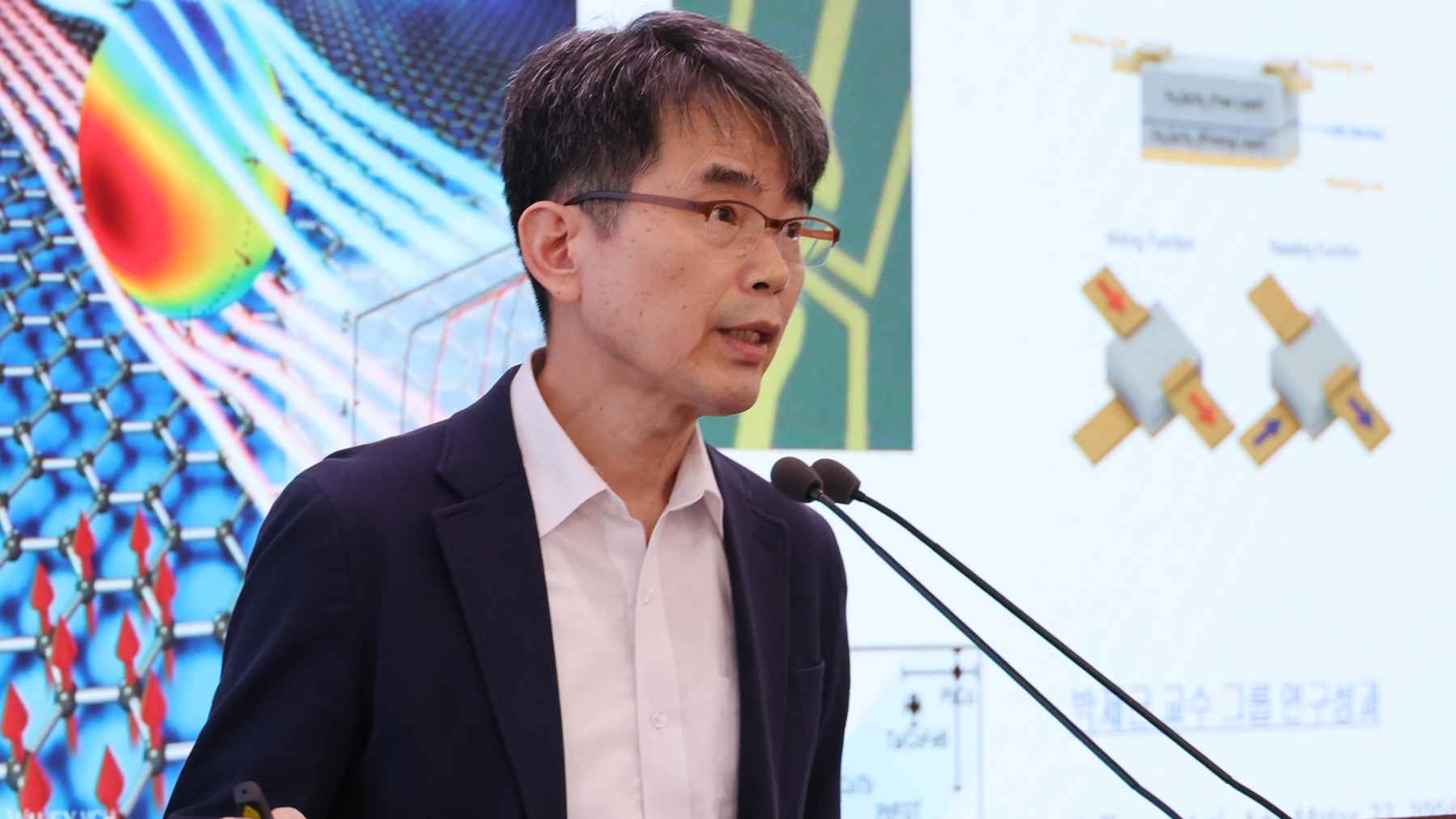
A once-in-a-generation physics review out of Seoul is landing right in the middle of today’s climate and industrial debates. South Korea’s Ministry of Science and ICT says Professor Je-Geun Park and collaborators have published a comprehensive paper on two-dimensional “van der Waals” magnetism in Reviews of Modern Physics, a journal known for inviting field-defining work.
This is not just lab trivia. If magnetism can be engineered at the scale of a single atomic layer, could the ripple effects reach electric vehicles, robotics, and even the energy hunger of AI hardware, where heat and power draw are becoming painfully real constraints?
But the path from a breakthrough to a factory line is rarely straight, and the magnet supply chain is already a geopolitical pressure point.
A magnet that is almost too thin to picture
Most magnets we handle are bulky because their atoms are stacked in three dimensions, which helps keep magnetism stable. For decades, physicists debated whether magnetism could survive in a two-dimensional sheet just one atomic layer thick.
The ministry briefing says Park’s group pursued that question for about 15 years and then compiled an 88-page review of the field. The same briefing notes the article is long enough to resemble a 250-page book when printed out.
A turning point came in 2016, when Park’s team experimentally demonstrated two-dimensional magnetism in an iron phosphorus sulfide compound at -118 °C. Park later said the field has grown into a global effort producing more than 1,000 papers a year.
Why magnets matter for the climate economy
If you think “magnets” means fridge souvenirs, you are missing the modern story. In the official Korean briefing, Park says one electric car can use more than 300 permanent magnets across motors and many smaller components.
Clean energy systems lean on them, too, especially high-performance rare-earth magnets used in motors, generators, and industrial automation. A European materials report estimated that rare-earth permanent magnet use in EVs could rise from about 5,500 tons in 2019 to roughly 55,000 tons per year by 2030.
There is also an environmental bill attached to this story. A 2025 open-access review in Resources, Conservation and Recycling notes that rare earth mining, processing, and purification can carry significant environmental impacts, which is why cleaner production and recycling are now part of the conversation.
Low-power chips are now an environmental story
Park’s review is not about swapping the big, permanent magnets in your car for atom-thin sheets anytime soon. The nearer-term promise is in spintronics and quantum devices, where researchers aim to use electron spin to store and process information with lower energy losses.
That matters because digital infrastructure is turning into a major electricity customer. The International Energy Agency estimates global data center electricity consumption at about 415 terawatt hours in 2024, roughly 1.5% of global electricity use, and projects it rising toward roughly 945 terawatt hours by 2030.
In practical terms, that means more demand, more heat, and more pressure to build generation and grids fast enough to cope with oppressive summer heat. Efficiency gains in memory and computing will not solve the whole problem, but they can help slow the growth curve.
Military and defense planners are reading the same chart
Rare earth magnets sit at an awkward intersection of climate policy and national security. The IEA says China accounts for about 60% of global mined production of magnet rare-earths, about 91% of refining, and about 94% to 95% of permanent magnet production.
That concentration is one reason Western governments are moving in public. On April 24, 2026, Reuters reported that the United States and the European Union signed a memorandum of understanding to deepen cooperation on critical minerals, with officials warning about supply chain risks for semiconductors, electric vehicles, and advanced weapons.
The money follows the politics, although not always smoothly. Reuters has also reported new work on Europe-based critical mineral pricing benchmarks and a $2.8 billion acquisition by USA Rare Earth to expand mining and magnet-making capacity outside China.
What to watch next
The most honest takeaway from the Korean briefing is that science does not automatically become a product. Park says the technology has been realized and verified, but whether it becomes industrialized is not something his lab can fully control.
So the next milestones will look less like physics and more like engineering and business. Watch for scalable manufacturing, stable performance at practical temperatures, and credible pilots inside real chips and sensors.
At the end of the day, the green transition keeps running into the same reality: cleaner energy still depends on hard materials and hard logistics, and now comes the hard part.
The official briefing was published on Korea.kr.